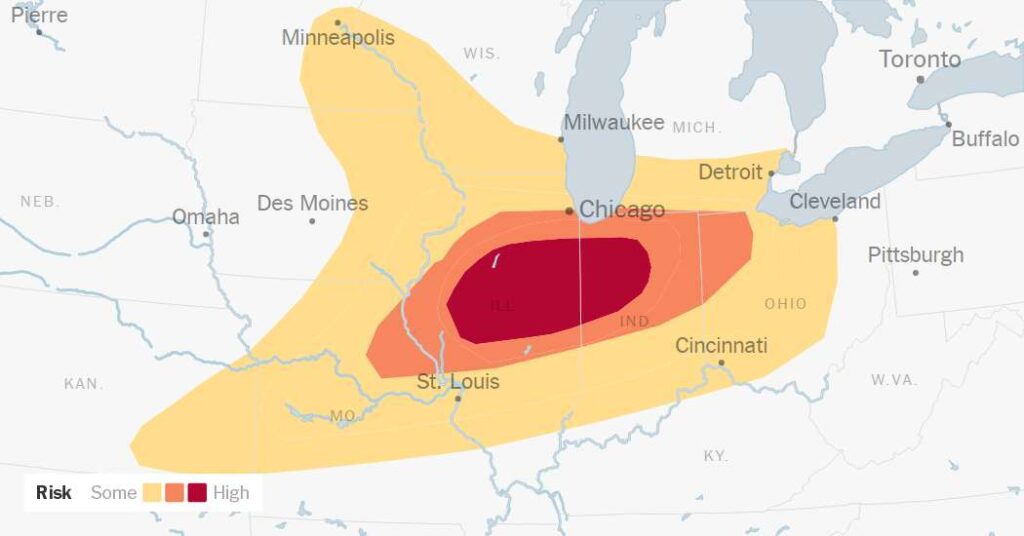
Millions of people across the Midwest are at risk of severe weather on Wednesday, with forecasters warning of the possibility of intense tornadoes, damaging wind gusts and hail as large as tennis balls.
Jared Guyer, a meteorologist at the Storm Prediction Center, said that while some uncertainty remained regarding the exact locations and timing of the storms, forecasters were confident that a large portion of the Midwest faced a heightened threat. Areas from Kansas, Missouri and Iowa east into Michigan and Ohio — including Chicago, Indianapolis and St. Louis — are expected to be at risk.
“Right now we’re focusing across north central Illinois and northwest Indiana,” he said. “That appears to be the area for the greatest concern.”
Heavy rainfall could bring further hazards. The Weather Prediction Center has highlighted much of the Midwest as being at a risk of flash floods through Wednesday. Multiple rounds of rain are likely from Chicago east into southern Michigan, forecasters said, while farther south — from Kansas and Missouri into Illinois and Indiana — intense storms could bring high rainfall rates, though these storms are expected to move through the region relatively quickly.
Here’s what to expect on Wednesday:
-
Threat area: Iowa, Missouri, Illinois, Indiana and Ohio are at a high risk of severe weather, with the greatest concern focused on areas of north central Illinois into northwest Indiana.
-
Timing: Some thunderstorms may hit during the morning, especially across parts of Iowa, Illinois and Indiana, before additional storms form late in the afternoon. Mr. Guyer said these early storms could influence the atmosphere and in turn affect where the greatest tornado threat eventually develops later in the day.
Through the evening and overnight, this line of storms is expected to push eastward across portions of Illinois, Indiana and surrounding areas.
-
Tornadoes: The strongest and most intense tornadoes are expected across areas of north central Illinois and into northwest Indiana, though Mr. Guyer said this detail could change depending on the evolution of storms earlier in the day.
-
Winds: Damaging winds are expected to be a widespread threat. Gusts could reach up to 80 miles per hour, strong enough to bring down trees and power lines, as well as to cause damage to buildings.
-
Large hail: The largest hailstones could reach up to 2.5 inches in diameter, roughly the size of a tennis ball. The areas most likely to experience the largest hail include northern Missouri and parts of Iowa.
Wednesday’s storms were expected in some of the same areas that were hit by damaging winds and tornadoes during an outbreak last week. On June 10, a line of thunderstorms produced a derecho, or winds that can be as destructive as a tornado but that move in a straight line instead of a rotation. Wind gusts up to 85 m.p.h. led to widespread damage across northern Illinois.
The next day brought more storms and at least 20 confirmed tornadoes to the same region. At least two of the tornadoes — one in Streator, Ill., and another in Hebron, Ind. — were rated a three on the five-point enhanced Fujita tornado scale. A storm that day also toppled what is believed to have been the last surviving “witness tree” at Abraham Lincoln’s former home in Springfield, Ill.
The severe weather threat in the region is expected to be short-lived. By Thursday, Mr. Guyer said, the Northeast and the Mid-Atlantic could see some severe weather. “We’re not expecting an outbreak again, but there will be the risk of some severe storms,” he said.
This is the time of year for severe storms
Forecasters often know up to a week in advance whether conditions are likely to be favorable for thunderstorms, but their ability to pinpoint exactly where and when those thunderstorms kick off is much more limited. Read more about why forecasting thunderstorms is still so hard.
Scientists have been able to draw links between a warming planet and many types of extreme weather, including hurricanes, heat waves and droughts. But they are not yet able to determine whether there is a link between climate change and the frequency or strength of tornadoes. Read more about tornadoes and climate change here.
How to prepare
The post Intense Tornadoes Possible Across the Midwest on Wednesday appeared first on New York Times.