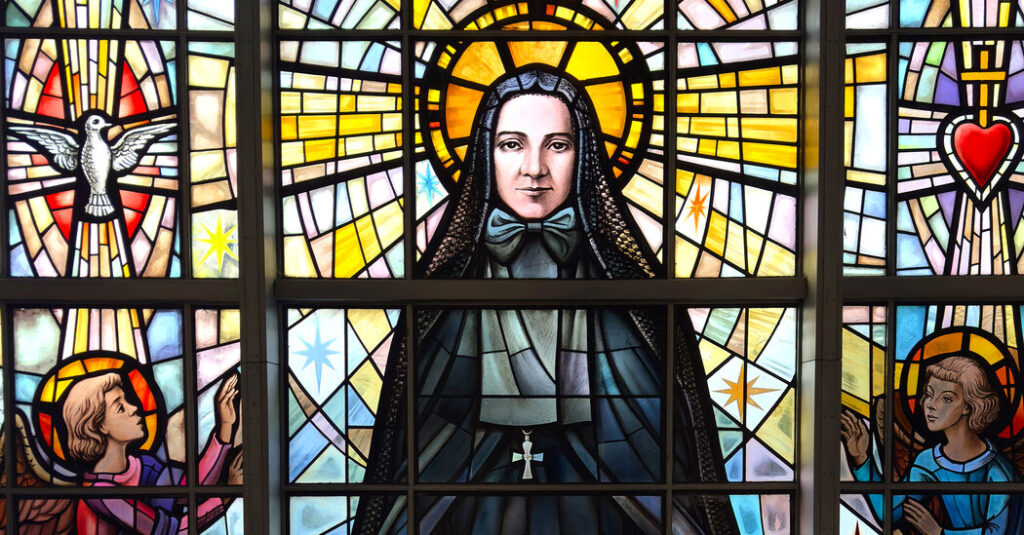
On Saturday, Pope Leo XIV plans to visit the northern Italian village of Sant’Angelo Lodigiano, where he will venerate a saint close to his heart: Mother Frances Cabrini, who was born there in 1850 and died in 1917 in Chicago, the pope’s hometown. When the Catholic Church canonized Cabrini 29 years later — speedy for a painstaking process that can last centuries — she became the first American saint.
Leo’s visit would seem to be a ready-made occasion for a celebration of Catholicism in the United States, but that would miss the point. Leo and Cabrini are linked by something far more profound than their common U.S. citizenship: a shared global sensibility, developed by their own passages across borders, cultures and continents, that inspired a commitment to people building new lives in distant lands.
The pope’s Cabrini pilgrimage, like his election to the chair of Peter, is an invitation to Americans to see themselves as global citizens while their government appears to be retreating into political, cultural and economic isolation.
It’s fine for Americans to celebrate the creation of a homegrown pope. (Italian cities and villages have had that chance 217 times, after all!) But it would be even better if Americans adopted the lessons Leo and Cabrini learned from personal experience: that people, problems, goods and ideas flow freely across political boundaries, and as a consequence, the world’s challenges — climate change, public health crises, wars and economic instability — can’t be understood, let alone solved, simply on a local or national level.
Chiefly among these issues is migration, one of the world’s most urgent global challenges. While in Sant’Angelo Lodigiano, Leo will surely call attention to the matter by highlighting Cabrini’s lifelong ministry to migrants during an earlier era of mass displacement. His message will inevitably draw comparisons to President Trump’s anti-immigrant campaign, of which Leo has been a critic.
As the founder of the Missionary Sisters of the Sacred Heart of Jesus, Cabrini made dozens of ocean journeys between 1889 and 1912, establishing 67 schools, orphanages and hospitals on three continents. The sisters had at first set out to minister to migrants from Italy, but before long their work came to embrace newcomers of all origins.
In his homily at the 1946 canonization Mass, Pope Pius XII praised the new saint for extending “a friendly hand, a sheltering refuge, relief and help” to people uprooted from their native countries. Pius suggested Cabrini’s international outlook rendered her an agent of peace and reconciliation in a world torn apart by conflict.
That message was drowned out in the United States. Instead, Cabrini’s canonization was celebrated as a national triumph. Her boosters pushed her American identity, ascribing to her a special love for the United States and insisting that she had become a naturalized citizen out of a desire to ally herself with its greatness. (In reality, the practical Cabrini had most likely been following her lawyer’s advice.)
The church presented Cabrini as a model of a woman who transcended national borders. Yet together with their fellow citizens, U.S. Catholics anointed her the unofficial patron saint of American exceptionalism.
Like Cabrini did, Pope Leo has lived for extended periods in Italy, the United States and South America. Also like she did, he traveled widely and became an adopted citizen of a country in which he had long served; for him it was Peru. Perhaps the most striking commonality between the first American pope and the first American saint is also the most instructive: Their U.S. citizenship means or meant far more to other U.S. citizens than to the rest of the world or, for that matter, to either of them.
It seemed that Leo’s U.S. citizenship barely registered with the cardinals who voted for him. Throughout his years in Peru, his travels as head of the Augustinian order and his work at the Vatican’s department overseeing bishops and their selection, he cultivated a global perspective that helped shatter the unspoken taboo within the Vatican of a U.S. pope. However ardently Leo might cheer for the White Sox or savor Chicago pizza, he stopped viewing the world primarily through an American lens long ago.
That might explain why he did not speak English during his first appearance as pope, or why he is pointedly choosing to travel to Lampedusa, the Italian island where so many migrants have landed, on July 4, rather than join the patriotic spectacle surrounding America’s 250th birthday celebrations. The sentiment, I suspect, that Cabrini said propelled her far from Sant’Angelo Lodigiano resonates with Leo: “The world is too small,” she wrote in 1887, “to limit ourselves to one point; I want to embrace it entirely and to reach all its parts.”
Eighty years ago, flush from victory in World War II, Americans could blithely ignore Pope Pius’s characterization of Cabrini as a global saint. Today, from a far more precarious perch in the world, they overlook the example of this global pope at their peril. The deeper lesson of the first U.S. pontiff may be that our interdependent world has become, in Cabrini’s words, “too small” for bygone fantasies of American exceptionalism.
Kathleen Sprows Cummings directs the Global Catholic Research Initiative at the University of Notre Dame.
The Times is committed to publishing a diversity of letters to the editor. We’d like to hear what you think about this or any of our articles. Here are some tips. And here’s our email: [email protected].
Follow the New York Times Opinion section on Facebook, Instagram, TikTok, Bluesky, WhatsApp and Threads.
The post America’s First Pope Pays Homage to Its First Saint appeared first on New York Times.