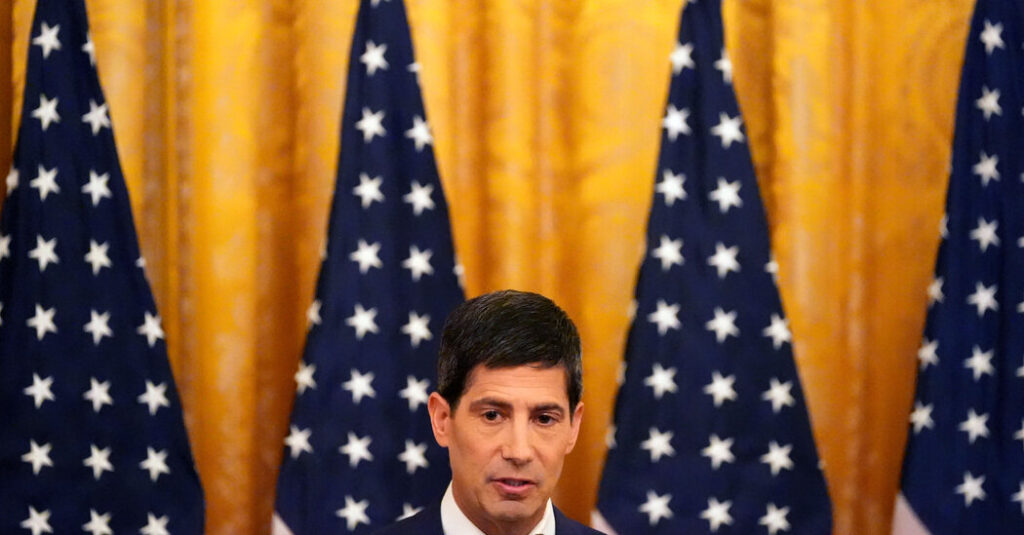
Kevin Warsh finally won the prize he long pursued: becoming chairman of the Federal Reserve. Now, as he presides over this first meeting, comes the harder part.
Mr. Warsh finds himself in a Bermuda triangle of policy pressures, greater challenges than any new Fed chairman since the Jimmy Carter era. The new chairman is caught between his 11 fellow committee members, the strong desires of the president and an economy where inflation has hit a three-year high.
And the highly experienced Mr. Warsh must reconcile his own views, which have evolved over the years since he first served on the Fed board during the financial crisis.
At the crux of the dilemma are interest rates — that most important weapon in the Fed’s arsenal to control the growth rate of the economy and of inflation. President Trump, like many of his predecessors, wants lower rates. That would encourage borrowing and spur spending and economic growth (which in turn tends to help the approval rating of the commander in chief).
Unlike those past presidents, however, Mr. Trump is trying to force the move, demonstrating little respect for the Fed’s independence. With inflation now at 4.2 percent thanks to the Iran war — roughly double the Fed’s target — some members of Mr. Warsh’s committee are getting queasy. At the least, they want to keep interest rates where they are.
Mr. Warsh must now reconcile those conflicting forces with his own complex views. During his prior stint on the Fed board, he evinced lots of concern that holding interest rates at zero for an extended period to try to spark economic growth could lead to renewed inflation. He was particularly concerned about the inflationary risks of combining low interest rates with other measures, such as quantitative easing (i.e., large bond purchases).
Mr. Warsh resigned from the board in 2011 and made his unhappiness with Fed policy known in speeches and opinion columns. He sought the chairmanship in 2017, but Mr. Trump, in his first term in the White House, passed him over for Jerome Powell (who Mr. Trump now regularly lambastes).
Given his past concerns, Mr. Warsh would seem to be the perfect candidate for this moment, with inflation running high. In my time as a Times correspondent covering the Fed, I saw firsthand the dangers of inflation. An economy can get stuck in a wage-price spiral, with rising costs leading workers to seek higher wages, which in turn leads companies to push prices still higher. In the late 1970s, it took interest rates approaching 20 percent — rates that pushed the economy into recession — to finally arrest that spiral.
But roughly a year ago, when the second opportunity to serve as chairman was approaching and when the president had become increasingly agitated about rising rates, Mr. Warsh seemed to pivot. Singing more of Mr. Trump’s tune, he began offering a somewhat convoluted argument that the Fed could cut short-term rates while selling off part of its vast debt holdings accumulated during the financial crisis and subsequent years. That latter move would put upward pressure on long-term rates, like mortgages, which would offset the short-term rate cut.
That’s a bit like pressing the accelerator and the brake at the same time. Skeptics argue that a huge bond sell-off — known as quantitative tightening — is an imprecise and potentially disruptive tool whose effects don’t cleanly offset rate cuts.
In fairness, Mr. Warsh also argues that greater efficiencies from artificial intelligence and other new technologies could allow the economy to grow faster without creating inflationary pressures, although this has yet to evidence itself.
In addition to reconciling his own views, Mr. Warsh must contend with a 12-member Federal Open Market Committee, which sets rates, typically by consensus. Only one member of the F.O.M.C. has voted to cut rates since the Iran war began.
No chairman has been on the losing side of an F.O.M.C. vote in more than 85 years. Moreover, Mr. Warsh’s immediate predecessor as chairman, Mr. Powell, who has repeatedly resisted calls to cut rates, has chosen to remain on the board, at least until Mr. Trump’s efforts to prosecute him unfairly have been conclusively put to rest.
For the foreseeable future, the Fed needs to at least stay the course and maybe even raise rates to bring inflation down to the central bank’s target of 2 percent. Indeed, that is what our financial markets are anticipating; they are currently pricing in no rate cuts at all this year and a likely rate increase near the end of the year.
Of course, that may well bring Mr. Warsh into conflict with Mr. Trump, just as Mr. Powell found himself in the president’s cross hairs. Mr. Trump constantly berated Mr. Powell and absurdly threatened to fire or even prosecute him.
That’s why one of Mr. Warsh’s most critical tasks will be to demonstrate his commitment to the independence of the Federal Reserve. Putting the Federal Reserve under the control of elected politicians would jeopardize the Fed’s historical, data-driven approach to policymaking. Numerous cases worldwide have demonstrated that when monetary policy is captured by politics, inflation spirals out of control, investors demand rate increases to compensate for the erosion of their capital and borrowing costs go up for everyone.
The Federal Reserve doesn’t get everything right. Mr. Powell and his colleagues wrongly termed the Covid-related inflation “transitory” and were late to move rates up to address it.
But Mr. Warsh should also keep in mind that efforts by the Fed in September 2019 and again last October to reduce its holdings of bonds (part of his proposed solution) caused enough market disruption to lead the bank to put those efforts on hold. In my view, that’s where they should remain. As the bonds mature, the size of the Fed’s holdings will naturally decrease, and that’s fine with me.
With the Supreme Court often divided along partisan lines, the Fed remains one of our last governmental institutions that operate truly in a nonpartisan and independent fashion. Mr. Warsh can greatly enhance his chances of being remembered as a great Fed chairman if he keeps it that way.
The Times is committed to publishing a diversity of letters to the editor. We’d like to hear what you think about this or any of our articles. Here are some tips. And here’s our email: [email protected].
Follow the New York Times Opinion section on Facebook, Instagram, TikTok, Bluesky, WhatsApp and Threads.
The post Good Luck, Kevin Warsh. You’ll Need It. appeared first on New York Times.