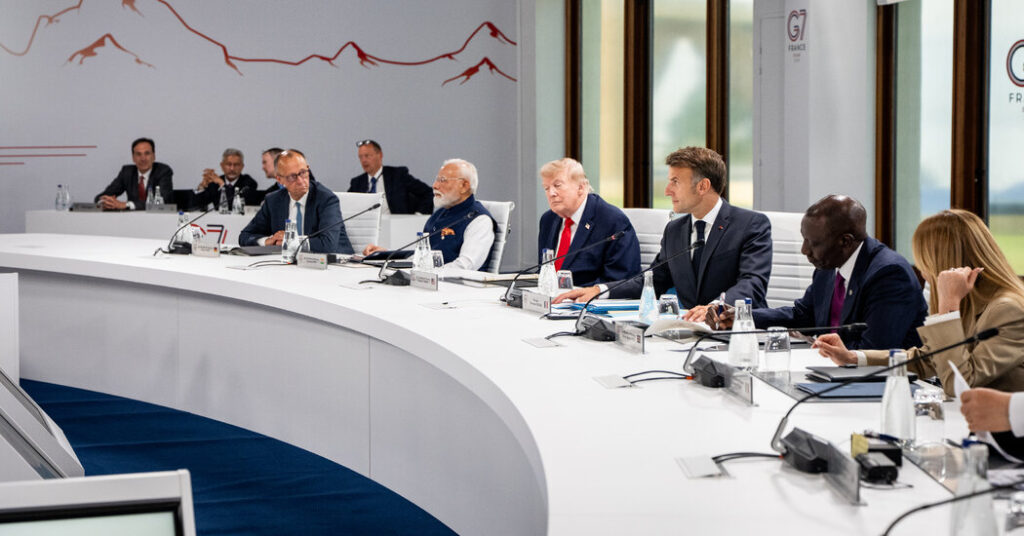
When Chancellor Friedrich Merz of Germany presented President Trump with a soccer jersey emblazoned with the number 47 on Tuesday morning, it was the kind of gesture that a foreign leader might have made during his first term: flattering, emollient, and calculated to please.
But Mr. Merz was doing it after a rancorous stretch, in which he and other European leaders condemned the war in Iran, provoking Mr. Trump to announce that the United States would pull some American troops from the Continent.
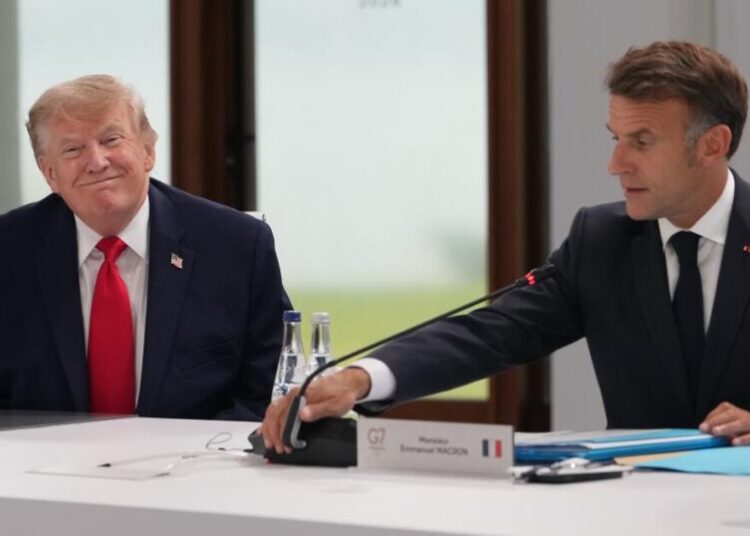
Europe’s alliance with the United States may still be on the rocks, but on the first full day of a Group of 7 summit meeting at this Alpine spa town in France, the leaders showed they remained ready to behave politely toward Mr. Trump.
For all the sharp elbows of the last year, they appear to have concluded that the best way to deal with a disruptive president is to court him, particularly since they still hope to engage the United States on thorny issues like the war in Ukraine.
“We’re on the same team,” Mr. Merz said of the president on social media, wishing him a belated happy 80th birthday.
Such conciliatory words would have seemed improbable even a week ago, given the bitter split over Iran, Mr. Trump’s threats to take over Greenland and his regular hectoring of Europe’s centrist leaders — all of which persuaded several of them that America was no longer an ally, and was even, in some cases, a threat.
Now, though, Mr. Trump has presented at least the contours of a peace deal with Iran, and Europe’s leaders have gone back to charming him.
“That’s how diplomacy delivers,” said Ursula von der Leyen, the president of the European Commission, congratulating Mr. Trump on the framework. She said it would reopen the Strait of Hormuz, drive down oil prices and perhaps even ultimately put an end to Iran’s nuclear ambitions.
At one level, the bonhomie was scarcely a surprise. Even in the absence of a peace accord, analysts and diplomats predicted that the other six leaders in the Group of 7, representing the world’s advanced industrial countries, would work to prevent the meeting from collapsing in acrimony.
“Europeans in private now broadly accept that they can’t wait out Trump and that something quite fundamental in the trans-Atlantic relationship has changed,” said Jeremy Shapiro, a director at the European Council on Foreign Relations, a research group with offices in Berlin and London.
“But of course the rupture does not give Europeans an alternative plan,” Mr. Shapiro said. “So, they have to play nice with Trump.”
The president also shook up the calculus by announcing his peace agreement on the eve of the gathering. If the United States and Iran were to conclude a definitive deal — a major if, given all the uncertainties — it would be an economic lift to European economies that have been choked by the disruption to oil and gas shipments.
The three months of hostilities between the United States and Iran have put Europe’s leaders in a nearly impossible position. They have been caught between Mr. Trump, who castigated them for failing to support the effort even as he demeaned their potential contributions, and their own populations, which are mostly opposed to the war and increasingly frustrated by the economic fallout from it.
President Emmanuel Macron of France and Prime Minister Keir Starmer of Britain pledged this week to quickly deploy military assets to help ships navigate the Strait of Hormuz once it was clear the new cease-fire would hold.
“We do want to make sure that where we’ve got capability — and demining is an obvious example — where we’re coordinating that we agree a way forward with the United States and others to get the Strait of Hormuz open as soon as possible,” Mr. Starmer said.
Mr. Macron, the host of the meeting, set the tone for catering to Mr. Trump, inviting him to dinner at Versailles, the palace of France’s kings, on Wednesday to celebrate the 250th anniversary of American independence.
It was a page out of the playbook he used during Mr. Trump’s first term, when he invited him to watch a military parade on the Champs-Élysées, a grand boulevard in central Paris. And the strategy worked again, with Mr. Trump — who has a well-advertised interest in buildings laden with gold — marveling at Versailles’s gilt-edged décor.
“I was leaving in the afternoon and then the French president, who happens to be a very nice man, invited me to dinner at Versailles,” Mr. Trump told reporters. “Versailles is not a gold leaf. Versailles is the real deal.”
However polite the exchanges between Mr. Trump and Europeans, there was little evidence they had changed the president’s views about getting involved in a settlement to end the war in Ukraine.
Speaking to reporters, he reiterated his position that it is not America’s fight. “We have nothing to do with it, we sell weapons to them,” Mr. Trump said. “It has no impact on us, other than we sell weapons. We’re thousands of miles away.”
There were more subtle signs that the personal rapport between Mr. Trump and European leaders had frayed. Mr. Trump did not hold a one-on-one meeting with Mr. Starmer, forcing the British prime minister to insist that he had not been snubbed.
Mr. Trump did meet one on one with the leaders of the United Arab Emirates and Qatar — Sheikh Mohamed bin Zayed Al Nahyan and Sheikh Tamim bin Hamad Al Thani — thanking them for their support on the Iran war, with a warmth that seemed absent from his encounters with the Europeans.
When Sheikh Mohamed offered barely audible thanks back to Mr. Trump, the president joked that only a man of the Emirati’s wealth could afford to speak in such a quiet voice, and command a room. He praised Sheikh Tamim for bravery and for Qatar’s billions of dollars of investment in the United States.
Mr. Trump spent much of the day defending his agreement with Iran, the details of which he has not yet released. He dismissed reports that the United States had agreed to invest $300 billion in Iran. “We are not investing any money,” Mr. Trump said. “We have no obligation to invest any money in Iran.”
The president added that the deal includes a pledge that Iran will never have a nuclear weapon — something it has long said publicly — and warned that the country would suffer “unbelievable consequences” if it pursued one.
“That’s the reason I got in,” Mr. Trump said, “and that’s the reason I agreed to sign.”
Reporting was contributed by Erica L. Green, Zolan Kanno-Youngs and Jeanna Smialek.
The post After a Bitter Split, European Leaders Play Nice With Trump appeared first on New York Times.