It’s tempting to feel despondent about the state of American democracy. The propulsive pace of the Trump administration’s lawlessness — defying court orders, prosecuting political enemies, stealing power from Congress — often feels unstoppable. In the early days of the new administration, we often wondered whether Americans were too complacent, too comfortable, too numb or too afraid to turn back the authoritarian tide.
But after spending a year interviewing more than 100 dissidents and activists on five continents, we believe that American resistance is stronger than you might realize.
There are a range of proven ways to defeat a leader who has little regard for the rule of law, and people across the United States are taking part in many of them, forming a wellspring of defiance that is vivid, dynamic and growing every day.
Nearly every dissident we interviewed — whether a student in the Democratic Republic of Congo who helped pressure an aspiring authoritarian leader into stepping down or a Venezuelan mother working to validate a true ballot count in a rigged election — told us that the key to fighting authoritarianism isn’t a single political strategy or protest march. It’s the willingness of individuals to engage in what the political scientist Maria J. Stephan calls “collective stubbornness”: people working together to increase the costs of authoritarian behavior, throwing enough sand in the gears of the state that its operations sputter and eventually fail.
Collective stubbornness looks like Minneapolis, where residents banded together to protect their neighbors from ICE raids, eventually helping to drive the immigration police to retreat from the city. It looks like New Haven, Conn., where unions, faith groups and community leaders withheld their business, supported local legislation, pressured financial backers and eventually led Avelo Airlines to end its contract flying deportation flights for the federal government. It looks like the underground networks of everyday citizens helping trans people flee states that have criminalized key aspects of transgender life.
Each is an example of a maneuver familiar to those who have fought tyranny abroad. At precisely the moment conventional wisdom would say to retreat into the ease of a smaller, more cautious, more guarded life, people facing authoritarianism made their community bigger.
An authoritarian regime is at its most powerful when its leaders manage to scare its citizens into compliance. Defeating it is a numbers game: The more people who join a resistance movement, the more likely it is to succeed. According to research led by a Harvard Kennedy School professor, Erica Chenoweth, movements generally prevail when at least 3.5 percent of a population participated in nonviolent opposition.
That 3.5 percent must do more than just show up at a single protest march. As the veteran Serbian activist Srdja Popovic, who helped lead a movement that brought down President Slobodan Milosevic at the turn of the 21st century, wrote in his book “Blueprint for Revolution”: “The big rally isn’t the spark that launches your movement. It’s actually the victory lap.”
Authoritarians deliberately target marginalized groups, knowing that they will rarely be large enough to topple a regime. A serious opposition movement demands that people who are not in the political cross hairs intervene on behalf of those who are. These interventions don’t have to be heroic. They can be small, specific and social.
After the 2024 presidential election, Stephanie Campos, a research administrator in New Jersey, was “just raging in my apartment, doom scrolling, reading articles obsessively online.” Restless and anxious to take action, she signed up with a local pro-democracy group. But when a volunteer assisting families outside Delaney Hall, an ICE detention center in Newark, came looking for locals who could help with Spanish translation, the “lightbulb went on for me,” said Ms. Campos, who is bilingual. “This is something that I can do.”
On her first day, Ms. Campos helped translate exchanges between the guard at the front gate and the families waiting outside. She could hardly believe the conditions they described inside — inedible food, freezing rooms with no blankets, and lack of sufficient due process (the Department of Homeland Security has denied these claims). Soon, she was driving families who needed transport to the detention center, in an isolated industrial site, and accompanying children inside to see their parents.
These days, Ms. Campos works her 9-to-5 job and then puts in a second shift on nights and weekends coordinating volunteer drivers and helping families navigate the center’s ever-changing visiting rules. Volunteers also provide diapers, baby formula, grocery store gift cards and other essentials to help families that have lost their wage earner.
When advocates and family members said that detainees inside Delaney Hall resorted to a hunger strike last month, demanding better medical care, decent food and water, and sanitary bathrooms, Ms. Campos and her fellow volunteers helped broadcast their message via round-the-clock vigils outside the walls. When DHS temporarily barred visitors, citing the protests outside the facility, volunteers including Ms. Campos relocated to a nearby church where they handed out supplies to families.
The detainees haven’t yet achieved all of their goals, but they have brought visibility to what they say are abysmal conditions. (Department of Homeland Security officials said there was no hunger strike.) Politicians have been demanding entry to the center and calling for its closure. ICE has released some youths and pregnant women who were incarcerated there. The New Jersey attorney general is suing to require access for health inspections.
Many Americans are still struggling to find the best way to defy the Trump administration by searching for the ideal protest to attend or the right vote to cast.
But resistance starts with a decision that is as much spiritual as it is political. Even when it is hard and risky to do so, expand the bounds of whom you are committed to. Reconsider whom you feel responsible for.
What is needed now isn’t just an action checklist, but a new orientation — a posture for daily life. The people who survive political repression, and the movements that protect democratic institutions, are those able to redefine who they mean by “we.”
“Authoritarianism is about how we can do less for each other and still feel OK about it,” said Remelya Jackalope, the founder of the Transcendence Care Network, which helps trans people relocate inside the United States. “A key piece of fighting against authoritarianism is asking the question, ‘What more can we do for each other?’”
Now all of us should ask ourselves the same.
Julia Angwin, a contributing Opinion writer, is an investigative journalist. Ami Fields-Meyer, a senior fellow at the Harvard Kennedy School, was a senior adviser in the Biden administration. They are the authors of the forthcoming book “On Courage: How to Be a Dissident in an Age of Fear,” from which this essay is adapted.
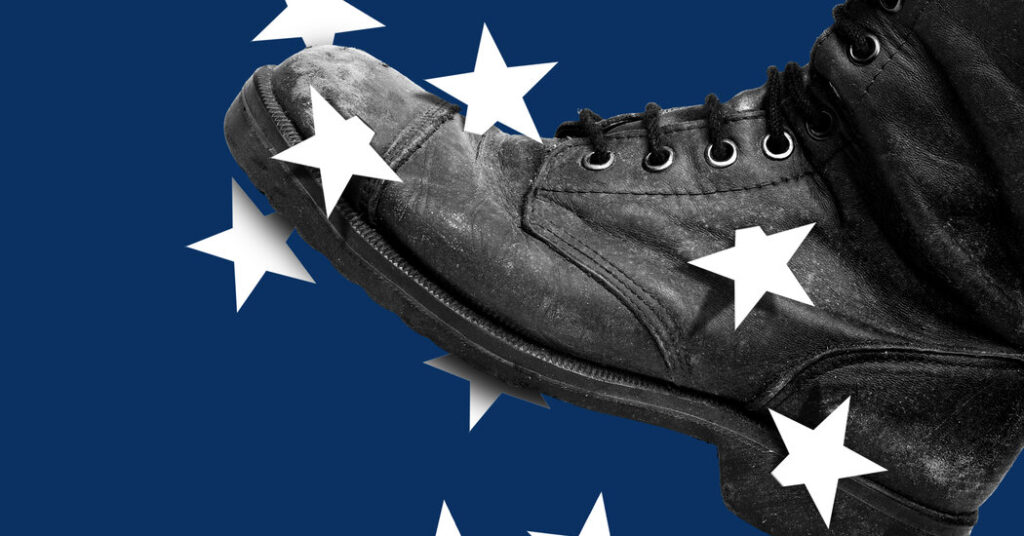
Source photograph by eldadcarin/Getty Images.
The Times is committed to publishing a diversity of letters to the editor. We’d like to hear what you think about this or any of our articles. Here are some tips. And here’s our email: [email protected].
Follow the New York Times Opinion section on Facebook, Instagram, TikTok, Bluesky, WhatsApp and Threads.
The post We Interviewed Over 100 Dissidents and Activists. This Is the Secret to Resisting Trump. appeared first on New York Times.