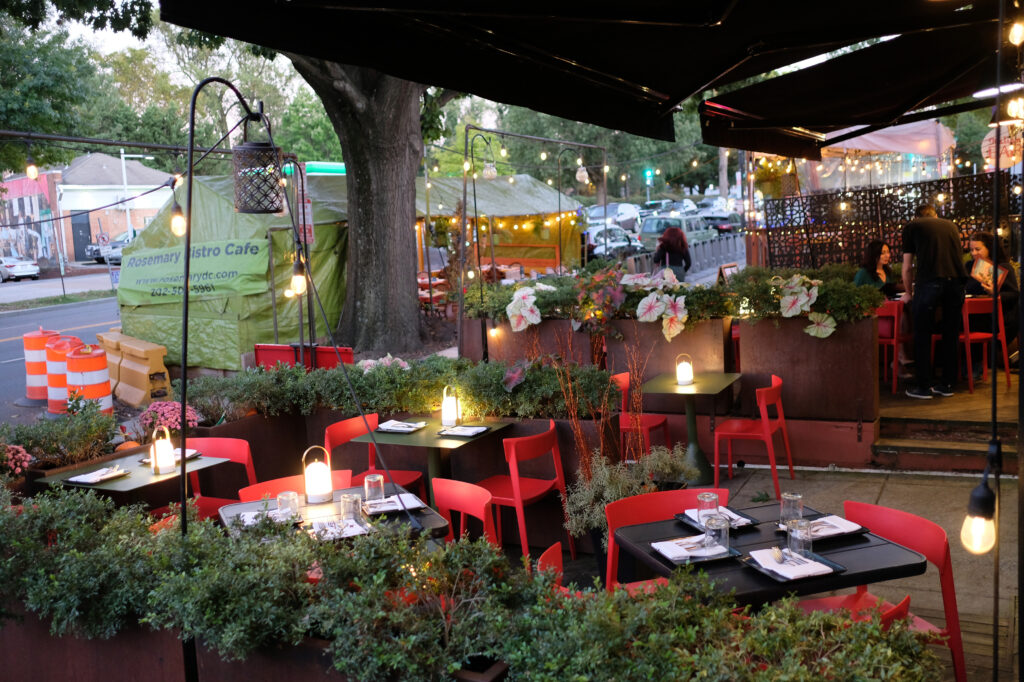
The D.C. Council on Tuesday unanimously passed an emergency bill that could allow streateries to operate year-round, essentially loosening the District’s new guidelines that would have restricted the use of the outdoor dining structures to warmer months.
The temporary law will also lower the annual costs of operating a streatery, a welcome move for restaurant owners who said the fees would have made it too expensive to run the structures, even though they have become a significant source of revenue for proprietors — and a major source of tax revenue for D.C.
Streateries sprang up during the coronavirus pandemic, and since then have been allowed to operate at no cost and with minimal oversight. This month, new guidelines went into effect charging businesses for street space and requiring that they conform to safety-related designs.
D.C. said it wouldn’t start enforcing the rules until sometime next year. But some of most popular “streateries” have already been demolished ahead of the new program, including the chalet-style setup outside Le Diplomate on 14th Street and the palm-filled patio outside Tiki on 18th.
Under the emergency law, which goes into effect if signed by Mayor Muriel E. Bowser (D), the charge per square foot has been knocked down from $20 to $15. The drop acknowledges what many restaurant operators said in a public hearing last month: The fees — including $260 for a permit and $250 per jersey barrier if rented from the city — would make streateries too expensive, particularly if owners would not be able to operate the structures year-round. The lower fee would be more in line with what the city charges for an enclosed sidewalk cafe, currently $10 per square foot.
The emergency law also provides more wiggle room for the city to grant exceptions to rules that would have prohibited restaurant owners from winterizing their streeteries or placing them too close to a curb cut. The Public Space Committee, which reviews permits for use of spaces such as parking spots, will have more discretion to issue exceptions to the District Department of Transportation’s permanent rules, provided the “waiver would not create an undue risk to pedestrians or other roadway users,” according to the emergency legislation introduced by council member Charles Allen (D-Ward 6).
The five-member committee already has the authority to grant exceptions, but the technical detail of the new guidelines meant the body may not have had much leeway to issue waivers.
“When done right, streateries are a boon for the neighborhood around them,” Allen said in a statement to The Washington Post. “The city has needed regulations and certainty around streateries and this legislation delivers that. But we also heard from businesses that DDOT’s initial proposal was too expensive and too limiting. These are common sense changes balancing how we use our public space with the many benefits a streatery can deliver year-round.”
The emergency legislation will supersede any DDOT rules currently in place, said Erik Salmi, deputy chief of staff for Allen. So if there are any conflicts — such as the price per square foot for a streatery — the council’s law would take precedent. The council agreed to extend the emergency legislation for 225 days. DDOT is expected to finalize its new regulations by the end of the month, and several council members said Tuesday the agency may incorporate the amendment’s language into its final rules.
Few of the city’s streateries meet the new standards, which prohibit walls that block visibility and require concrete barriers separating them from traffic. The rules also require streateries be located 25 feet from curb cuts, alleys and driveways, as well as 10 feet from fire hydrants. The guidelines not only establish safety rules but also aesthetic ones — an attempt to counter criticism that the structures were eyesores and blights to the landscape.
DDOT will begin enforcing the new rules on Jan. 15, as required by the emergency law. Previously, the agency only said it would begin enforcement early next year. Allen and other council members said they wanted to provide more clarity for restaurants.
DDOT Director Sharon Kershbaum said that with the pandemic over, it was time to impose some order on public space that would otherwise generate revenue as parking. Seventy of the 139 restaurants with temporary streatery permits applied for the permanent program. DDOT has allowed these permit holders to continue to operate their existing streateries while their application winds through the review process.
But restaurateurs say that they are now struggling due to a host of issues — federal layoffs, increased food and labor costs, immigration crackdowns, economic uncertainty — and can’t afford to comply. Some of the most successful argue that the streateries generate far more city revenue in taxes than parking spots would.
Patrice Cleary, the chef and owner of Purple Patch restaurant in Mount Pleasant, said her streatery should be held up as an example for others to follow. Her streatery covers 12½ parking spots in the neighborhood, but it has helped her more than double revenue since 2019, the year before the pandemic.
Cleary employs 65 people, almost double from her pre-pandemic staffing level. If she decided to scrap her outdoor structure, she figures she’d have to lay off 26 of them.
“And I’m just not going to do that,” she said.
To Cleary, the city has missed the larger point of the streatery program: It didn’t just save restaurants during covid. It became a revenue generator for the District. From 2019 to 2024, the money that Purple Patch paid to the city in sales and use taxes rose from $194,000 to $438,400, largely due to her streatery, she said. The city, she said, should be encouraging streateries, not discouraging the use of them through onerous rules and higher fees.
“This is an ecosystem. Let’s not forget that,” Cleary said about streateries and the city. “We feed each other.”
Before Tuesday’s vote, Bowser sent a letter to council members, asking them to reject the emergency amendment.
“During the long public outreach and comment process, DDOT heard the need to balance the many demands on limited public space: from businesses looking to expand their commercial space to the ability of buses, pedestrians (especially those with mobility challenges or persons pushing strollers), cyclists, and emergency services to access roadways and sidewalks,” Bowser wrote. “DDOT developed and issued design and permitting requirements that struck the right balance; this emergency legislation simply ignores that process.”
Bowser declined to comment for this story, but even if she vetoed the emergency law, the council could override it with a two-thirds majority vote. The council voted unanimously for the amendment.
The post D.C. Council votes to change streatery rules after restaurant pushback appeared first on Washington Post.