Michael Singh is managing director and senior fellow at the Washington Institute.
The U.S.-Israel relationship is falling apart. Or so one might think from breathless media coverage of the dynamic between the two allies in the past few weeks.
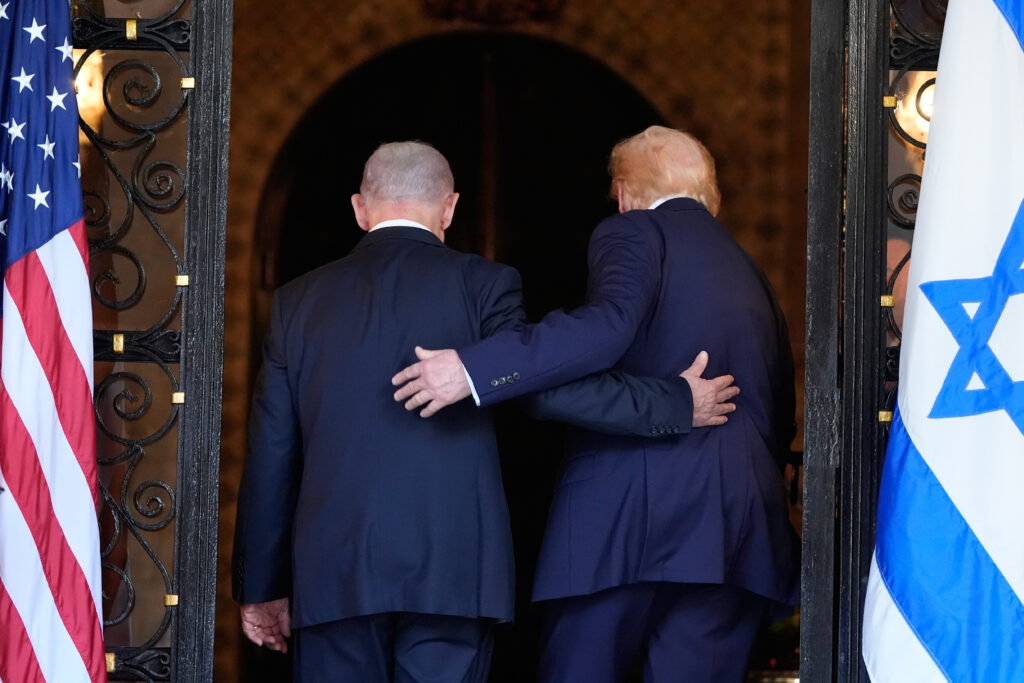
President Donald Trump has been publicly pressuring Israeli Prime Minister Benjamin Netanyahu in recent weeks, trying to get Israel to pull back from its attacks on Hezbollah in Lebanon — a key demand of Iran. This past weekend, Trump fiercely questioned Netanyahu’s judgment for ordering attacks on Beirut as negotiations were getting close to finalized. And earlier this month, he acknowledged calling the Israeli “effing crazy” in a heated exchange.
Yet such tensions between American presidents and Israeli prime ministers are nothing new. In 1975, President Gerald Ford wrote to then-Israeli Prime Minister Yitzhak Rabin to “convey [his] deep disappointment over the position taken by Israel during the course of the negotiations” between Egypt and Israel following the 1973 Yom Kippur War and warned, “The failure to achieve an agreement is bound to have far-reaching effects … on our relations.”
Likewise, following Israel’s 1982 attacks on Beirut, President Ronald Reagan called Israeli Prime Minister Menachem Begin, asserting that if Israel did not stop, “our entire future relationship was endangered.” And President Joe Biden famously advised Netanyahu to “take the win” rather than retaliate after it successfully intercepted a massive salvo of Iranian missiles in April 2024.
The United States and Israel have complementary but not identical interests, and much of the difference can be explained by the adage, “where you stand depends on where you sit.” Both Trump and Netanyahu are under pressure to achieve a successful result in the war with Iran. For the ordinary American, success may boil down to lower gas prices and the elimination of the nuclear threat posed by Iran. But for an Israeli — or, for that matter, a citizen of the United Arab Emirates or Kuwait — success also means safety from Iranian and Hezbollah rockets, missiles and drones that pose little direct threat to the U.S..
Such dynamics are common between allies. Leaders from Caesar to Eisenhower would recognize them. Large states are perennially frustrated by the fact that their smaller partners not only fail to do as they are told, but can railroad the larger partner with their actions. Meanwhile, the small state will inevitably feel at the mercy of its larger partner, asked to contribute blood and treasure but often denied a seat at the decision-making table. The U.S. and Israel are often implicated by one another’s actions and have little choice but to live with that — not despite their close partnership, but because of it.
Yet such frustrations obscure a remarkable reality. The war with Iran is the first in decades in which the U.S. military has operated in tandem with a partner as a near-equal. Israel depended on American support, but in turn took on its shoulders a significant share of the work of striking targets in Iran. And elsewhere in the region, Israel has operated largely solo against mutual enemies of the U.S., like Hezbollah, which, prior to 9/11, has been responsible for more American deaths than any other terrorist group.
With this partnership, Israel has earned the “model ally” moniker bestowed upon it in the Trump administration’s most recent National Defense Strategy. It is the rare state that is not only capable but willing to act in America’s stead, projecting power far more effectively than U.S. allies with gross domestic products many times Israel’s. The Jewish state’s capability is the product of a unique mix of societal factors, but is also in part the product of a decades-long, bipartisan strategy of building up Israel’s capabilities and its interoperability with the U.S. military.
With this success in mind, Trump should avoid two temptations.
First, he should not be too quick to claim the ability to rein in Israel. Diplomacy often works best when backed by credible threats, and Israel offers just that; with effective U.S.-Israel coordination, that threat can enhance rather than endanger Trump’s diplomatic efforts. And sometimes Israel can do things that benefit the U.S., but that we prefer not to do ourselves. In 2007, for example, Israel destroyed a Syrian nuclear reactor in an audacious operation that never would have passed muster in a risk-averse American national security bureaucracy.
Second, U.S. officials should avoid scapegoating Israel. Many not just on the left but on the right have suggested — some with good intentions, others far less so — that the U.S. went to war with Iran in February for Israel’s sake or because Israel forced our hand. Trump himself has asserted that this is false; his first threats to attack Iran in January were sparked by his outrage at the Iranian regime’s brutal crackdown on its own people.
Pointing the finger at Israel may be politically expedient but risks further undermining support for a U.S.-Israel relationship already under strain from divergences over Gaza and other issues. But weakening our most capable ally in the Middle East may ironically mean fewer opportunities to shift burdens and thus more work, not less, for the U.S. in the region.
Allies are frustrating, and the closer they are the greater the frustration can be. But as Winston Churchill astutely observed, the only thing worse than fighting with allies is fighting without them.
The post Don’t mistake friction for a broken alliance with Israel appeared first on Washington Post.