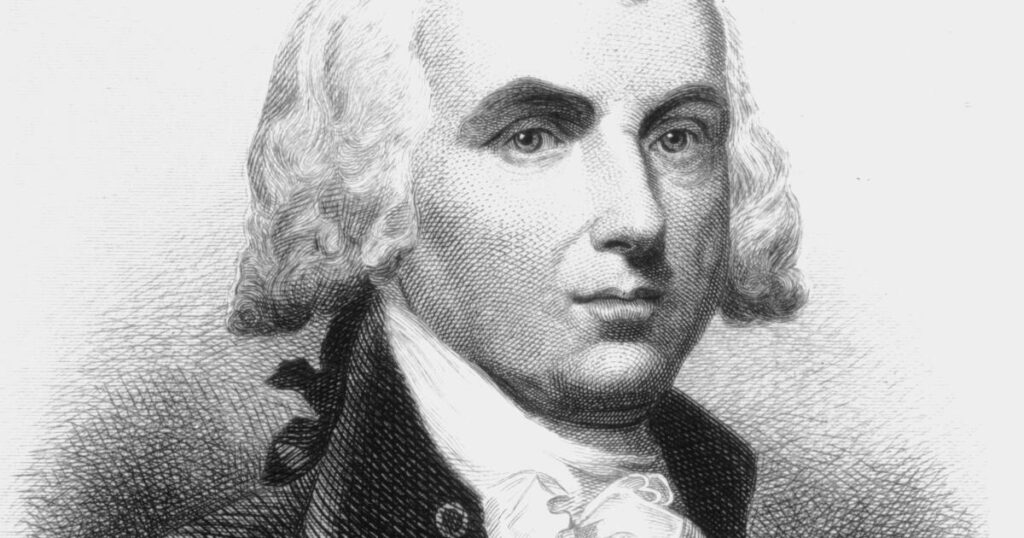
In May 1818, James Madison rode the 25 miles from his Virginia plantation Montpelier to Charlottesville to address the recently founded Albemarle Agricultural Society. As he rose to speak, some 30 men — politicians, wealthy landowners, physicians, lawyers and farmers — listened closely to what the former president had to say. It was a speech that placed Madison at the forefront of forest and soil conservation, decades before Henry David Thoreau called for the preservation of the wilderness and John Muir championed the protection of the Yosemite Valley. His words reveal a strikingly modern understanding of humanity’s relationship with nature and our capacity to damage it.
In his address, Madison argued that the defense of the environment was crucial to the survival of the American republic. He didn’t suggest living in misty-eyed harmony with nature, but rather described it as a fragile, interconnected system that was vulnerable to exploitation and humankind’s destructive power. These were radical ecological views. At a time when many Americans believed that God had created the natural world entirely for their benefit, Madison challenged the notion that nature “can be made subservient to the use of man.” He spoke about the devastating effects of deforestation and the long-term harm of large-scale tobacco cultivation on Virginia’s once-fertile soil, insisting that the first step toward sustained use was to “make the thieves restore as much as possible of the stolen fertility.”
Although only a few people were present that day, Madison’s visionary appeal did not remain confined to the room. The speech was published as a pamphlet and reprinted in newspapers across the country. Largely forgotten today, it nonetheless belongs to the founding documents of the United States, for it spelled out a clear argument that the protection of the nation’s forests, rivers and soil was essential for the country’s future. Conservatives, Republicans and right-wing think tanks, such as the Heritage Foundation, regard Madison as a hero — invoking his writings on limited government and celebrating him as the architect of the Constitution. He speaks directly to some of their core commitments, including their skepticism of the expansion of federal power. His views are the foundation for so-called originalism, the interpretation of the Constitution according to the founders’ intent.
A report on the conservative Heritage Foundation website explains “James Madison insisted that the guide for ‘expounding’ the Constitution must be ‘the sense in which the Constitution was accepted and ratified by the nation.’” In another publication, the foundation cites Madison’s Federalist Paper No. 51, in which he wrote that “the great difficulty lies in this: you must first enable the government to control the governed; and in the next place oblige it to control itself.” Others refer to Madison’s role in drafting the 2nd Amendment to defend the right to carry arms. But it might surprise many conservatives to learn that their revered “Father of the Constitution” can also be seen as the “Father of American environmentalism.”
Let’s take a closer look at what Madison talked about on that day in May 1818. His address was a call for change and an explanation of what he called the “symmetry of nature” — the relationship between our planet and humankind. Not everything, Madison argued, could be used for the “increase of the human part of the creation.” Plants drew their nutrition from the atmosphere, soil and water, but they also returned it. This reciprocity, Madison explained, “is sufficiently seen in our forests; where the annual exuviae of the trees and plants, replace the fertility of which they deprive the earth” — not only that, “vegetable matter which springs from the earth … returns to the earth.” In other words, we have to return what we take from the soil.
As a farmer and plantation owner, Madison had seen the effects of exhausted soils. The subject of manure is frequently mentioned in his letters, and his knowledge of agriculture was so expansive that Thomas Jefferson described him as “the best farmer in the world.” When Madison retired after the second term of his presidency in March 1817, he was glad to return to Montpelier, to farming and to putting on his worn-out old gardening trousers.
His ecological awareness extended beyond soil depletion. “The atmosphere is the breath of life,” he told the Albemarle Agricultural Society, noting that animals, plants and human beings alike depend on it. Amazingly, he even spoke of air pollution: “Were the atmosphere breathed in cities and not diluted and displaced by fresh supplies from the surrounding country, the mortality would soon become general.” He warned about “the excessive destruction of timber,” cautioning that what was left of the forests ought to be preserved and that what had been destroyed ought to be replanted. He was not the first to worry about the decline of woodlands — Jefferson, Benjamin Franklin and George Washington had done so too — but he was the first to give a public speech about it.
Taken individually, none of the ideas in his speech were entirely original, and yet Madison was the first American to weave them together into a comprehensive argument. Just as he had read and distilled 200 books on modern and ancient republics into a single paper in preparation for the Constitutional Convention three decades earlier, he synthesized the latest theories into one voice, urging his fellow Americans to safeguard their environment. In a gesture that underlined the depth of his conviction, he set aside a portion of forest for preservation — not on public land but on his plantation — making him the first American political leader to practice land conservation. Today, the 200-acre James Madison Landmark Forest stands as a testament to his vision.
Conservatives might also be surprised to learn that their revered Madison likely would have opposed the current administration’s draconian environmental agenda — including the withdrawal from the Paris Agreement, major rollbacks of federal environmental regulations and the formal repeal of the Environmental Protection Agency’s 2009 greenhouse gas endangerment finding, a move that undermined the legal basis for many U.S. climate protections, as well as proposed cuts to the National Park Service and reductions in climate research funding. The consequences for the environment are grave, and one can easily imagine that Madison would have been shocked. If conservatives cite Madison’s words to justify and reinforce their arguments and beliefs, they should also reconsider the dismantling of critical environmental policies.
Andrea Wulf is the author of ”The Traveler: One Man’s Quest for Humanity From the South Seas to Revolutionary Paris.”
The post The right’s beloved James Madison, the founder of American environmentalism appeared first on Los Angeles Times.