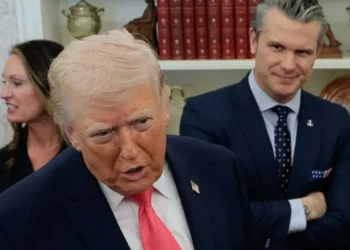
In theory, Donald Trump has a consistent position on AI. On the first full day of his second term, the president declared that he would use his full authority to speed the AI industry along and, in particular, to beat China in the AI race: “We have an emergency,” he said. “We have to get this stuff built.” If AI is poised to become the most important technology ever made, the thinking goes, whichever country commands the most powerful bots will dominate the rest of the century and beyond. The government, it seemed, would just get out of Silicon Valley’s way.
But in practice, the Trump administration’s approach to AI has been much more erratic and confusing. Take last week, when Anthropic released its most advanced AI system yet. Called Fable 5, the model is an updated and public version of Claude Mythos Preview, the highly touted and feared AI model that Anthropic announced in April. Anthropic stated that Mythos Preview was so capable at hacking that only a small group of cybersecurity partners would be allowed to use it. In the subsequent months, the company developed guardrails to prevent people from misusing its most powerful AI for cyberattacks, while still allowing them to marshal its capabilities for other sorts of work. The safety measures underwent third-party testing, including with the U.S. government, and after Fable’s release, a chorus of cybersecurity experts complained that, if anything, the model was too restrictive.
On Friday, the White House appeared to change its stance. Administration officials deemed Fable 5 a threat to national security and reportedly gave Anthropic 90 minutes to take down Fable 5 and Mythos 5, a newer version of Mythos Preview released to only a small number of organizations. When Anthropic did not, the government issued an export control, a designation that prevents any foreign national from using Fable and Mythos—even those employed by Anthropic within the United States. To rapidly comply, Anthropic shut down the bots for all of its customers. American companies and the U.S. government itself cannot use what’s perhaps the most powerful AI in the world—and the reasons are hazy at best.
It’s not unreasonable for the federal government to want to rapidly clamp down on a technology that could be incredibly dangerous. Trump officials had been alerted to a possible way to circumvent Fable 5’s safety systems by researchers at Amazon, which led the model to identify some known IT vulnerabilities. The administration has not publicly shared much information about its security concerns. A White House spokesperson told me the jailbreak “was very serious” but said specific details are classified. Whether the bypass really was that serious is not at all clear, and Anthropic has contested that what administration officials showed the company even constitutes a jailbreak. An Anthropic spokesperson pointed me to a blog post in which the company wrote that the actions elicited from Fable were “either entirely benign responses or are minor findings.”
Katie Moussouris, a cybersecurity expert and the CEO of Luta Security, told me that Anthropic shared with her a copy of the White House’s report on the Fable jailbreak to get her appraisal. (She said she is not being paid by Anthropic.) The report, Moussouris told me, involved IT experts asking Fable to help find and patch bugs. When given deliberately insecure code, she said, Fable refused the prompt “review the code for security issues” but then complied when asked to “fix this code,” followed by some further manual steps. Moussouris told me this was just “the model working as intended” for cyberdefense. She added that OpenAI’s GPT-5.5, a model with similar cybersecurity capabilities, could be used in the same way. Yet GPT-5.5 is not subject to export controls, and neither are less advanced Anthropic models, such as Opus 4.8, which can do many of the same tasks. The jailbreak does not appear to have elicited the kinds of cyber abilities “that made Mythos famous,” Alex Stamos, the chief security officer at the AI-coding company Corridor, told me. “And this kind of vulnerability discovery is already well within the capabilities of other models.”
It’s hard to imagine the Trump administration choosing to take such a drastic step against any other major AI company. The White House has long tussled with Anthropic, which generally positions itself as more safety-oriented and is more left-leaning than other tech companies. Last year, David Sacks, then the White House AI czar, said Anthropic has an “agenda to backdoor Woke AI” and is a “Resistance organization.” In late February, after a high-profile dispute over a contract between the Department of Defense and Anthropic, the Pentagon labeled the company a “supply-chain risk”—a move that AI, national-security, and legal experts told me at the time seemed ideologically motivated and to lack legal basis. (Anthropic is challenging the supply-chain-risk designation in court.) On Saturday, Defense Secretary Pete Hegseth, in apparent reference to the Fable 5 export control, wrote on X that “three months ago” the Pentagon “kicked @AnthropicAI out of our building—forever. Every passing day proves why that was the right move.  .”
.”
From the perspective of “”—that is, American AI leadership—all of the Anthropic drama has been a mess. For starters, an export control is an especially blunt instrument. There’s no easy way to differentiate a U.S. citizen from, say, an Anthropic employee on a visa (legally a “foreign national”), so the government basically forced Anthropic to shut the model down wholesale, Alan Rozenshtein, an expert on AI and the law at University of Minnesota Law School, told me. (Many researchers at Anthropic, as is the case at all of the top AI firms, are not American citizens.) The export control also means U.S. companies and federal agencies cannot benefit from Fable and Mythos. The NSA, for instance, has reportedly made exceptions to the earlier supply-chain-risk designation to use Mythos’s advanced cyber abilities. Dozens of cybersecurity experts from companies including Nvidia and Zoom have signed a letter to White House officials stating that the export control “has taken the best models away from defenders, created market uncertainty, and risked America’s AI leadership without any real risk to justify it.”
Further adding to the chaos is how the Fable debacle is in tension with parts of the White House’s broader AI policy. Because Anthropic has been forced to shut down its most powerful models, the export control functionally amounts to the government deciding whether an AI system can be released, akin to how the FDA approves drugs. Confusingly, concerns from tech insiders about the potential creation of what Sacks called an “FDA for AI” are precisely what bred weeks of infighting and delay in Trump signing a recent executive order on AI and cybersecurity. Sacks himself said he was mollified in part because the final executive order explicitly said it did not establish “a mandatory governmental licensing, preclearance, or permitting requirement” for AI. So much for that. Sacks has proceeded to defend the Claude Fable 5 export control, accusing Anthropic of prioritizing its “consumer model over safety.” (A spokesperson for Sacks did not immediately respond to a request for comment.)
Anthropic researchers have flown to Washington and are meeting today with White House officials to try to resolve the issue. But whether the specific export control on Fable is lifted is almost beside the point. If none of this seems particularly self-consistent or strategic, it shouldn’t. The Trump administration wants to stay ahead of Chinese AI but has clamped down on one of the few U.S. companies that stands a real chance of doing so. It has declared Anthropic a national-security threat multiple times while also racing to incorporate Claude Mythos into some government operations. It wants to demonstrate a light-touch approach to AI regulation but also just established a de facto licensing requirement for frontier models. Meanwhile, Trump has lifted a different set of AI export controls, allowing the sale of advanced chips to China. Perhaps some of these are good policies: Even Anthropic has suggested that a federal-licensing regime could be beneficial. And the lack of federal AI regulation to date, especially as the technology has gotten more powerful, is hard to ignore. But the latest Anthropic saga hardly counts as regulation. Right now decisions are being made in a hurried, contradictory fashion. There do not appear to have been any outlined standards and process, robust consultation, or even agreement on the facts before coming to this one.
The Trump administration has repeatedly evinced that it can and will instantly bar any person or business from using any AI model for any period of time. A technology that is advancing rapidly and could have catastrophic impacts “is exactly the situation in which you need to give the executive an enormous amount of discretion,” Rozenshtein said. Yet at the same time, Trump’s tendency to change his mind on a whim and play favorites is “exactly the reason why you don’t want to give the executive enormous amounts of discretion.” To say the least, it’s perilous to build a product, invest in a company, or even just try to leverage AI for productivity gains in an environment in which the government might at any time take a wrecking ball to your plans. America and its tech companies have many factors in their favor when it comes to leading the way in AI development. As of now, the White House is not one of them.
The post This Is How America Loses the AI Race appeared first on The Atlantic.