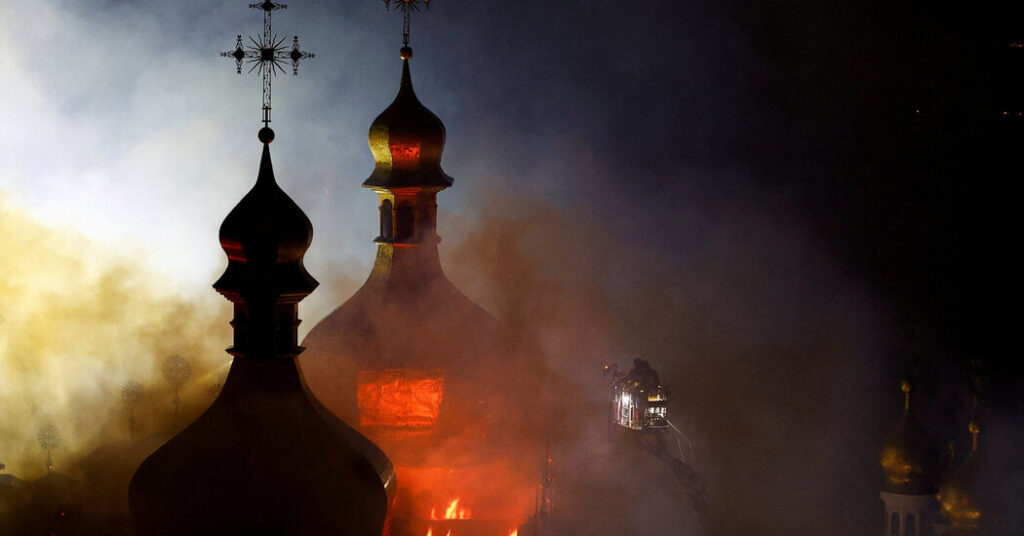
More than 80 years after Ukraine’s Dormition Cathedral was razed to its foundation during World War II, the reconstructed holy site was again engulfed in flames on Monday.
The cathedral, a popular Christian pilgrimage destination, was struck when a wave of Russian attacks across multiple cities killed 11 people and injured dozens more, the Ukrainian government said. Two drones also struck the historic monastic complex in Kyiv that is home to the cathedral, President Volodymyr Zelensky of Ukraine said in a post on social media.
Videos verified by The New York Times show fire crew members on tall cranes, spraying water through windows glowing orange against the cathedral’s white exterior.
Over the course of the war, hundreds of Ukrainian religious sites, museums, monuments and libraries have been damaged or destroyed, but the attack on the cathedral stood out.
“This is, as of today, one of the largest Russian crimes against Christian culture,” Mr. Zelensky said in his post.
Several museums, as well as a film studio and expansive costume collection, were also hit, Ukraine’s Culture Ministry said.
Russia’s Defense Ministry denied targeting civilian infrastructure and suggested on an official Telegram channel that “expired” American Patriot missiles had misfired and hit the site.
The cause of the destruction has not been independently confirmed.
Why is the cathedral important?
Since its construction in the 11th century, the golden-spired Dormition Cathedral has been central in shaping Eastern Europe’s monastic tradition. Christians from across the world have made pilgrimages to the Eastern Orthodox site, which sits within a complex of museums and churches called the Kyiv-Pechersk Lavra.
Alice Isabella Sullivan, a Tufts University art history professor who studies medieval Eastern Europe, said the site was one of the oldest active Eastern Christian monastic communities in the world.
Art historians have traveled to Kyiv to study the texts, the textiles and the icons kept at the complex’s museums, while architects have traced the buildings’ Byzantine and Baroque influences. Tourists have wandered the warren of holy caves below, which hold centuries-old tombs and religious artifacts.
Dr. Sullivan said the blaze on Monday threatened historians’ ability to study crucial elements of Ukraine’s heritage. “Other local monuments have been destroyed, but not with such deep historical value and significance,” she said.
Ukraine’s Culture Ministry has vowed to repair the damaged structures.
How have Ukraine’s cultural sites weathered the war?
It is far from the first time that natural or man-made disasters have struck the Dormition Cathedral. Over nearly 1,000 years, the site has endured earthquakes, blazes, sieges and bombs.
The current structure was built in the 1990s, after a previous iteration was demolished during World War II.
It is not even the first time the Kyiv-Pechersk Lavra complex has been damaged this year. Ukraine’s Foreign Affairs Ministry said Russian attacks in January caused windows to shatter and walls to crack.
Ukraine’s Ministry of Culture framed the strikes on Monday as part of a Russian campaign to erase the nation’s cultural heritage.
“Russia seeks to burn our memory, our history and the evidence of who we are,” the ministry said in a release.
Russia’s Defense Ministry insisted it had targeted only military infrastructure.
Since Russia launched its war in Ukraine in 2022, UNESCO has documented the damage or destruction of over 500 of the nation’s historic monuments, buildings and religious sites.
The post As Russia Strikes Ukraine, a Cultural Symbol Catches Fire appeared first on New York Times.