NEW YORK — A nationwide network of charitable foundations is encouraging its members to emphasize their positive contributions to American life, a 250th anniversary campaign aimed at quelling what it calls the “greater intensity” of scrutiny felt from the federal government and populist movements.
Popular notions of philanthropy as merely a game for the ultrawealthy to fund partisan projects and commit fraud have left the sector vulnerable to political attacks, as the Council on Foundations sees it, influencing policies that hamper essential community services. The advocacy group, which represents about 1,000 nonprofits, hopes to overcome what CEO Kathleen Enright calls the sector’s “perception gap” with its “Generosity Builds” campaign, launched Monday.
Enright believes most Americans don’t recognize their reliance on the charitable sector. Just about 1 in 20 adults said they or anyone in their immediate family received nonprofit services in the past year, according to a 2023 Indiana University Lilly Family School of Philanthropy report.
“This week, I got an MRI at Georgetown University Hospital, I participated in my church at St. Columba’s, my daughter was inducted into National Junior Honor Society. Four or five nonprofits have been instrumental in my life this week,” she said. “Folks just aren’t putting that tag on it.”
And that tag is growing increasingly important, Enright said. Last year, negotiations over President Trump’s tax and spending bill included proposals to levy new taxes on private foundations that Enright said would have taken resources from communities if they made it into the final law.
The battle over defining what nonprofits actually do has recently been amplified from the highest rungs of the Trump administration, which has upended decades of partnerships built with nonprofits. Trump froze, cut or threatened a sweeping range of social service grants characterized by the White House as “government largesse that’s often riddled with corruption, waste, fraud, and abuse.” More recently, the Department of Justice charged the Southern Poverty Law Center — a civil rights nonprofit accused by Republicans of targeting conservatives in its work tracking extremists — with defrauding donors through payments to informants.
Vice President JD Vance described the Ford Foundation, the Gates Foundation and the Harvard University endowment as “cancers on American society” back as a 2021 U.S. Senate candidate, telling Tucker Carlson that “we are actively subsidizing the people who are destroying this country and they call it a charity.”
“All across our country, we have nonprofits — big foundations — that are effectively social-justice hedge funds,” he said in a talk that year on “woke capital.”
Narratives about nonprofits being “overly politicized” or wasteful are “extreme minority stories” that don’t reflect how philanthropy operates, according to Enright.
Across many surveys, trust in the nonprofit sector has remained higher than most others. But its impact is sometimes difficult to measure and explain. The sector hasn’t faced an environment this challenging in almost six decades, according to Kathryn Thomas, the vice president of communications for the Charles Stewart Mott Foundation in Flint, Michigan.
She cited the congressional effort to increases taxes on foundations’ investment incomes and acknowledged the Trump administration’s federal funding cuts.
“In an era when everything is under partisan attack and there’s so much polarization, we really have to do a better job of emphasizing why we exist,” Thomas said.
Enright said the story of philanthropy is not one where a rich person “saves the day.” She sees growing concerns about billionaires’ influence fueling suspicion about philanthropists’ motivations. Some argue the charitable sector allows moneyed interests to decide how tax dollars are spent rather than elected officials.
The campaign will emphasize that most donors “have just a little bit more than they need and therefore want to give back,” she said, especially at the local level.
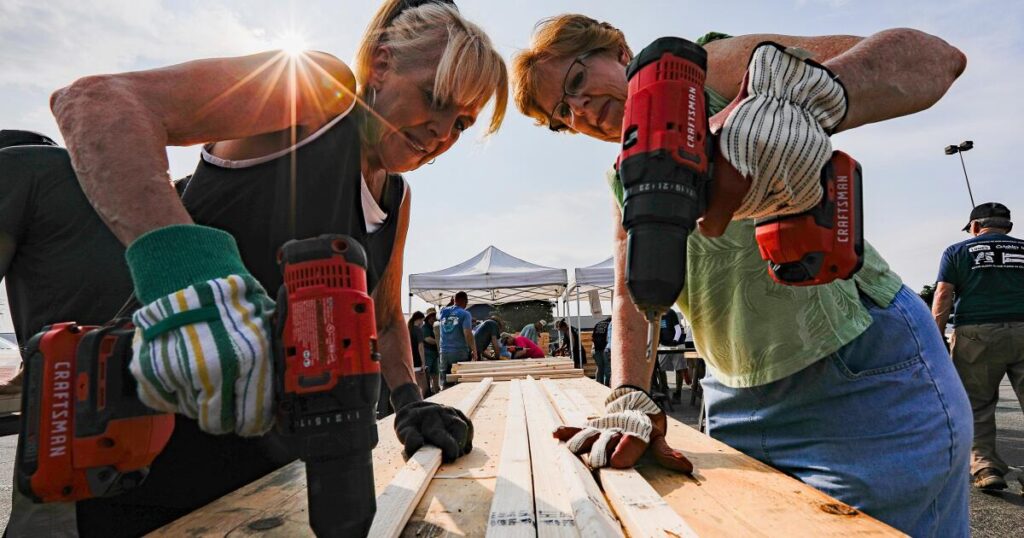
“Money does not solve problems. It’s a tool that creative people and institutions inside communities use to solve problems,” she said. “The real heroes of most of these stories are nonprofit leaders, religious leaders, civic leaders who just roll up their sleeves and get something done — but do it with some financial underpinning by charitable foundations.”
That’s the story told by the Gulf Coast Community Foundation in Sarasota, Florida. A 10-apartment affordable housing complex for military veterans opened last year with the foundation’s support.
The area has an “embarrassingly high” number of veterans without housing, according to Jon Thaxton, the foundation’s director of policy and advocacy. Many are priced out in Sarasota, increasingly a luxury destination with high real estate prices.
Local donors had been trying to build a similar project when they approached the foundation in 2020 for help. Thaxton secured land already vested for affordable housing, corralled $2.2 million in donations, got $800,000 from the city and won the backing of their U.S. representatives.
The foundation’s leaders believe their track record made that possible. Phillip Lanham, the president and CEO, noted the project was completed across multiple election cycles and a pandemic, suggesting that community foundations are well situated to “play the long game.”
“Most people think that foundations like us deal with money and donors. We really don’t. We deal with relationships and trust,” Thaxton said. “That’s our commodity. That’s what we earn. That’s what we save. And that’s what we contribute back to the community.”
The Council on Foundations will also elevate examples of early, ordinary philanthropists as part of its case for philanthropy as an integral “part of the American story.” Enright credited a formerly enslaved man with donating land in North Carolina that became an African Methodist Episcopal church that endures as a pillar of the local community.
Lillian Kuri, the president and CEO of the Cleveland Foundation, welcomed the focus on everyday philanthropists. The Cleveland Foundation is considered the first community foundation, established in 1914 by lawyer Frederick Harris Goff as a way to fund durable change in the city.
The foundation aims to find new ways to expand today’s tent of philanthropists dedicated to improving their surrounding areas. It announced new investments this week in a fund dedicated to turn vacant industrial land into job-ready work sites. They’ve also launched a fund that allows donors to invest in major Northeast Ohio companies, supporting local business growth while that money increases into a sizable amount that can be donated to nonprofits.
“Generosity cuts across everybody,” she said, adding that community foundations offer “a way for everyday people — not just the largest, wealthiest people — to participate in the change they want to see in their communities.”
Pollard writes for the Associated Press.
The post Foundations are emphasizing their community services to counter narratives of fraud and partisanship appeared first on Los Angeles Times.