The police officers barricaded themselves inside sandbagged stations. When they left on sporadic patrols, they rode in packs of six, clutching rifles, their faces hidden behind masks.
They do not venture deeper into the jungle. Out there, farther into this remote part of northeast Colombia, dirt roads wind past fields of coca and white flags civilians have hung outside their homes, desperate to avoid the crossfire between two guerrilla groups warring for territory.
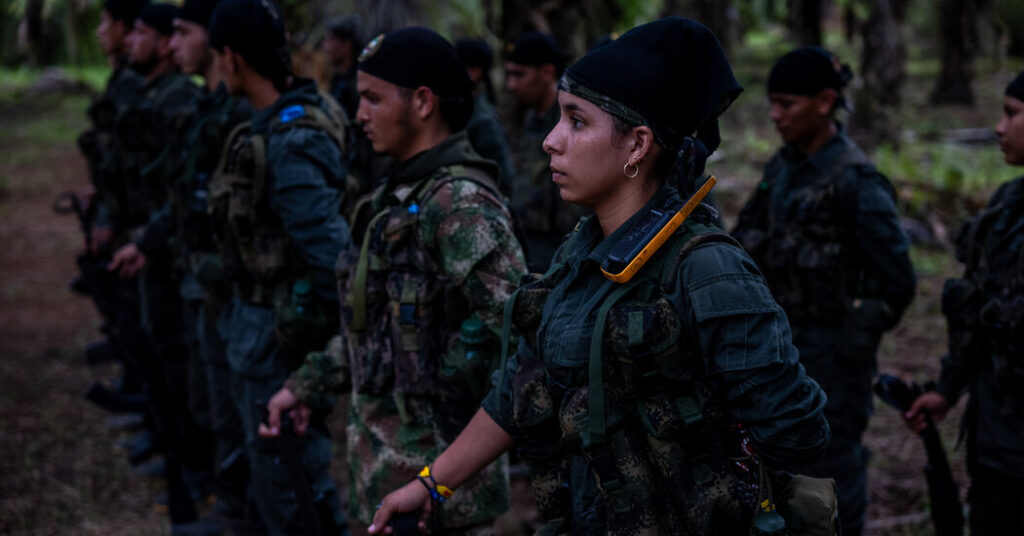
Young, pimple-faced guerrilla fighters in dark-green fatigues inspected vehicles and controlled access to parts of the Catatumbo region, along the Venezuelan border, enforcing curfews, speed limits and rough justice for petty crimes.
Deeper into the hills, their comrades hunt rivals and launch drone attacks, locked in one of the deadliest conflicts borne from Colombia’s failed promise of peace.
“Coca is the cause of bloodshed in Catatumbo,” said Jose Reyes Quintero, 82, a farmer, referring to the plant harvested to make cocaine. The guerrilla groups, he added, have “compassion for nobody.”
Ten years ago, the world watched as Colombian leaders dressed in white signed a landmark peace deal meant to end one of Latin America’s longest and bloodiest internal conflicts.
For more than 50 years, Colombia fought a brutal war against a leftist insurgent army that left at least 220,000 dead. The 2016 accord led to the disarmament of 13,000 fighters from the Revolutionary Armed Forces of Colombia, or the FARC, the biggest guerrilla group in the Western Hemisphere at the time.
The deal earned Colombia’s then-president the Nobel Peace Prize.
But peace never came to Colombia.
Almost immediately, old and new armed groups began carving up Colombia’s impoverished regions. They filled vacuums where the state failed to establish a permanent presence, fighting over illegal gold mines and drug-trafficking corridors in the nation that is the world’s biggest cocaine producer.
Illegal armed groups now have a footprint in 47 percent of municipalities, up from 18 percent in 2019, according to researchers. Their ranks have grown to an estimated 27,000 members, more than the 18,000 before the peace deal, accelerated through the recruitment of children. And rebel groups have combined traditional jungle combat with new drone warfare.
The surging violence has become a flashpoint in a crucial presidential runoff Sunday that could swing Colombia to a right-wing candidate promising to crush criminal groups with an iron fist.
Colombia’s current president, Gustavo Petro, the country’s first leftist leader, staked his legacy on a bold policy — called Total Peace — to negotiate truces to end Colombia’s remaining conflicts.
Mr. Petro, who blames his predecessor for failing to properly implement the 2016 peace agreement, has said his policy was the alternative to “perpetual war.”
But during Mr. Petro’s four years in office, critics say, the groups took advantage of brief cease-fires to expand their territories and illicit economies, growing only stronger.
“Total Peace was a total failure,” said Laura Bonilla, the deputy director of the Foundation of Peace and Reconciliation, a Colombian research group.
The military, she said, failed to adapt to groups blending in among civilians and exerting control in more covert ways.
“The armed forces still think they’re fighting the FARC and not groups that don’t have camps, that are difficult to bomb, which are spread out, extorting everyone and causing major civilian harm,” she said.
For many Colombians, the presidential runoff has become a referendum on the violence, with two candidates pitching opposing paths forward.
On one side is Iván Cepeda, a leftist senator and key negotiator of the 2016 peace deal, who pledges to continue a version of Mr. Petro’s fraught peace dialogues.
On the other is Abelardo De La Espriella, a right-wing front-runner endorsed by President Trump, who has vowed an all-out military offensive through airstrikes and the construction of remote mega prisons.
The election could also determine whether the United States plays a more direct role in Colombia’s drug war as Mr. Trump makes combating narcotrafficking a cornerstone of his regional agenda.
The violence, which is unfolding largely outside Colombia’s largest cities, is not as widespread as the kidnappings, car bombs and paramilitary massacres of the 1990s.
The stakes are highest for far-flung regions like Catatumbo. Since last year, a bloody war between two rival guerrilla groups, and a military trying to contain them, has set off a humanitarian disaster there.
The clashes have forced 100,000 Catatumbo residents to flee their homes, almost one-third of the population, and have led to more than 160 homicides, including of children, according to Colombia’s human rights agency.
The violence has also fueled appetite for change: Mr. De La Espriella won most of Catatumbo in the election’s first round. If he prevails, he promises to launch a U.S.-Colombia offensive to “recover territorial control in Catatumbo” within 90 days.
Trapped in the Crossfire
A vast maze of mountainous jungles, Catatumbo has been isolated from most of Colombia by a chronic absence of state institutions and a lack of basic infrastructure like paved roads.
Trump Administration: Live Updates
Updated
- Democratic lawmakers warn Trump officials not to pursue the president’s arch without Congress’s approval.
- The Trump administration appeals a ruling that blocked Kennedy’s vaccine policies.
- The Supreme Court declines to revive a Trump adviser’s lawsuit against Comey.
For decades, guerrillas and coca cultivation have filled the void, with cocaine and weapons easily smuggled across Colombia’s porous border with Venezuela.
In late March, five guerrilla fighters manned the base of a transmission tower that they had turned into a hidden bunker.
They carried rifles, but also an arsenal of drones: small kamikazes for short-range attacks and larger, Chinese-made drones to drop homemade explosives on enemies miles away.
The fighters are part of a dissident FARC unit that rejected the peace deal. Known as Frente 33, or the 33rd Front, the unit is among dozens that rearmed and expanded.
Their enemy has been the National Liberation Army, or E.L.N., a group founded in the 1960s by radical priests and Marxist intellectuals. The E.L.N., which experts say has more than 6,000 members nationwide, is Latin America’s oldest guerrilla group.
Both groups cast themselves as the true protectors of the poor and refuse to lay down arms.
“The guerrillas have always been in Catatumbo,” said Andrey Avendaño, the commander of the 33rd Front, suggesting that a stronger military assault against them would fail.
“Guerrilla commanders could die, guerrilla fighters could die, soldiers and police officers will die,” he said. “But the problem will persist because Colombia’s problem will be resolved when we resolve need and inequality.”
The groups say they have survived by acting as middlemen: They tax drug traffickers who buy cocaine paste made from the coca plants that are the financial lifeline of many farmers here. They also impose taxes on coal mining and the sale of palm oil.
As the 33rd Front expanded, winning over locals by building roads and bridges, the E.L.N. increasingly viewed the rival group as a threat, experts said.
The 33rd Front’s peace talks with Mr. Petro deepened the friction, with the E.L.N. asserting that the FARC dissidents were using the negotiations to gain legitimacy and displace them.
“The plan was to annihilate the E.L.N., but it didn’t turn out that way,” Antonio García, the E.L.N.’s top commander, said in a statement to The New York Times.
The tipping point came on Jan. 15, 2025, when armed men killed a funeral-home owner, his wife and baby. Blaming the 33rd Front — which denied involvement — the E.L.N. launched a surprise offensive, plunging the region into war.
Civilians and community leaders have been killed. Drone attacks terrorize residents. And thousands of families have been confined to their homes or displaced.
The war arrived at Diego Quintero’s doorstep last October.
His 9-year-old son, Matias, was playing outside when FARC dissidents fatally shot two E.L.N. fighters in an ambush outside his farmhouse, Mr. Quintero said. Matias was traumatized by the sight of the bloodied bodies.
“He didn’t want to sleep here anymore,” Mr. Quintero said. “When he sees someone in uniform, he gets scared.”
Mr. Quintero, 33, briefly sent Matias and his wife away. But Mr. Quintero could not afford to leave: He was replacing his coca with oil palm trees he had to harvest.
“I’m conscious that this hurts people,” he said, pointing to his remaining coca shrubs.
Into the Front Lines
Across Catatumbo’s countryside, guerrilla fighters rove pastures on foot, shooting at each other in a never-ending battle.
Most of the two dozen FARC fighters The Times met were in their late teens or early 20s. Many said they had joined the group before turning 18.
With AR-15 and AK-47 rifles slung on their shoulders, they smoked cigarettes as they cooked rice over a gasoline stove and connected to the internet using a mobile Starlink.
Born poor, many said joining the FARC dissidents had given them purpose. Unlike other armed groups that offer contracts, FARC fighters must serve for life and without pay, though they are fed and sheltered.
Some spoke loftily about freeing Colombia from a corrupt oligarchy, echoing the FARC’s revolutionary language from its founding in 1964.
Beneath the ideological discourse are tragic stories of adolescent years cut short.
For Daniela Rodríguez, 22, joining the FARC led to something worse — a fatal encounter with her father.
Both her parents were E.L.N. combatants, she said, but at 15, she left home and joined the FARC, attracted by their “discipline.”
She hadn’t seen her father for years until she came head-to-head with his E.L.N. unit last year during a deadly gunfight.
She saw her father killed by her own forces.
“It was painful because, despite it all, he was my father,” she said. “But we’re at war.”
Her mother, no longer an active E.L.N. fighter, is caring for the 5-year-old son Ms. Rodriguez had with her boyfriend, a FARC fighter.
He, too, was killed last year, by the E.L.N., she said.
“It filled me with rage,” she said, motivating her to never abandon the front lines.
A Vicious Cycle
Ten years after the peace deal, the story of Catatumbo mirrors those haunting other conflict zones where peace never arrived.
The resurging violence, experts say, has exposed the fragility of peace without solving the root causes of Colombia’s eternal conflict: lack of opportunities for poor Colombians pushed to illegal economies, and lack of security in remote regions exploited by armed groups.
Mr. Petro visited Catatumbo last year and denounced the E.L.N.’s initial attacks as “war crimes,” deploying thousands of soldiers to strike both groups.
In Tibú, the region’s largest town, Jaime Botero is one of the few community leaders who has not fled or been killed.
Though he understood why many in Catatumbo were eager for a stronger military solution, he worries whether it would lead only to more bloodshed.
“Starting one conflict to finish another is not the solution,” he said. “We’ve seen that story play out for 50 years.”
Federico Rios and Sofía Villamil contributed reporting.
The post A Shattered Peace: Inside Colombia’s Never-Ending Drug War appeared first on New York Times.