She was the superfan in the front row whose celebrity was about location, not vocation. She sat courtside for decades, directly behind the Knicks bench, with a reporter’s eye and a psychologist’s ear.
She was one of those special choice-seat Madison Square Garden patrons not there to be seen, or to preen. After more than four decades of faithful commuting to the Garden from Stamford, Conn., she deserved the 2026 champion Knicks.
If only she could have come back for Game 4, the N.B.A. finals’ greatest comeback.
When Michelle Musler died in 2018, I lost a career counselor and a life coach. Our friendship began in the early 1980s, when I was a young tabloid beat reporter eager to chat up a potential source who, from her privileged view into the Knicks huddle, could help unlock the key to backpage prominence.
Away from the Garden, Michelle was a suburban mother of five who found her post-divorce footing in Midtown Manhattan. She befriended and dropped nuggets of wisdom on fellow fans, team employees, coaches, players, their girlfriends, wives and sports journalists alike. From near-poverty, she built a career in corporate human resources and her own company training executives around the world — travel typically planned around the Knicks’ home schedule.
She was weeks from her 82nd birthday when cancer staged a terror attack, justifying her lamentations of how James Dolan, the Knicks’ owner, had sabotaged her last chance for a title run with his Carmelo Anthony acquisition and obsession. “Just hire someone competent and get out of the way,” she would rage, never to know that Dolan was one (more) dreadful season from apparently doing just that with a new president, Leon Rose.
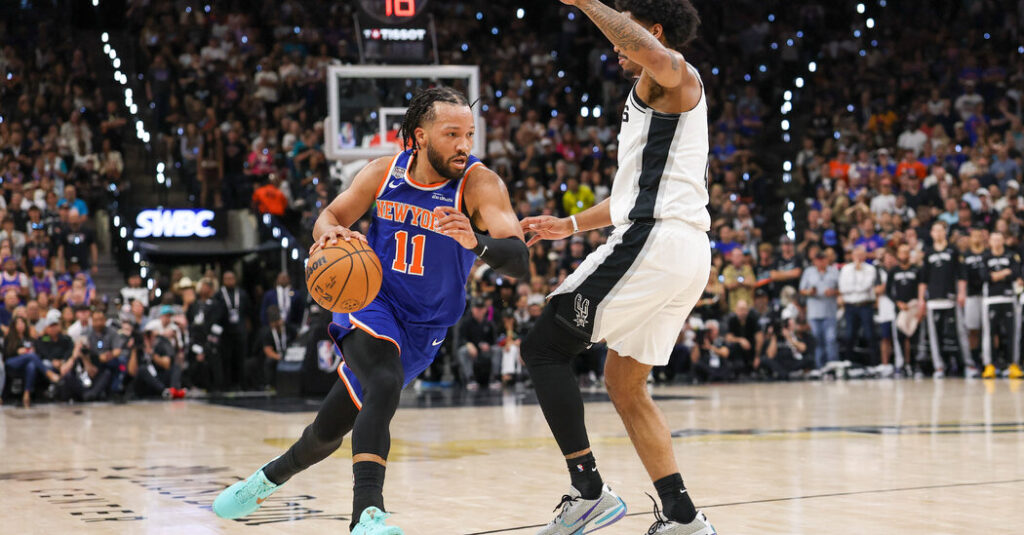
Fifty-three years after the Knicks’ last (and second) N.B.A. title, 15 years after my book about the early 1970s Garden era encapsulated as Eden, friends naturally wondered what was on my mind as we watched Jalen Brunson and company spontaneously galvanize to defeat the San Antonio Spurs as few playoff teams have in this or any sport.
No longer reporting, was I back to boyhood rooting? Not quite, with all due respect to a most relatable group, ownership aside. Walt Frazier and the late Willis Reed were iconic figures of my youth, but readers of my New York Times columns might recall my admiration for Coach Gregg Popovich, Tim Duncan and their five-time champion Spurs.
More often during the finals, I was saddened by what Michelle was missing: how she would have loved the narrative of the Villanova Knicks, the all-in connectivity of the playoff spring, the overwhelming joy created by the one team still capable of uniting the New York metropolitan area.
As Michelle would insist, referring to the vibe-challenged Dolan, and perhaps to justify the cost of tickets that blew up her retirement budget, “It’s our team, not his.”
I found myself silently recounting to her the Knicks’ renaissance of recent years — the signing of Brunson, Rose’s piece-by-piece assembly of what became the championship puzzle.
This was the team she had been wishing for, waiting for, much like the early ’70s group she had followed from her living-room sofa. As Michelle was a proud Knicks historian, franchise shorthand would have sufficed while explaining how OG Anunoby, following his December 2023 trade to New York from Toronto, became Dave DeBusschere, fitting this Knicks team in the exact way that DeBusschere completed the 1969-70 championship lineup after being acquired from Detroit.
She would have loved how the core four — Brunson, Anunoby, Karl-Anthony Towns, Josh Hart — eschewed the standard look-at-me grandstanding of the modern game, in the image of their championship ancestry. These are players who clearly put in the work despite their guaranteed riches.
She was far from the only departed Knicks longtime loyalist. Cal Ramsey, a relished friend of the Knicks family who died in 2019, comes to mind. So do Fred Klein, the former Carnegie Deli owner, and his ref-baiting buddy from under the basket, Stan Asofsky. They all dated back to the 1960s. Michelle’s regular attendance began in 1974, or one season too late.
For those of us — fan or journalist — who arrived in the post-titles era, the 1990s represented peak attendance years, championship-less though they were. Michelle was awed by the coaching luminescence of Pat Riley. She adored the tenacity of Charles Oakley. She admired the Hall of Fame skill and steadfastness of Patrick Ewing.
She was also a realist, one who maintained that leading by an exemplary work ethic, as was Ewing’s M.O., was not full-fledged leadership.
When the Knicks headed to Houston for Games 6 and 7 of the 1994 finals, she hastily booked a flight and scored tickets from her Garden contacts, insisting that they were not to win a title without her in the building. She wasn’t bitter when they lost Game 7 — only bewildered by how Ewing, even more than Riley, allowed John Starks to shoot (2 for 18) the Knicks’ chances to death.
In the parlance of N.B.A. superstardom, that was Ewing’s team, his time. As we shared a nightcap after I filed my column, Michelle wondered if Ewing had grabbed Starks by the jersey at any point and demanded the ball. Sitting on the baseline adjacent to the Knicks bench, I had not seen that. “He should have,” she said.
Why would coaches and teammates intrinsically trust a player for a game’s most crucial possessions, even on substandard shooting nights? Because you can almost see the caption over that player’s head flashing red: I am not afraid.
Brunson thus had license to grab Games 1 and 2 of the finals by the throat, on the road, based on precedent, not earlier game performance. Those closeouts — arguably the best examples of a Knicks captain’s leadership since Reed hobbled onto the court for Game 7 in 1970 — laid the foundation for the all-time classic that was the fourth quarter of Game 4 this year.
How would I explain to Michelle the extraordinary finish that assured that Anunoby’s jersey would someday be raised to the Garden’s rafters? With just this: His chasedown block of De’Aaron Fox’s ill-timed layup happened right in front of where she would have been sitting.
It was the unexpected, the underdog’s ascension — including the Jeremy Lin phenomenon, brief as it was — that she most loved. In that vein, no one forecast this version of Brunson — not when the Knicks signed him in 2022, and certainly not when he was drafted in the second round, with the 33rd overall pick, in 2018.
On that very June night, I visited Michelle in the hospital. She was weak, on morphine, with only days left to live. Still, she demanded that the TV go on when I casually mentioned that the draft was soon to begin. Propped up in bed, she watched intently as the parade of newly minted millionaires proceeded. Given her condition, it was no wonder that she lost interest after the Knicks, picking ninth, chose Kevin Knox, a forward from Kentucky. She was asleep by the time Brunson was chosen, and I had said my last goodbye.
If eight years is a long time to wish a loved one could have hung on for something she truly would have loved, I was far from alone.
Towns, who lost his mother in 2020, shared poignant postgame conviction that she was watching over him. Roberta Cohen, Asofsky’s wife, texted me that, if there is an afterlife, it hopefully comes with a streaming service. Gale Kennedy, Willis’s widow, told Ian O’Connor of The Athletic after Game 4, “I just wish Willis was here to see it.”
After Brunson had sealed the deal and secured his finals most valuable player trophy with 45 points and the kind of closeout we routinely anticipated from the immortals of the game, the reflective texts filled my phone’s screen — from Wynn Plaut, who subsidized Michelle in her last couple of years so she wouldn’t lose her prize seats; her daughter Blair Musler from the West Coast.
Understand how impossibly high emotions were at the Garden, all around New York, from one generation to another, as the finals played out at the intersection of remarkable historical achievement and the liberating conclusion of a 53-year drought. One needn’t be a Knicks fan — only one of the City Game — to know how very much this team, this title, meant to those who are, or would have meant to those who were.
The post She Didn’t Live to See the Knicks Championship. She Would Have Loved It. appeared first on New York Times.