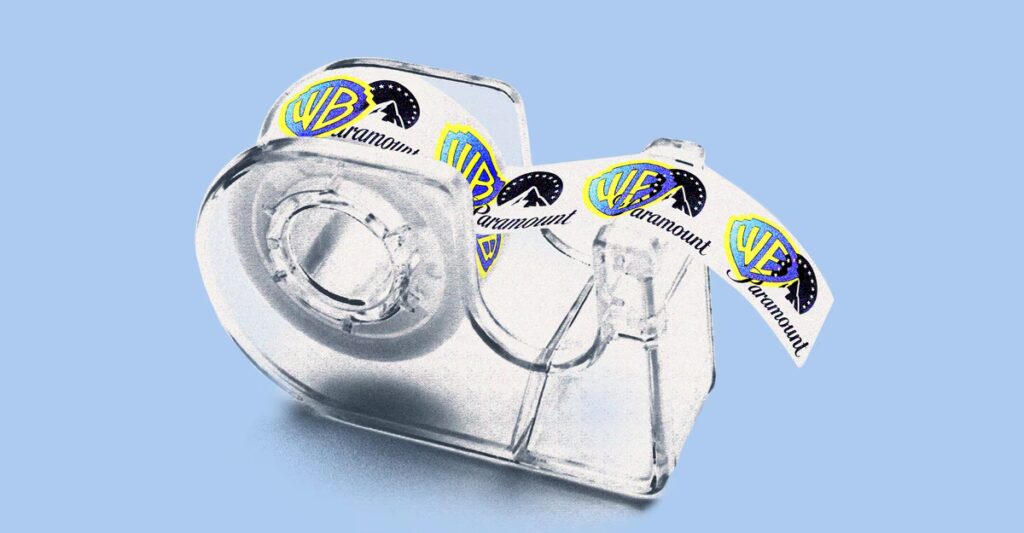
In the fall of 1929, the Paramount Famous Lasky Corporation, then the most successful film company in America, seemed poised to buy Warner Brothers Pictures Inc. The latter was smaller and newer, but it had already become a lucrative commodity, having recently bought Vitagraph, an even tinier studio that operated cutting-edge sound technology. But in October came the stock-market crash, and with it a world of potential complication; among other hurdles, the executives involved were left waiting around for the Federal Trade Commission to approve the deal. “The merger is definitely off,” Albert Warner, a co-founder of Warner Bros., said at the time, “and will not be resumed again.”
Almost a century later, the companies now known as Paramount Skydance and Warner Bros. Discovery are engaged in yet another potential merger. But unlike in the 1920s, when consolidations swept Hollywood during a boom in production, the companies today appear to be treating the move as something of a last resort—a consequence of an uncertain decade marked by the coronavirus pandemic, multiple industry strikes, a drop in casual theatergoing, and the looming threat of AI. The business is “collapsing,” Jonathan Kuntz, a film historian, told me. “The classic Hollywood model of making high-quality feature films that show around the world in movie houses—that model is definitely in a decline.”
Yet the possible consequences of the merger remain just as murky. About three months ago, Netflix seemed poised to purchase Warner Bros. Discovery but then withdrew its offer. Now regulatory concerns regarding investments in the Paramount–Warner Bros. merger by three sovereign wealth funds, and worries about the transaction’s potentially monopolistic size, could lead to lawsuits that might block the merger entirely. (California Attorney General Rob Bonta has said that his state’s Department of Justice will be “vigorous” in its review of the companies’ plans.) I asked Kuntz to help put the pending deal into perspective, given Hollywood’s history of corporate consolidation: The merger could hasten the death of the broader industry’s largest studios, or it could keep the studios alive long enough that they can figure out how to sustain themselves on a smaller scale. But neither option, Kuntz explained, seems likely to resolve Hollywood’s dilemmas. “Merger or no merger,” he said, “Hollywood is still in trouble.”
Kuntz and I had two conversations on the topic earlier this month, prior to Friday’s news that the Justice Department has approved the deal. After the first conversation, a crash course on Hollywood’s history of mergers, we spoke more deeply about how that history informs the industry’s present. Below is our second discussion, which has been edited and condensed for clarity.
Shirley Li: As I understand it, the history of Hollywood is one of vertically integrated mergers, in which a movie studio swallows up companies that allow it to make and distribute films on its own. Metro-Goldwyn-Mayer was a combination of three entities and the Loews movie-theater chain. Universal was born from six smaller film companies. Paramount’s takeover of Warner Bros. would be the latest corporate smoothie. Why did vertical integration become the bread and butter of Hollywood business?
Jonathan Kuntz: It’s tricky to make movies in quantity. Many of the early film companies were exhibitors—people who owned theaters, who needed product—so vertical integration was effective. It allowed companies to grow.
Everybody in the 1920s moved in that direction, with one notable exception: United Artists, which was formed by Charlie Chaplin, Mary Pickford, and other key independent people in Hollywood to resist vertical integration. They lobbied the federal government to put pressure on Hollywood from an antitrust perspective to reduce vertical integration.
Li: Do you see any similarities between what was going on then and what’s going on now with the possible Paramount and Warner Bros. merger? More than 4,000 Hollywood creatives signed an open letter condemning the pending deal; both of the studios are in deep trouble financially without any guarantee of a profitable future after they combine; and there’ve been weeks of talk that several states will file a potential lawsuit to block the acquisition on antitrust grounds. There seems to be a constant battle over how much Hollywood can consolidate.
[Read: Hollywood can’t survive without movie theaters]
Kuntz: The relationship between the big companies of Hollywood and the federal government, particularly as it relates to antitrust laws, is an ongoing thing that they’ve been working at for 110 years now—and as long as there’s a Hollywood, there’ll probably be people working on it. The thing is, Hollywood has to survive financially, and there have been periods when it’s been obvious that certain kinds of integration are economical for Hollywood to survive. Film companies have had enormous success—the 1920s, the ’40s, the ’80s, even the 20-aughts and teens—but they’ve also had some near-death experiences, like in the ’30s, some would argue the 1960s, and maybe today.
The fact that there will always be a Hollywood is definitely not a settled issue. We’re clearly undergoing a transformation, and that age of Hollywood that has lasted maybe 110 years is fading. There are a lot of other factors: Netflix and the streamers is one thing, and also just the fragmentation of the marketplace with TikTok and YouTube. The question is, will Hollywood be able to reformulate itself and maybe become more of a boutique industry rather than the dominant form of mass entertainment?
Li: Let’s talk more about the 1960s arguably being a near-death experience for Hollywood. When we last spoke, you told me about how, during that time, a lot of companies without any ties to show business made moves to take over Hollywood: There was Gulf and Western, a maker of auto parts, buying Paramount; Transamerica, an insurance company, acquiring United Artists; and Kinney National Service, which ran funeral homes, purchasing Warner Bros. Why was Hollywood shrinking then, and how does that period of transformation compare with today’s?
Kuntz: The box office started falling off in the late 1940s and bottomed out in the ’60s and early ’70s. People were staying home and watching television. That’s like today—you know, people are not going to the box office and buying tickets, because they’re watching a YouTube video. So Hollywood has gone through this before, where they begin to lose the mass audience. And in the 1960s, the conglomerates were able to march in.
Li: What did that time period teach Hollywood? How did the industry survive?
Kuntz: Samuel Goldwyn by legend used to say, “There are no problems in this business good pictures can’t solve,” so maybe that’s a little bit of what we’re seeing. Starting in the ’70s, new, fresh, young filmmakers closer to the target audience in age—Francis Ford Coppola, Steven Spielberg, George Lucas, Martin Scorsese, and so on—came in, and a whole new generation of filmmakers and the films themselves helped revitalize Hollywood.
There’s also the idea that Hollywood finally, after being very stodgy, began to change its marketing and advertising policies. Hollywood in the 1970s embraced the television commercial. Combine their move to the wide release—to putting movies in a lot of theaters instead of a first-run exclusive at top prices—with airing 10 commercials for a movie the night before release, and you’re going to darn well come out and see the movie.
[Read: What Spielberg, Lucas, and Coppola got right]
Li: So, in short, the turnaround happened because of fresh creative blood and fresh marketing tactics?
Kuntz: Yes, but also, we can say that from the mid-’70s onward, Hollywood saw a slew of new ancillary markets arrive that they could milk. This is when pay cable comes in, when home video starts kicking in, not to mention the expansion of merchandising and music tie-ins.
Li: What can today’s Hollywood take advantage of, then? Aren’t there new revenue streams to be found in influencers and social-media platforms—TikToks, Reels?
Kuntz: The other alternative is to say, “Okay, we’ve lost a mass audience, but we’re going to make our sphere-like IMAX theaters such an enveloping experience—maybe like a Disneyland ride, almost—that we’re going to be able to charge you $50 a ticket.”
Li: The debates about this potential merger have included a political component, given how Warner Bros. owns CNN, an outlet that President Donald Trump considers antagonistic, and the fact that Paramount’s CEO, David Ellison, has reportedly promised Trump that he will revamp the network. There’s precedent for this: After buying CBS as part of the Paramount-Skydance merger last year, which was funded in part by Trump’s allies, Ellison overhauled the news division’s leadership, resulting in coverage that’s viewed by many as being more favorable to the Trump administration. How does this moment compare with previous times when politics has seemed to play a role in Hollywood’s dealmaking?
Kuntz: Politics has been involved in Hollywood since the earliest days, but at the corporate level, it’s been mainly about dealing with federal regulation. In general, Hollywood is going to want political figures who do less regulation rather than more, because they want to do their thing.
Right now, the political thing is kind of weird, because the question to me is more: What does it do for the people in Hollywood, for keeping their employment and the industry going? I don’t think it’s very clear that the Paramount takeover or the Netflix takeover is preferable or not preferable. I’m worried that we’re going to see Paramount and Warner go the way of RKO and other classic studios. Look at Fox. The Disney takeover really swallowed Fox.
[Read: CBS and CNN are being sacrificed to Trump]
Li: Are the reactions to Paramount’s interest in Warner Bros. more dramatic than we’ve seen in past situations?
Kuntz: The objections today are especially loud, maybe because Hollywood is in such a dire state right now. No one’s sure about anything. It’s not like we’re waiting for, you know, a whole bunch of great movies to come out.
Li: Oh, I don’t know about that. This summer, Universal will release Christopher Nolan’s The Odyssey and Steven Spielberg’s Disclosure Day. You mentioned IMAX earlier. The company has apparently been one of the winners emerging from this troubled time for the industry; it’s up for sale and attracting a long list of potential suitors already. Which leads me to wonder: Could there be any solution to Hollywood’s troubles that wouldn’t involve mixing and matching companies?
Kuntz: Oh, geez, that’s the $64 billion question. We’re in an era of such rapid change. Just think, 10 years ago, we were watching an Avengers movie and Hollywood was setting box-office records; Netflix was an annoyance but it wasn’t going to take over the universe; and the idea that people would be satisfied watching 45-second videos on TikTok was not something that we would have really thought was real. But it has happened.
Li: There are many possible scenarios, clearly, but what would you say is the doomsday outcome to all this?
Kuntz: Maybe, in a weird way—maybe sadder or maybe greater, some would say—we won’t have a world culture in the same way. We won’t have everybody in the world out there seeing some movie as we have with Top Gun. Probably people in every country in the world have seen Top Gun. Maybe in 10 or 15 years, we won’t have that kind of world culture. It will be much more fragmented.
[Read: No one knows how to ‘save’ Hollywood]
Li: We’ve discussed why mergers built Hollywood, but the more studios consolidate, the fewer places filmmakers can go to find a buyer for their work, whether it’s just a pitch or a completed script. At a moment when the industry needs to cultivate more talent that would revitalize the business, what makes for a successful merger?
Kuntz: The question here is “How do we stop the bleeding?” more than anything else—or at least slow it down a little bit? Because I don’t know if anybody has a vision for how we’re going to restore classic Hollywood or classic Paramount or classic Warner Bros. Can we keep them on life support for a few more years and have a little bit more fun?
Li: So in other words, anything being done now is at best a Band-Aid? The truth is that merger or no merger, like you said, the real reasons causing Hollywood to bleed are not going to be fixed.
Kuntz: I’m sorry to say I agree with exactly that, yes. I’m a doom-and-gloomer, and I feel terrible about it, because I would love Paramount and Warner, two of the all-time greats, to keep doing what they used to. They each fortunately still have their historic lots in Hollywood. They’re not just ideas, you know; Paramount’s in Hollywood, Warner is in Burbank. Casablanca was made on the Warner lot there, and the great films of Ernst Lubitsch were shot on the Paramount lot. So there is history and tradition there. I would love for the Hollywood companies to actually lean more into their tradition.
Li: Widening out from these local lots, though, why should the average person care about Hollywood’s dealmaking?
Kuntz: We have a vibrant Hollywood culture. It’s one of the great features of the United States of America, and it would be sad if we were just talking about the 20th-century Hollywood film industry as something in the distant past. The movie industry is what gave us worldwide fame. I’d like to hang on to that.
The post In Hollywood, Mergers Are Just a Band-Aid appeared first on The Atlantic.