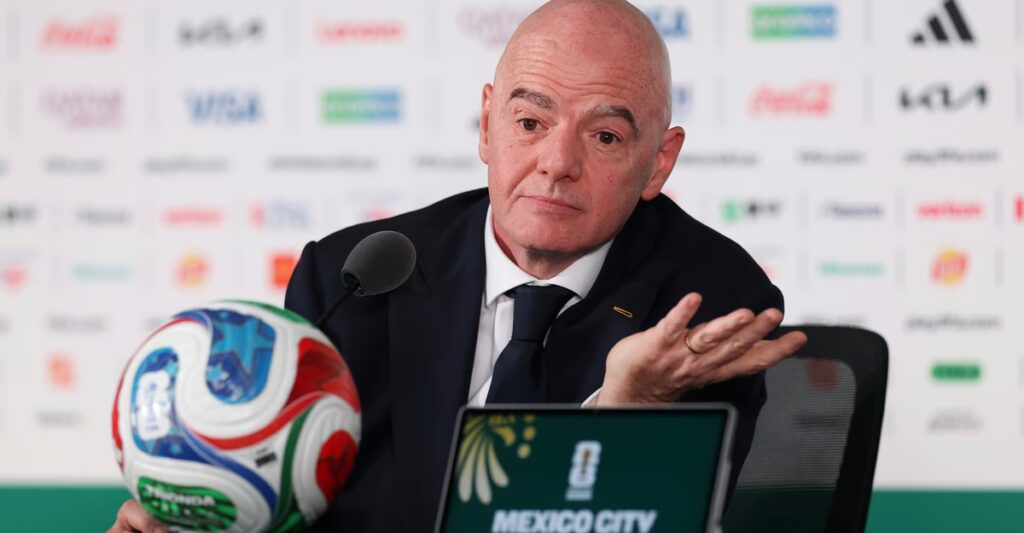
Even before the first ball of the World Cup was kicked in Mexico City on Thursday, there was one team that everyone was already rooting against. FIFA and its president, Gianni Infantino, have been widely lambasted for ticket costs this year—which are four to 10 times higher than they were for comparable matches at the 2022 World Cup in Qatar.
Initial prices for some of the cheapest games in the United States ranged from $60 for a smattering of nosebleed seats to $620 for seats closer to the field. Tickets for Friday’s U.S. opener in Los Angeles ranged from $560 to $2,735 when initially released. Critics argue that FIFA, soccer’s governing body, is gouging fans of the world’s most popular sport. The attorneys general of New York, New Jersey, California, and Texas have launched investigations into World Cup ticketing, including for allegedly misleading fans about seat locations and creating false scarcity to drive up prices.
FIFA, which maintains that legal experts have vetted its practices, should be held culpable for any misrepresentation of where ticket buyers will be sitting. But the loudest complaints have been about World Cup organizers’ use of elaborate pricing techniques to maximize revenues. Take the final at MetLife Stadium on July 19, where $2,030 was the lowest cost of entry. Thanks to dynamic pricing, which adjusts ticket costs based on demand, the “Category 1” seats, the most desirable regular seats for sale by FIFA, shot up from an initial $6,370 to $8,700, and then to $10,990 during later sales windows.
Infantino has defended the overall pricing strategy by pointing to limited supply and high demand. He has also noted that on secondary markets, including one that FIFA oversees, many tickets sell for well above face value. The implication is that the soccer organization has previously been—and may still be—charging less for tickets than the market would bear.
I, too, would like to take my family to a World Cup game without spending thousands of dollars. But as an economics professor, I see Infantino’s logic. The eye-popping prices obscure some fairly ordinary dynamics: Sellers of many products try to distinguish among different consumer groups according to their willingness to pay; early birds sometimes pay less than people who buy closer to the event, particularly when demand is stronger than sellers expect. Although aggressive pricing makes for terrible public relations, under-pricing creates different problems: ticket shortages, financial incentives for speculators to buy up seats en masse and resell them to real fans at huge markups, the diversion of revenue to third parties who contribute nothing to the cost of putting on events.
Since the dawn of ticketing, there have been speculators searching for profit by inserting themselves between performers and their fans. In 1868, tickets for a reading by Charles Dickens of A Christmas Carol at Steinway Hall in New York City were initially sold for $2 each but were promptly resold for $20 each in advance of the performance.
For more than a century afterward, speculators would elbow into box-office lines or pay people to stand in line for them. They were also known to bribe box-office clerks for access to desirable seats, paying what was colloquially called “ice.” According to a persistent rumor recorded in a 1999 report by the New York attorney general’s office, the box office for the Broadway hit Phantom of the Opera made more money in bribes from speculators than the producers earned in actual profits from the show.
The advent of online ticket platforms and computerized ticket-buying algorithms empowered speculators still more. Shortly after the musical Hamilton premiered in 2015, the average ticket price was $159 at the box office but climbed to $1,200 on the secondary market within the first year. The Hamilton producer Jeffrey Seller said at the time that as much as 78 percent of the tickets early in the run were initially purchased by speculators using bots.
On her 2023–24 Eras Tour, Taylor Swift offered some seats at a face value of $49; the average ticket price across the whole tour was $204. Meanwhile, the average price for an Eras Tour ticket on StubHub was more than five times that, at $1,088 each. If just 20 percent of Swift tickets were resold—that would be on the low end of the typical range—gross revenues in the secondary market would exceed the roughly $2 billion that Swift collected at the box office.
When artists underprice their tickets, they’re presumably not doing so for scalpers’ benefit. “My product is being resold at many times its face value and my team isn’t sharing in those profits,” Seller said in 2016. “It’s not fair.”
As corrupt as FIFA might be, it is still a nonprofit that organizes a quadrennial tournament that billions of fans love. Wouldn’t most fans prefer that extra ticket revenue flow to FIFA rather than to speculators who added nothing to the production of the World Cup? I would.
But what if we don’t want to be fleeced by speculators or face aggressive price discrimination from a monopolistic ticket seller such as FIFA? There is a third option, but it involves some annoyances for ticket buyers—and in some jurisdictions would require legal changes.
If sports leagues and performing artists want to hold down prices for actual fans without enriching ticket speculators, they need the ability to issue discounted tickets that can’t be resold. Live-events tickets would become more like airline tickets—contracts that offer the right to sit in a seat for a few hours but can’t be transferred for a profit. If a named attendee cannot attend, the ticket might have to be returned to the venue. On the way into the stadium, fans would need to prove they are ticket holders, perhaps by showing IDs or submitting to facial-recognition scans—precautions that might lead to longer lines.
[Henry Grabar: The unhappy hosts of the World Cup]
This approach isn’t possible everywhere. A handful of states have laws that, to varying degrees, treat live-event tickets as a property right that can be freely resold on a secondary market. Not coincidentally, ticket resellers and the platforms on which they operate strongly back these laws.
But fans have demonstrated a willingness to accept significant hassles for a ticket substantially cheaper than what’s available from a ticket broker. Fans who enter the “Ham4Ham” lottery for $10 Hamilton tickets, or New York City’s lottery for $50 World Cup tickets, have been ecstatic to win, even though the tickets come with major restrictions designed to prevent resale, including ID checks.
The very need for lotteries, of course, speaks to another obstacle: When tickets are discounted well below what the market will bear, the number of people who want them will far outstrip the number of seats. Performers, sports leagues, and other live-event organizers need a way to choose among the many fans who would want these affordable seats. Given their own costs, they will likely need to sell seats at market-rate prices as well.
Empty seats at some early games have fueled claims that FIFA is charging too much, but a pricing strategy that maximizes profits rather than total attendance may leave tickets unsold. In the end, no one should be surprised that FIFA wants to keep the proceeds from World Cup tickets for itself. But ticket buyers are feeling the pinch, and they deserve at least some alternatives that put devoted fans first.
The post The Unpopular Truth About World Cup Ticket Prices appeared first on The Atlantic.