The D.C. Council voted Tuesday to extend an expanded juvenile curfew policy until April, buying legislators time to decide whether they want to adopt the stricter curfews on a permanent basis.
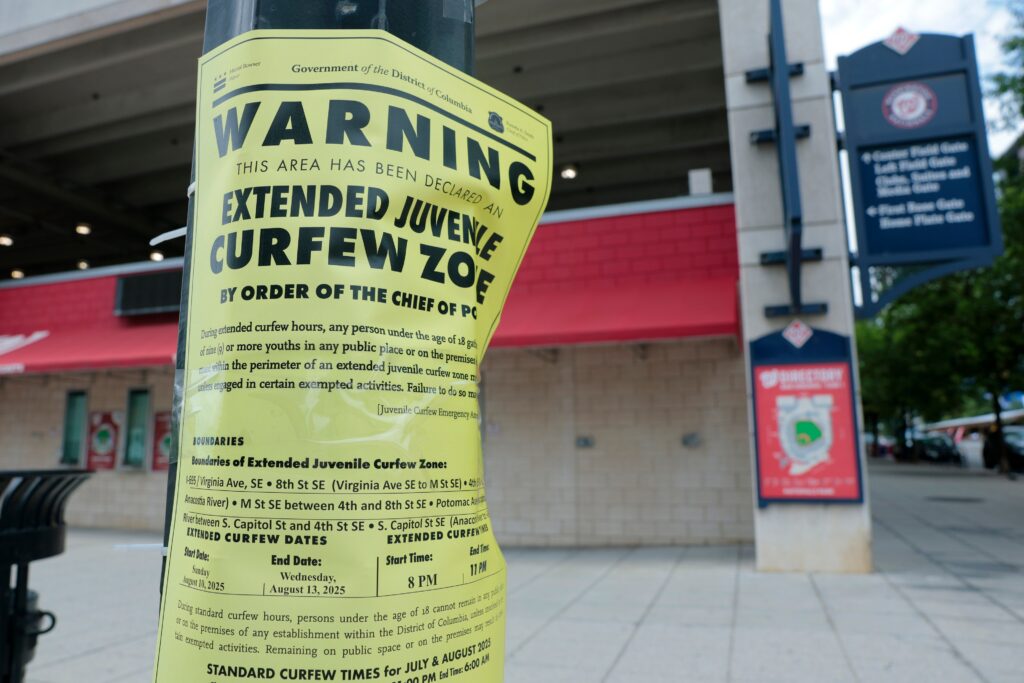
The policy allows the police chief to declare special extended curfew zones where young people, age 17 and under, are banned from gathering after 8 p.m. in groups of more than eight.
It also adjusted the youth curfew law that had been on the books for decades by instituting a curfew for children age 17 and younger from 11 p.m. to 6 a.m. daily. Previously, the law did not apply to 17-year-olds and included a later curfew of midnight on weekends.
A version of the expanded curfew initially went into effect over the summer. It was the mayor, police chief and council’s collective response to several incidents in the spring where large groups of young people gathered and wreaked havoc in busy commercial parts of the city, such as Navy Yard and U Street. The events, which some teens call “takeovers,” sometimes ended in violence.
The curfew policy has been in effect since, save for a gap of several weeks in October when the council opted not to extend it. D.C. Mayor Muriel E. Bowser (D) blamed lawmakers for several large teen gatherings that occurred during the gap, including one in Navy Yard that involved hundreds of teens and led to 10 arrests. Lawmakers rejected the assertion that the uptick in youth gatherings was their fault but reinstated the curfew on an emergency basisshortly afterward.
While the council has tussled over the curfew in the past — with some council members concerned the policy was not evidence-based and would invite over-policing of youth — the extension passed Tuesday with little discussion. Three lawmakers — Robert C. White Jr. (D-At Large), Brianne K. Nadeau (D-Ward 1) and Janeese Lewis George (D-Ward 4) — voted against it. The curfew law will expire April 15.
The extended curfew zones can remain in effect for four days at a time unless extended by the mayor or police chief, who each have the authority to stretch them to 30 days. D.C. Police Chief Pamela A. Smith has used the policy in recent weeks, announcing juvenile curfew zones in Navy Yard and U Street for the past two weekends. During the first weekend of November, she put curfew zones in effect around Banneker Recreation Center and Union Station, in addition to Navy Yard and U Street.
Feedback on the curfew has been mixed. In a council hearing last month, several young people and youth advocacy organizations urged the council to work on providing young people with more safe places to have fun. D.C. Council member Brooke Pinto (D-Ward 2), who chairs the council’s public safety committee, reiterated Tuesday that she had heard the message. She introduced a slate of bills last month that aim to provide young people with more safe spaces and cash in their pockets — including bills that would create an app to connect teens to part-time jobs and establish teen centers in each quadrant of the city.
“Yes, we need to authorize the chief to have this preventative enforcement tool,” Pinto said. “But we also need to move forward these other interventions.”
Also Tuesday, the council debated whether the District’s Board of Elections was adequately prepared to implement ranked-choice voting in time for the June 2026 primary election. A year ago, D.C. residents passed a ballot initiative to adopt the voting method, which allows voters to rank candidates in their order of preference.
BOE Executive Director Monica Evans said in a council hearing last week that the board would make it happen in time, though the size of the voter outreach campaign could depend on resources.
Council member Wendell Felder (D-Ward 7), an opponent of ranked-choice voting, put forth an emergency bill to require the board to conduct a needs assessment, which would delay implementation until the evaluation is complete. He withdrew the legislation amid uncertainty about its fiscal impact, but said he intends to “put in the work” to move it forward at a later meeting.
“My opinion holds firm in that I do not feel confident the DC BOE is ready for a responsible and successful implementation of RCV in June 2026,” he said in a statement.
Meagan Flynn contributed to this report.
The post D.C. Council extends stricter youth curfew through April appeared first on Washington Post.