Sonny Rollins died at 95 on Memorial Day. He was New York City born and bred, raised in Harlem, where W.E.B. Du Bois was his neighbor, and later lived on the Lower East Side. Along with fellow jazz giants like Max Roach, Abbey Lincoln and Charles Mingus, Mr. Rollins was a leader in the fight for Black empowerment in the 1950s. By 1959, Mr. Rollins, not yet 30 years old, was a renowned tenor saxophonist and composer.
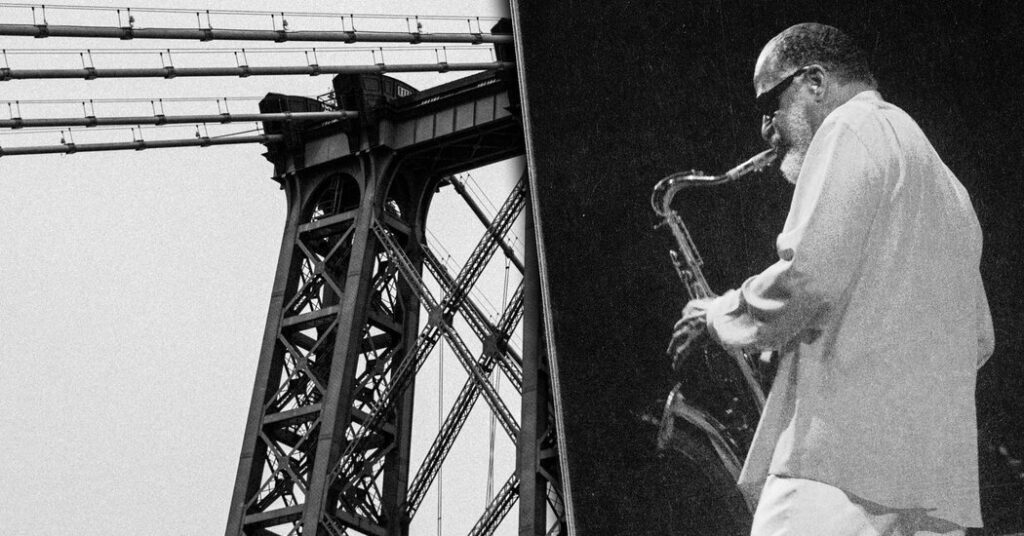
Yet Mr. Rollins remained dissatisfied with his musical voice. So he did the most unexpected thing. From the summer of 1959 to the autumn of 1961, he retired from public performance and spent upward of 15 hours a day practicing on the Williamsburg Bridge’s pedestrian walkway.
He made the bridge his musical mountaintop. He was living by then in an apartment he shared with his wife, Lucille, on Grand Street on the Lower East Side, a short walk away. Initially, he made this trek out of consideration for a neighbor who was pregnant and needed her rest. But he found unexpected rewards competing with the roar of the trains rolling by. “It was so wonderful to be so close to the sky up there, any time of year. Maybe this might sound a little bit corny to people, but it was a spiritual feeling to me,” Mr. Rollins told The Guardian in 2022.
There could be no more fitting tribute than to rename the Williamsburg Bridge the Sonny Rollins Williamsburg Bridge in his honor. If we can name a bridge for Ed Koch or a tunnel for Hugh L. Carey, we can certainly name a bridge after Sonny Rollins.
As a saxophonist, I can tell you that although playing on a bridge may sound romantic, there is nothing harder than practicing outside. You are sonically naked, with no acoustic resonance to egg you on (there’s a reason many horn players practice in tunnels), and you have to compete with the sounds of the city and with the wind that’s constantly stealing your voice.
Mr. Rollins was undaunted. The setting allowed him to confront himself in a search for musical transformation, without worries of what an audience might think.
When he returned to public performance in the fall of 1961, his sound and approach had changed profoundly. For those who know, Mr. Rollins’s time on the Williamsburg Bridge has become a metaphor for artists of all genres and disciplines seeking their inner voice.
Over his career, Mr. Rollins achieved not only a musical transformation but a personal evolution, as he went from being a gifted but selfish young musician to a true citizen of the world — a journey well documented in the biography “Saxophone Colossus” by Aidan Levy. Naming the bridge in his honor would send an inspiring message for seekers of all disciplines, from all over the world, and would serve as an affirmation of something Mr. Rollins firmly believed: What is most special about humanity is the questions we ask.
An effort to rename the bridge for him began in 2017, led by the writer and jazz historian Jeff Caltabiano. But the movement stalled and was perhaps premature. A petition established to rename the bridge has drawn more than 20,000 signatures, though any renaming effort would ultimately require legislation passed by the City Council. Such honors are generally reserved for the deceased.
Mr. Rollins himself, while tickled by this homage, always seemed more interested in the work ahead than in an act of public recognition. Now that he has died, however, the case becomes undeniable. New York should honor one of its greatest artists by permanently linking his name to the structure that, thanks to him, stands as a potent symbol of artistic self-discovery.
Throughout his life, Mr. Rollins came to understand the connection between his personal search for creative excellence and the larger human search for meaning. As he wrote in The Times, “Technology is no savior. We can eat, sleep, look at screens, make money — all aspects of our physical existence — but that doesn’t mean anything. Art is the exact opposite. It’s infinite, and without it, the world wouldn’t exist as it does. It represents the immaterial soul: intuition, that which we feel in our hearts. Art matters today more than ever because it outlives the contentious political veneer that is cast over everything.”
Let the Sonny Rollins Bridge tell this story to our schoolchildren. Let it inspire all the visitors who flock to New York as the country’s cultural capital. The precedents are there: New Orleans named an airport after Louis Armstrong, and in Warsaw the airport is named for Frédéric Chopin. There’s a bridge in Pittsburgh named for Andy Warhol and one in Georgia for Otis Redding. Sonny Rollins would stand easily among them.
After his two years of practicing outdoors on the bridge, in 1962 Mr. Rollins released a landmark album. It is titled, appropriately, “The Bridge.” New York now needs to return the favor and rename the bridge for him.
Source photographs by Vincent Tullo for The New York Times and David Redfern/Redferns, via Getty Images.
Ned Rothenberg is a composer and performer who plays saxophone, clarinet and the shakuhachi flute. He teaches in the school of jazz and contemporary composition at the New School.
The Times is committed to publishing a diversity of letters to the editor. We’d like to hear what you think about this or any of our articles. Here are some tips. And here’s our email: [email protected].
Follow the New York Times Opinion section on Facebook, Instagram, TikTok, Bluesky, WhatsApp and Threads.
The post Sonny Rollins Changed New York. There’s a Fitting Way to Honor Him. appeared first on New York Times.