The state of California is walking back protections meant to keep destructive golden mussels out of Lake Oroville, one of the largest and most important reservoirs in the state.
The move follows a new state-funded risk assessment that the invasive species poses a lower risk to the lake, which water managers say changes the state’s calculus on costly and difficult measures aimed at keeping the invaders at bay.
No state agencies or scientists have found mussels in Oroville yet. But invasive species experts say the revised policy by the Department of Water Resources increases the likelihood that golden mussels will invade Lake Oroville and hitch a ride on boats to other lakes. They disagree, though, about whether preventing such an incursion is even possible.
“California is under an epidemic of golden mussels,” said Anthony Ricciardi, a professor of biology and the director of the Bieler School of Environment at McGill University in Montreal. “Like in any epidemic, you got to control the key hubs — or else the war is lost.”
Reopening Lake Oroville California water managers first discovered golden mussels invading California’s Sacramento-San Joaquin River Delta in October 2024 — marking their first detection in North America.
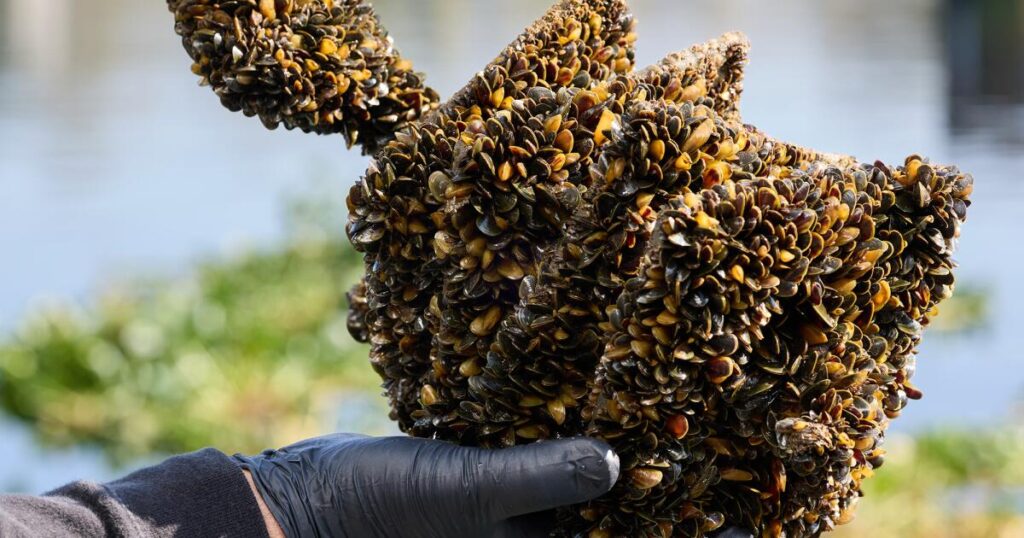
The voracious and rapidly spreading mussels can encrust surfaces so thoroughly that they choke off water supplies and damage dams and power plants.
They are now invading critical infrastructure in the Delta. And the very pumps, canals and aqueducts that keep water flowing to much of the state are funneling the larvae to irrigation districts and water suppliers downstream.
San Joaquin and Kern Counties have declared states of emergency, and officials are updating key facilities along the state’s nature-defying water delivery system to reduce mussel damage.
With summer weather heating up, state water managers said that they are ending a program to prevent mussels and their larvae from stowing away on boats and invading Lake Oroville, one of California’s largest reservoirs.
The department now no longer requires inspections and decontamination for boats launching at Lake Oroville and nearby reservoirs — the Thermalito Forebay and the Thermalito Afterbay.
The Department of Water Resources says lakes and launches upstream in the Feather River watershed didn’t take similar precautions, raising the risk that golden mussel larvae would wash into the reservoir on river flows regardless of the boat inspections.
The cost of the inspection program for the lake was also around $7.5 million to start it up, and $6.5 million per year to continue it. Installing UV treatment to prevent mussels from settling in the pipes at powerplants downstream from Oroville, by contrast, would cost an estimated $1 million.
“We severely impacted recreation at that lake,” said Tanya Veldhuizen, special projects section manager in the California Department of Water Resources’ environmental assessment branch. “We also evaluated the risk to our infrastructure and what it would take to mitigate mussels — and that was much lower than expected.”
Cold water, fewer mussels?
The decision reflects the findings from a new risk analysis the department commissioned for these reservoirs and related hydropower and fishery hatchery facilities, as well as for the Upper Feather River Lakes.
Conducted by a Canada-based consulting firm specializing in aquatic invasive species, the assessment reports that, while surface temperatures are warm enough for the mussels to survive in shallower water at Lake Oroville, they’re too cold farther down for the mussels to reproduce at depths greater than 60 feet below the surface.
Unlike the Delta, the waters at Lake Oroville are also low in nutrients, Veldhuizen said. Between the scarce food, cold temperatures and water levels that drop enough to dry out mussels on the shoreline, Veldhuizen said she doesn’t expect the mussels to reach nuisance levels.
The department also expects that cold water released from the reservoir will slow the growth of any larvae that reach the Feather River Fish Hatchery and the Oroville-Thermalito Complex power plants downstream.
But Oroville’s shoreline, boats and docks remain at risk — and those are what worries Ricciardi.
“That’s where the action is. The boats will be moving them,” Ricciardi said — because boats and aquatic weeds clinging to vessels and their trailers can ferry mussels from one lake to another.
And adult mussels can actually survive even in extremely cold water, says Demetrio Boltovskoy, a retired researcher formerly at Argentina’s National Scientific and Technical Research Council. One study in China found that they can live for weeks at near-freezing temperatures.
Still, Boltovskoy said that while he isn’t specifically familiar with Lake Oroville, reducing precautions may be reasonable.
“No matter what precautionary measures you take, sooner or later it will spread,” he said. “I don’t think that stopping their range expansion is actually feasible at all.”
But invasive species experts are sharply divided on the subject. That’s true especially in California.
Last year, the California Department of Fish and Wildlife told CalMatters that invasions delayed translated to money saved. This year, the wildlife department directed inquiries about the new Oroville strategy to the Department of Water Resources.
“There’s so much to protect yet,” Martha Volkoff, environmental program manager for the California Department of Fish and Wildlife’s invasive species program, said last summer. “Yes, it’s a lot of work, but the long-term savings — to the environment and to all the other ways that it costs us — is investment well spent, even if we just delay new introductions.”
Relying on boaters: Clean, drain, dry
The responsibility now rests more heavily with boaters to ensure their boats are clean, drained and dry — especially when leaving an infested body of water such as the Delta.
If state water managers detect mussels at Lake Oroville, Volkoff said, the department will begin inspecting boats as they leave the lake.
It’s a strategy already in use at other infested lakes, including Castaic and Pyramid. Managers of other Northern California lakes told CalMatters they will continue their inspection programs, including at lakes Folsom, Tahoe and Berryessa.
Drew Gantner, manager of water resources at Solano County Water Agency, which oversees the mussel program at Lake Berryessa, called the Oroville decision concerning.
“If Lake Oroville does surrender its program and becomes infested with golden mussels it creates an increased risk for all waterbodies,” Gantner said. “At that point, any watercraft traveling to Berryessa (or anywhere else) from Lake Oroville would essentially be no different than watercraft coming from the Delta.”
Ricciardi agreed that the stakes extend well past Oroville’s dam and downstream facilities.
“There is another thing about invasions. They often surprise you,” Ricciardi said. “Sometimes invaders don’t act the way they’re supposed to act.”
Becker writes for CalMatters.
The post California ends Lake Oroville boat inspections meant to block destructive mussels appeared first on Los Angeles Times.