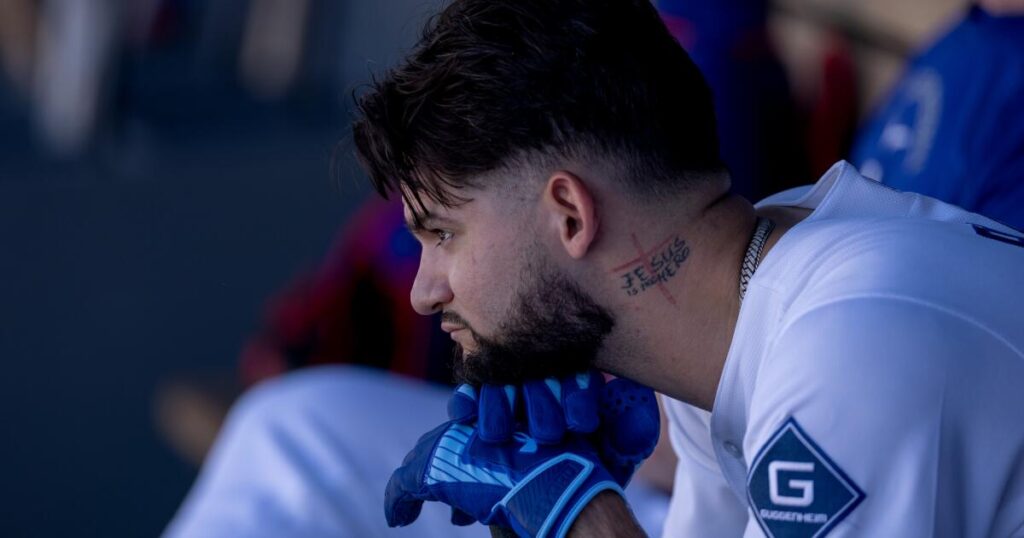
As he drives home from Dodger Stadium, Andy Pages, an immigrant in a city of immigrants, runs through questions to ask his family in Cuba. How is Mantua, a town of 23,000 people tucked in the northwesternmost part of the island? Is the power on? Is everyone safe?
Sometimes, the WhatsApp messages Pages sends his family read as delivered. The hardest days are when the messages don’t deliver, and his phone calls go straight to voicemail, he said. Somewhere in the back of his head, a voice whispers: Something must have happened.
Unlike his teammates — both American and those on visas — Pages is distinctly cut off in the United States, where he lives with his wife, Alondra, but is separated from his parents and sister in Mantua. The third-year Dodgers center fielder is making $800,000 this year but can’t spend his money on flights home or on bringing his family to the country where he plays baseball. The tense relations between the U.S. and Cuba — the Trump administration has imposed economic sanctions and made diplomatic threats — don’t allow for that.
So as the phone dials, Pages is put through the agony of not knowing, hoping he doesn’t have to experience the hell of something bad happening.
“I haven’t found any way that gives me that tranquility and peace,” he told The Times in Spanish two weeks ago. “Because the way things are there, what’s always on your mind is that it could happen. Anything, anytime. And I have all my family in Cuba. So, you have to live with that worry all the time.”
Pages — one of 34 Cuban players in MLB — is a quiet, private person. He doesn’t dwell for long in the good or the bad. Keeping his thoughts from drifting too much, even about Cuba, has propelled his career forward.
When he was younger, he didn’t think much about being a baseball player in the United States or leaving the island. He just wanted to be the best, like his childhood hero, two-time World Series winner Yuli Gurriel.
“As I grew up, I was able to understand the big leagues,” said Pages, at 25 a two-time World Series champion and the youngest player from Cuba to achieve that feat. “I realized it was the best baseball in the world. I had it in my mind to reach this level.”
Pages’ journey to the U.S. was not unique among Cuban players. But, in U.S.-Cuban relations, there’s never been a greater moment of escalation in Pages’ life. He was born nearly a decade after the end of the Cold War, and tensions eased under the Obama administration. Pages remembers this time in Mantua with a smile, one of the few times he isn’t serious.
“It’s a pretty cheerful place where everyone tries to help each other, and where people like to spend time together,” he said. “They have wonderful scenery that anyone who visits can enjoy. And yes, I would say that people are always happy there, spending time together and lots of parties, lots of music.”
Nowadays, Pages sees Cuba through the eyes of others: the television packages about the U.S. government’s sanctions, the fuel restrictions that cause blackouts, and the brief glimpses of Cuba his family sends him.
The two countries’ foreign relations over more than a century have been complicated, oscillating between a hesitant neutrality and saber-rattling. But ever since the United States captured Venezuelan president Nicolás Maduro in January on charges related to narco-terrorism and drug trafficking, the officials in President Trump’s administration, including Secretary of State Marco Rubio, declared the Cuban government is “in a lot of trouble.”
In late January, Trump signed an executive order imposing tariffs on countries that sell or supply Cuba with oil, causing hospitals to suspend noncritical surgeries and rampant blackouts on the island. In recent weeks, a federal grand jury in Miami indicted former Cuban president Raúl Castro,95, on charges related to a 1996 shooting in which a Cuban fighter jet downed two planes piloted by Cuban exiles from the U.S.
The humanitarian crisis in Cuba places players such as Pages in difficult situations.
He can’t go back and he worries about expressing his thoughts about the situation, risking becoming a liability. The pressures, both economic and personal, are familiar to the other Latin American players on the team. Some, like Teoscar Hernández, try to make life a little lighter.
“This game is, like I always said, already hard for us to be putting more pressure on ourselves, so I go around, I just try to be positive to everybody, so they can feel good going into the games,” Hernández said.
But unlike the family of Hernández, who watched his children run around the mound when the Dodgers recently honored the Dominican outfielder with a bobblehead doll, most of Pages’ family can only listen to his baseball games on the radio or through fuzzy images on the television.
No one understands that more than Dodgers infielder Miguel Rojas. A Venezuelan immigrant, Rojas said he felt a personal responsibility for Pages, who is caught between wanting to speak more about the situation and being guarded because of his budding career and the fact that he’s not yet eligible to be a free agent.
“We need to preserve our job, because this is our only way to make an income, and a lot of us are the head of the family, so we got to continue to think about it that way,” Rojas said. “I would like to be more vocal and be a little bit more present for my community, but it’s really hard because I’m performing my job, and if I stop doing this, I don’t know how to do anything else.”
The duality of Pages — the baseball player and the person off the field — was on display following a 4-3 loss to the Philadelphia Phillies on May 30, a game in which he’d doubled and scored a run. He squeezed past a huddle of media members waiting to talk to Tanner Scott, and Scott’s locker stood between Pages and the double doors that lead out of the clubhouse.
The usual bass-thumping reggaeton music was nowhere to be heard. Instead, it was quiet as the players entered, heads tucked as they quietly bid each other a good night. Pages’ black cap was pulled low, and he shuffled through, turning only to say good night in Spanish quietly.
Pages has been a breakout star for the Dodgers this season and has shouldered the weight of steadying a team that had an unsteady May. He‘s tied for the major league lead in RBIs with 56 and is second in the National League in defensive runs saved (13) while playing error-free ball. Pages has the second-most home runs on the Dodgers (15) and is in the top five on the team in batting average and slugging percentage — all while he monitors his family’s situation from afar.
Pages doesn’t speak much about his life in the U.S. other than in small, general assertions. He’s grateful for the freedom he has here. He struggles to overcome the sadness that he can’t share his life with his family. He leaves his hopes for a better future in the hands of his Christian faith.
There are also glimpses of homesickness. He rattles off everything he loved about Mantua without hesitation when asked, circling through the words to make sure he didn’t miss anything. When he’s tired, he orders from Porto’s, a chain of Cuban bakeries in Los Angeles that Pages said remind him most of home. Though, truthfully, he doesn’t think anything in the city lives up to Cuba. It’s just not the same.
“Those things shouldn’t happen in a country as beautiful and joyful as Cuba,” he said, looking off into the distance.
As Rojas describes, it is not easy to focus on your job when you see people you know at home suffering.
“We are here to perform and actually provide entertainment to people, and sometimes we are seen like that,” he said. “The problem is when the lights are off at night, when you have to go home, when you become a regular human being that is on the streets.”
The post The hardest days are when calls don’t go through: Andy Pages opens up about family in Cuba appeared first on Los Angeles Times.