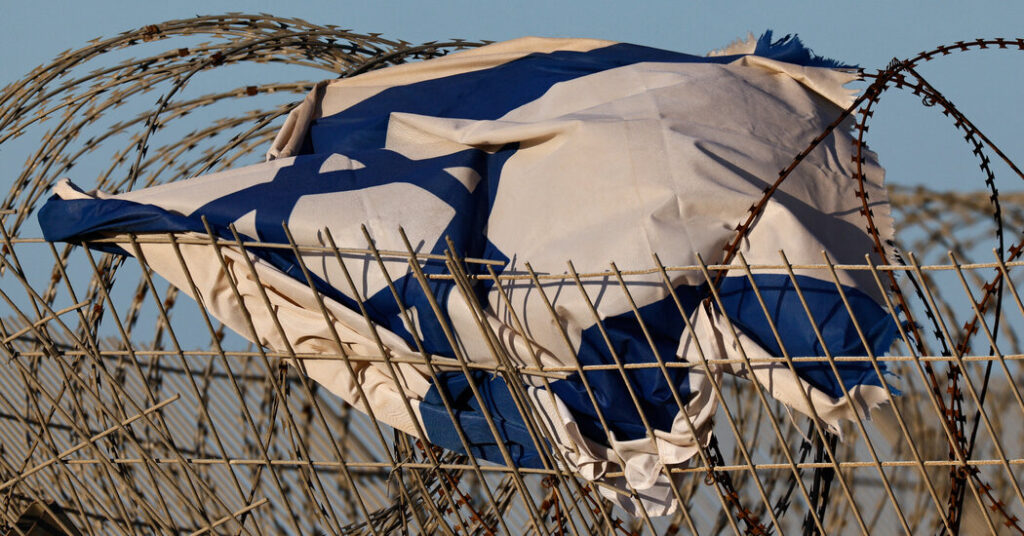
As the public debate around Israel, Gaza and the future of Palestinians becomes ever more pointed around the world, Israeli creatives — filmmakers, musicians, comedians and authors — are left feeling ostracized from the global stage. Invitations have been withdrawn and exhibitions canceled.
The irony is that these artists are sometimes among their government’s most influential critics.
At the Cannes Film Festival last month, no Israeli films played. Actors and directors seemed expected to declare their views on Gaza as a price of admission. At a news conference there for his latest film, “The Beloved” (“El Ser Querido”), the Spanish actor Javier Bardem said he believed that genocide in Gaza was “a fact.” He continued: “If you justify it with your silence or with your support, you are pro-genocide.”
Then I flew to Tel Aviv.
There, I spoke to about a dozen Israeli Jewish artists from varying disciplines, some on the phone or Zoom, others in person at one of Tel Aviv’s sprawling and now largely empty five-star hotels, to discuss the state of their artistic lives. More than two and a half years after Oct. 7, and the ensuing war in Gaza, they feel the world does not understand them, and, more important, does not care.
My conversations obviously don’t constitute any conclusive consensus. I tried to seek a range of political leanings.
The five I met at the hotel have concluded they can no longer have a good-faith discussion with the outside world since they believe their own survival is at stake. Their reactions struck me as a kind of emotional armor against the judgment of the West.
“After Oct. 7, you realize you have no one else to trust. We are on our own,” said the songwriter Aya Korem.
Israeli artists have often used their work to interrogate the state’s treatment of Palestinians — as well as racism, misogyny, religious extremism and corruption in Israeli society. The latest film from Paris-based Israeli filmmaker Nadav Lapid, “Yes,” is a scathing provocation about the moral state of his homeland. It has been repeatedly condemned by Israel’s minister of culture. Last month, he felt compelled to pull out of the jury of the French FID film festival to be held in Marseille in July because of a planned boycott of his presence.
A common refrain among the people I spoke to was that it was time for their country to move on from the prime minister, Benjamin Netanyahu. They blame him for a failed strategy to contain Hamas, and also for allowing Israel to let its guard down, resulting in the massacre of about 1,200 people in Israel on Oct. 7, 2023. They believe he prolonged the Gaza war to delay corruption proceedings against him, at the expense of Israelis held hostage and achieving a cease-fire.
Their anger toward Mr. Netanyahu lives in tension with their alienation from the judgment of the West.
Maor Zaguri, a director and writer who has voted for Mr. Netanyahu in the past, said he is a political orphan. In fact, he would rather not vote at all. “The fight in Israel today is what we want to be. Do we want to be Europe? Or do we want to be America? We want to be more capitalist or more socialist? Do we want to be more militant or less militant? Do we want to be more liberal or less liberal?”
“There’s a monolithic view of Israeli society,” said Julia Fermentto-Tzaisler, the director of the Jerusalem International Writers Festival. “It doesn’t matter what I think. Who I vote for. If I protest or don’t protest. If I’m an artist. We’re all the same,” she said. She finds herself cut out of a conversation she wants to be a part of. “I want to build things. I want to change things,” Ms. Fermentto-Tzaisler said. “I don’t think I should be personally punished as a writer, as an Israeli, with all the criticism I accept and that we deserve.”
J.M. Coetzee, a Nobel Prize winner for literature, criticized Israel in a searing letter to Ms. Fermentto-Tzaisler declining an invitation to the festival. He denounced Israel’s “genocidal campaign” and a “campaign of annihilation” in Gaza. And he wrote that Israel’s artistic community is not exempt from sharing the blame for the destruction of Gaza, given the Israeli population’s apparent support of the war. The rejection was notable as Mr. Coetzee had previously considered himself a supporter of Israel, and had accepted the Jerusalem Prize in 1987.
When Mr. Coetzee rejected the invitation to the festival, Ms. Fermentto-Tzaisler told me that she grieved. She has struggled to get international writers to attend the festival over the past three years. Organizers considered canceling this year’s event but decided to press on. It was held in May with about 70 participants, including eight from overseas.
“It gets harder each year. They don’t want to come,” said Ms. Fermentto. “And I understand — it’s a literary festival. Why risk your career just because you’re going for a week to Jerusalem?”
The idea that participating in a gathering of Israeli writers might be career-ending was striking to me but conventional wisdom to Ms. Fermentto-Tzaisler. She has tried to get Palestinian writers to attend but has given up. Palestinians either don’t want to validate the festival by participating, or they don’t want to risk being ostracized if they do. So, she said, it’s “almost mission impossible.”
Noa Regev, who heads Israel’s public film fund and is a former chief executive of the Jerusalem Cinematheque, an art house movie theater, said Israeli filmmakers were in a double bind. A film about a Palestinian boy who sneaks across checkpoints to see the Mediterranean, called “The Sea,” which was Israel’s submission to the international category of the Oscars, was attacked by Israel’s culture minister as pro-Palestinian. It also faced boycotts from activists who opposed the Israeli public fund that produced the film.
“It’s an unbearable situation where filmmakers in Israel are being attacked from within and being boycotted by some festivals from the outside,” Ms. Regev said.
Hollywood in particular is skittish. This is a turnabout from less than 10 years ago, when Israeli films and shows were the basis of successful Hollywood series. “Fauda,” a spy thriller set amid the Israeli-Palestinian conflict, was a hot show on Netflix.
“We used to be the belle of the ball. Now we’re the girl with dubious morals you take behind the bleachers,” said Roy Iddan, one of the writers of a comedy show in Israel called “Bobby and Me.” He recently completed an Arabic-language show, “Nutuk,” co-written with a Druze Arab, about a young Druze boy who sees his reincarnated past. It aired in Israel on the Israeli TV channel Keshet 12, but has struggled to sell elsewhere.
“Our European partners bailed on us. Some don’t want the headache,” he said.
Ms. Korem noted how nearly everyone in Israeli society has been affected by the war. “You become humble in front of that and you remember what is important. Your art is the continuation of that. And our moral obligation is to that humility, and to the stories of people who paid actual prices.”
On her daily way to work, Ms. Korem passes a wall with posters of Palestinian children who were killed in Gaza. It stands in the Arab-Israeli town where she lives, Jaffa, just beside Tel Aviv. “Every day it pains me,” she said. She said it is necessary to create space for all the suffering. “I need to feel both things if I want to be a person in this world,” she said. “My mission in this crazy time is to live with the complexity.”
Ms. Fermentto-Tzaisler’s upcoming novel, “Black Honey,” is about an Israeli woman who marries a Jewish American man and in midlife comes to regret her choice of making her life in America. “It’s the story of what happened if I’d stayed” in the United States, she said.
When we spoke, she was worried that she won’t find a U.S. publisher for it. “I don’t know if my stories are relevant anymore. Who wants to read about Israeli protagonists, no matter the story?”
Even by talking to me she worries she will just stir up more negative reactions. “There’s nothing for me to say that will come out good in your piece. I lost. I lost the game.”
Sharon Waxman is the founder, chief executive and editor in chief of The Wrap.
The Times is committed to publishing a diversity of letters to the editor. We’d like to hear what you think about this or any of our articles. Here are some tips. And here’s our email: [email protected].
Follow the New York Times Opinion section on Facebook, Instagram, TikTok, Bluesky, WhatsApp and Threads.
The post ‘We Used to Be the Belle of the Ball’: The New Isolation of the Israeli Cultural Scene appeared first on New York Times.