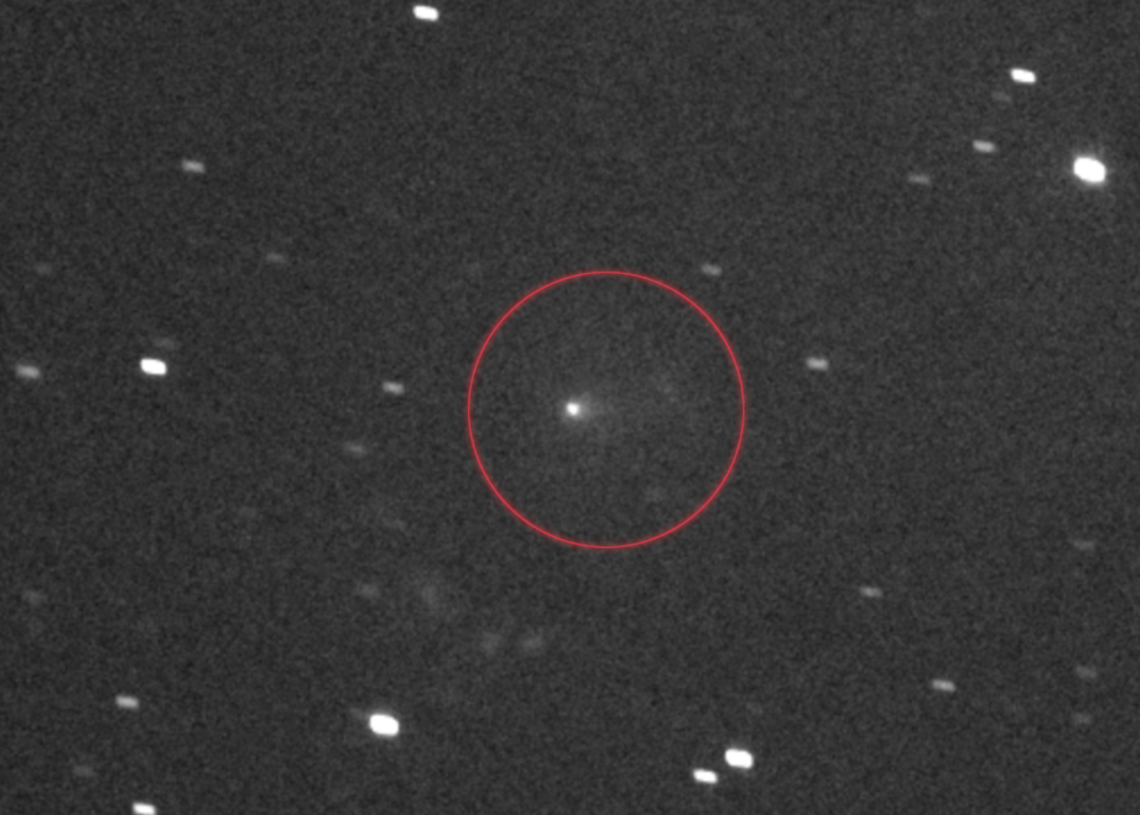
Everyone’s favorite guy who probably thinks a stiff breeze is actually a cloaked alien ship zipping overhead, Harvard astrophysicist Avi Loeb, is at it again with a new theory about the oddball comet 3I/ATLAS. This time, the theory revolves around the strange light pulse the comet is giving off.
3I/ATLAS, which is only the third confirmed object we’ve ever caught slipping into our solar system from interstellar space, is about to make its closest pass by Earth on December 19, and by “close” I mean it will be 170 million miles away, which isn’t close in Earthly terms, but within arm’s reach in cosmic terms.
The latest in a long line of weird things it’s doing is its’ newly observed “heartbeat.” Not a literal heartbeat, mind you. Scientists did not discover that this thing is an organic being with a pulse that’s barreling toward Earth or anything like that. Rather, it’s a steady 16.16-hour pulse of light that was first flagged by a team of researchers spread across Europe and Africa.
It’s an intriguing observation, one made all the more so by Loeb, which is his whole thing. All of his theories have had a heavy dose of science fiction injected into them, so of course, he believes this pulse could theoretically be the handiwork of extraterrestrial engineering.
The more likely explanation, according to more levelheaded researchers who don’t want to immediately jump to dramatic, earth-shattering conclusions that will forever alter the course of the human race, is that the comet is just spinning like a rotisserie chicken, reflecting sunlight to us as it twirls in space.
To break that down even more, the leading theory mentioned above suggests that this bizarre comet is behaving like any other run-of-the-mill comet from outside of our solar system. The big difference is that it doesn’t originate from here. Its rotation could be exposing a pocket of ice on one of its sides that vents gas and dust whenever it faces the sun. That venting forms the “anti-tail” that I wrote about before, a jet of vapor pointing toward the sun rather than away from it, as is the case with most comets.
So that’s the more rational explanation. Loeb, ever the optimist or opportunist, however you want to see it, isn’t tossing out the possibility of aliens. He suggests that a high-tech spacecraft that we feeble humans can’t even conceive of yet might pulse its jets in a way that we, again, can’t even conceive of yet. The idea being that if this thing does turn out to be an alien, it’s like no life or technology we’ve ever seen before, so of course, its spaceflight procedures would be unlike anything we’ve ever thought of before.
It’s a fun idea, though one that remains highly unlikely.
We’ll know more soon when the weirdo comet passes by later in the month.
The post Interstellar Object 3I/ATLAS Nears Earth With a Strange ‘Heartbeat’ Pulse appeared first on VICE.