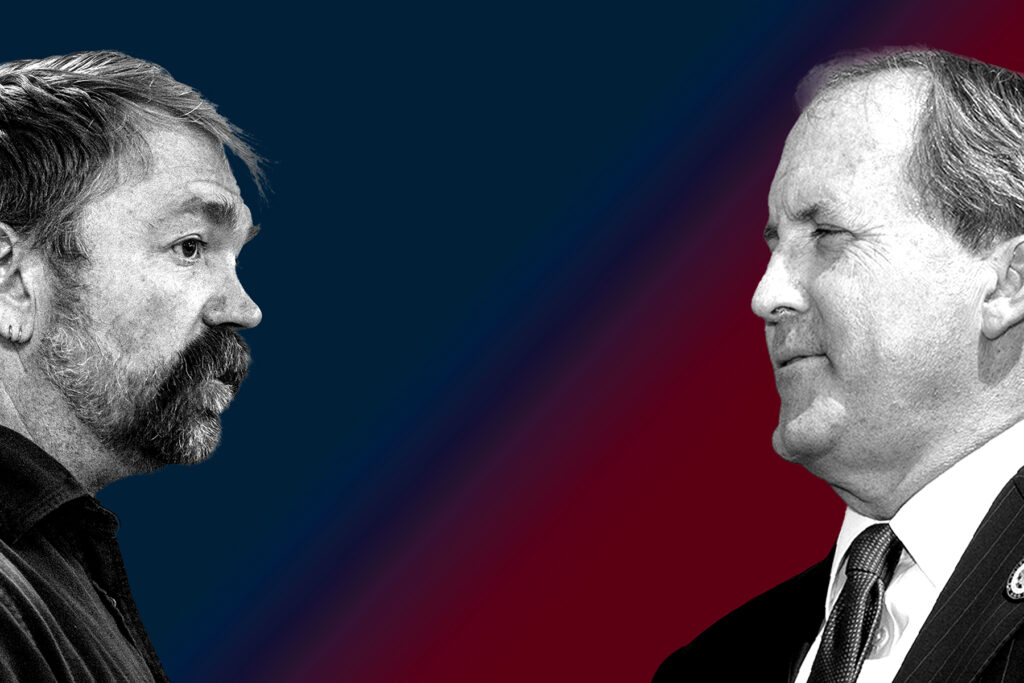
You can explain away all the scandals that have beset Graham Platner, Maine’s Democratic nominee for U.S. Senate. The tattoo of a Totenkopf, the death’s head emblem associated with Nazi concentration camp guards? That was a drunken mistake by a young Marine who didn’t know any better. His failure to remove it for nearly two decades? The self-professed “military history buff” found out about those associations only recently.
How about this shirtless profile on the anonymous chat app called Kik, favored mostly by the 13-to-24-year-old set? He made some mistakes early in his marriage. The ex-girlfriends who told the New York Times his behavior was “unsettling” and, in one case, physically abusive? The woman who says he manhandled her once worked for the conservative Heritage Foundation. QED, the accusation isn’t credible.
That sure is a lot of explaining to have to do, and some of the explanations seem unconvincing. So alternatively, you could simply say, “What about Ken Paxton?”
Paxton, the Texas attorney general who defeated incumbent Sen. John Cornyn in the Republican primary runoff last month, is at least as scandalicious as Platner. The Republican-controlled Texas House impeached him in 2023 for dereliction of duty and bribery, among other charges. As my news-side colleagues reported: “His own senior staffers reported him to the FBI, alleging he illegally used his position to help a prominent donor,” and “his wife, state Sen. Angela Paxton, filed for divorce last year on ‘biblical grounds.’” (The Senate later voted to acquit him.)
It’s hard to denounce Platner while supporting Paxton (or Donald Trump), but that won’t stop many Republicans from trying. The reverse is also true. Many Democrats will assure themselves that this is entirely different, even though it’s much the same. It is a rejection of the idea that character matters in politics. Some readers may retort that it doesn’t matter, that people of bad character can still make fine public servants.
Politicians needn’t be saints. But nor should Americans mindlessly vote for whoever represents their party without any care for character. Nominating those who are obviously unscrupulous and unstable is bad for the country — and, frequently, for America’s parties.
It mattered that Trump was vindictive, vain, pigheaded and unprincipled, because that’s how we got Jan. 6, unpopular tariffs, a budget deficit of almost 6 percent of gross domestic product, and the current mess in Iran. That can be twisted to justify standing by Platner: Trump is so bad that we must do all we can to check him. That’s the mirror image of the “Flight 93 election” argument that many Republicans advanced for supporting Trump 10 years ago. It was time to do something reckless because otherwise all would be lost.
This is now the dominant narrative of both parties: Our opponents are intent on destroying everything right and just, while we are doing what we must. Every election has become an existential contest between all-powerful supervillains and … amoebas who have no capacity for independent thought and can only react automatically to negative stimuli.
But we aren’t amoebas; we’re humans who have the capacity to make choices and draw lines. If your candidate is flashing all the warning signs of unstable temperament and bad decision-making, and you support him anyway, you are responsible for the results of that choice — especially when your party could have nominated someone else.
It’s helpful to remember how often these compromises go awry. Trump’s election denial arguably cost his party both Georgia Senate races in the 2021 runoffs, and MAGA primary challenges have ousted moderates from seats the GOP subsequently lost. The president’s unpopular policies are likely to do further damage this November. As may his meddling in Texas, where he endorsed Paxton because Cornyn — who boasted that he supported Trump’s positions 99 percent of the time — wasn’t abjectly servile enough.
Paxton might have won anyway, but it sure didn’t help that the president weighed in on his behalf. His victory caused the Cook Political Report to move the Texas seat from “likely Republican” to “lean Republican.” Platner also makes it more likely that Maine will return Republican Susan Collins to the Senate.
If both men survive their respective races, they will arrive in Washington carrying all their baggage, containing who knows what ticking time bombs waiting to go off, with the rest of their caucus in the blast radius. When the eruption comes, party stalwarts will console themselves by saying the voters had spoken and there was nothing they could do. Balderdash. There is at least one thing they could’ve done: Refuse to support a candidate who doesn’t belong in the Senate.
What’s that, you say? Politics ain’t beanbag?
Republicans have been saying so for 10 years and it’s gotten them only grief. Many have kept their jobs, but at great cost. They’ve been left with a badly weakened party that will either struggle to win elections or need to rebuild itself as something other than a cult of personality. Their jobs now mostly consist of explaining the inexplicable and defending the indefensible.
It’s a pity to sell your soul for power. It’s an embarrassment to sell it for nothing.
The post Politics ain’t beanbag. But character still matters. appeared first on Washington Post.