Kevin O’Leary, the celebrity investor and brash “Shark Tank” TV pitchman, wanted land, and lots of it, for his next big deal — building one of the world’s largest data centers.
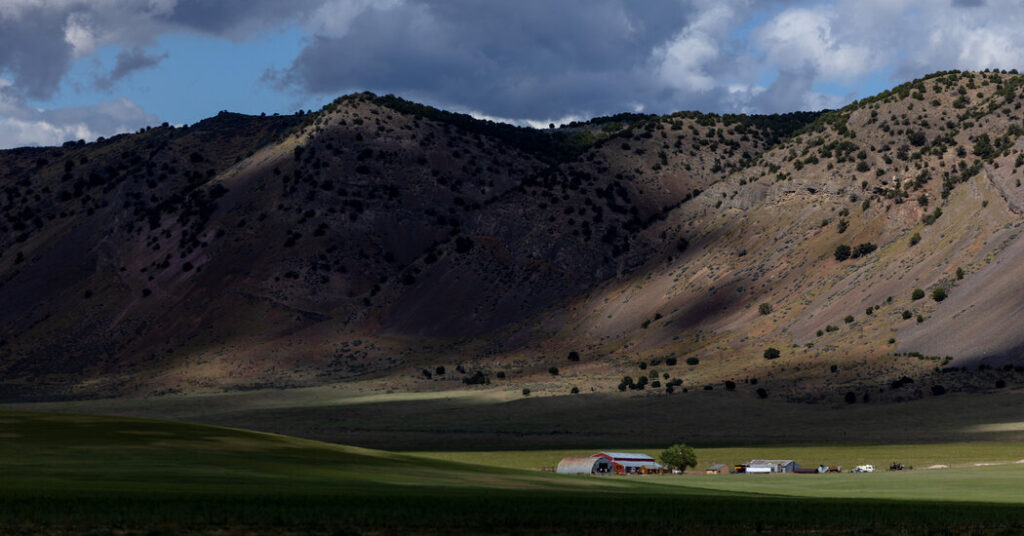
He also needed water, natural gas and access to interstate highways, so he set his sights on a remote Utah valley near the Great Salt Lake that was occupied mostly by grazing cows. In January, Mr. O’Leary flew to Utah to discuss his vision with Gov. Spencer Cox, a Republican, and within weeks, he had publicly announced the project and was on his way to securing the approvals in the proudly business-friendly Republican state.
Few were expecting the backlash that has become a crucial issue in Utah’s June 23 primaries, which, in a largely one-party state, will be the endgame in most races. Some Republican voters in the region north of Salt Lake City are saying they will vote against any incumbent who supported the project around the Hansel Valley, which Mr. O’Leary rechristened “Wonder Valley” after his nickname Mr. Wonderful.
“I’m getting rid of them,” said Frank Musil, 57, a substitute teacher and Republican voter in Box Elder County, the site of the project, where Republicans hold every elected office and President Trump won 80 percent of the vote.
Data centers have become flash points all over the country, uniting liberals and conservatives, environmentalists and ranchers, small-government crusaders and social justice activists. On Tuesday, Arizona lawmakers, under fire for data center approvals in their state, agreed to a three-year pause on tax exemptions for new centers, just days after Illinois’ Democratic governor, JB Pritzker, ordered a halt to tax incentives for data centers in his state.
What stands out about Mr. O’Leary’s Stratos Project is his celebrity and the politics of its opponents — most of them Republicans and members of the Church of Jesus Christ of Latter-day Saints, unaccustomed to rebelling against their own leaders.
“I’m so tired of crony capitalism in this state,” said Ben Soholt, a systems analyst for the church who lamented the energy and property tax breaks directed to the project while Utahns struggle with rising prices and higher taxes to help repair local schools. “I’m glad the public is kind of rising up.”
As word of Mr. O’Leary’s plans for a giant data center in Box Elder County began to spread through the conservative rural area, Mormon voters, farmers and ranchers worried it would pose a new threat to the Great Salt Lake, a symbol of Utah’s identity that is drying up in a record drought and warming climate, leaving behind dust laden with arsenic and other heavy metals.
They packed raucous town halls and sent thousands of public comments that opposed the project and slammed Utah’s Republican establishment for supporting it.
Now come the primaries, which could offer an early test of how the nationwide backlash against data centers will shape midterm races in November.
Two commissioners in Box Elder County who voted in May to move ahead with the data center are facing Republican primary challengers, as is as the long-serving Utah State Senate president who once championed the deal, but has backpedaled and called for cuts to its size amid a growing voter revolt.
Utah has approved other data centers with less public outcry, but Mr. O’Leary’s vision was audacious, even by the standards of a state that has proposed stringing the world’s longest ski gondola across the mountains and putting a surfing subdivision in the middle of the red-rock desert.
The original proposals envisioned Stratos stretching across 62 square miles of pastures and open land in the remote Hansel Valley, powered at first by an existing natural-gas pipeline. At full buildout, it could produce and use more energy than the state of Utah currently does, according to some projections.
Mr. O’Leary said the project would create 4,000 construction jobs and 2,000-full time jobs, bring billions of dollars of investment to Utah and actually benefit the Salt Lake by taking water out of agricultural use and putting treated water back into the lake.
It would also help the United States win a global competition to develop superior artificial intelligence capabilities, he said.
“The country with the best A.I. is going to be dominating in the economy and on defense,” Mr. O’Leary, a Canadian with significant business interests in the United States, said in an interview. “I’m not backing down on this.”
Neither are his opponents, who said they felt brushed aside by Republican leaders in the state who assumed Utahns would simply fall in line. At one meeting, a Box Elder County commissioner told jeering critics of the project to “grow up.”
“People are really tired of not feeling heard,” said Stephanie Hollist, a former university lawyer who is now challenging the Senate president, J. Stuart Adams, in Utah’s Republican primary.
Ms. Hollist said Mr. Adams and other incumbents had ignored voters’ concerns about tax breaks given to the data center, as well as how it might affect hunting and bird-watching along the Great Salt Lake’s receding shores.
Mr. Adams is also the chairman of the state agency overseeing the Stratos project, the Utah Military Installation Development Authority. The agency voted in April to move ahead with the project, and the Box Elder county commission voted its approval in early May.
Even with those approvals, it is far from clear when construction might start since the project must still pass environmental reviews and obtain additional water rights.
When a group of Box Elder residents tried to get a data-center referendum onto November’s midterm ballots, the county rejected it, prompting the residents to sue.
“It comes up at almost every door,” said Karianne Lisonbee, a conservative Utah state legislator challenging U.S. Representative Blake Moore, the incumbent Republican in a deep-red seat that would include the data center. “People are frustrated with a government that doesn’t listen.”
One scorching afternoon last week, she went door-knocking in a mountainside neighborhood in Brigham City, where residents have planted homemade yard signs opposing the data center. Nearly every person she met — Republicans all — opposed it, or complained about getting little say in a project that could transform the county.
The blowback has forced Mr. O’Leary to scale back. Last week, he said he would reduce the project’s footprint by about half — or 20,000 acres.
Mr. O’Leary has said local critics are misinformed, and suggested that China’s Communist Party is behind the effort to kill the project.
That is news to Rhonda Lauritzen, a seventh-generation Utahn who traces her ancestors to the Mormon pioneers who settled in the Salt Lake Valley.
Her family has a business extracting minerals from the waters of the Great Salt Lake for electrolyte drinks and supplements, and some of their land would be near the new data center. She said she was amazed to see so many Utah voters up in arms.
“There’s a lot of top-down, follow-the-leader culture here,” she said. “But something has changed. It’s torches and pitchforks out there.”
The post How Utahns Took on Mr. Wonderful and a Data Center on the Great Salt Lake appeared first on New York Times.