In the nearly 100-year history of the World Cup soccer tournament, 80 countries have competed (plus a few that no longer exist). Four new ones will join the ranks this summer, including Curaçao.
The tiny Caribbean island, which sits 40 miles off the coast of Venezuela and is better known for producing top baseball players, is home to 158,000 people. When it takes the field Sunday for the first time in World Cup history, it will supplant Iceland, which had 350,000 residents when it played in 2018, as the smallest nation ever to do so.
“It’s hope to other countries that it’s possible, no matter the size,” said Brenton Balentien, 35, a bartender and lifelong Curaçao soccer fan.
The journey has taken decades. But a shift in the national soccer federation’s approach — moving away from local amateur players toward professionals of Curaçaoan descent — has finally propelled the country into the 48-team tournament.
It has also created a dynamic emblematic of the nation itself: Only one player on the squad facing Germany in Houston, Tahith Chong, was born on the island. The rest were born and largely raised in the Netherlands.
The reason lies in history. Following the dissolution of the Netherlands Antilles in 2010, Curaçao became an autonomous constituent country within the Kingdom of the Netherlands. It has its own prime minister, Parliament and laws, but its head of state is the Dutch king, Willem-Alexander, its highest court is the Supreme Court of the Netherlands, and its military and foreign affairs are handled from The Hague. All Curaçaoans hold Dutch passports.
So when residents reach college age or want to start careers, many head to the Netherlands, relatively easy given that public schools teach four languages: Dutch, English, Spanish and Papiamento, the local Creole language. Nearly as many people of Curaçaoan descent (roughly 150,000) now live in the Netherlands as on the island itself.
Soccer players are no different. With no professional league and a meager development system at home, Curaçao’s best players head to Europe and its top-tier soccer leagues and academies. To improve the national team, the Curaçaoan soccer federation turned to its Dutch-born diaspora.
The only requirement, said Gilbert Martina, the federation’s president since last year, was that at least one of a player’s parents or grandparents was born on the island.
About two decades ago, he said, the team was made up mostly of local amateurs, and the best professional players of Curaçaoan descent dreamed of playing for the Netherlands, a perennial World Cup contender. That changed, in part, as the current captain, Leandro Bacuna, and his brother Juninho helped persuade other players to switch allegiances.
Mr. Martina, a former hospital chief executive who spent 16 years in the Netherlands before returning, said the squad had been embraced as “a local team, not as a Dutch team,” because of the players’ roots.
Sithree van Heydoorn, Curaçao’s minister of education, science, culture and sports, made two trips to the Netherlands to help recruit players, including Mr. Chong, appealing to their sense of ancestry. But he also understands why so many Curaçaoans leave.
“My family has been living in Holland for 40 years, and I’m the only who stayed on the island,” he said, later adding, “It also worries me as minister: That’s where our best minds are staying when they go study.”
He has struck deals with universities in Florida and Colombia so that Curaçaoans can study regionally and more easily return, since long-term residency in the Netherlands requires no visa but settling elsewhere does.
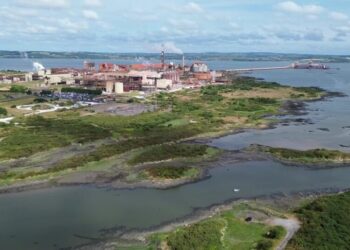
The World Cup has provided a needed jolt, he said. Curaçao’s economy has been hit hard in recent years. When the Venezuelan state-owned oil company abandoned the island’s lone oil refinery in 2019, thousands were put out of work, and then the Covid pandemic hammered tourism.
“We’ve been growing since, with tourism,” Mr. van Heydoorn said. “But despite that, whenever you leave the country, people always ask, ‘Where is Curaçao?’ Many people don’t know where the island is. But now they do.”
Atilay Uslu, a major team sponsor and owner of the Dutch travel company Corendon, said playing in the United States offers a particular advantage: showcasing the island to Americans, whose increased visits in recent years have boosted a tourism industry that once relied primarily on Europeans.
“When I was in the U.S., nobody knows where’s Curaçao and everybody knows Aruba,” he said, in reference to the neighboring island popular with American tourists. “Now with the World Cup, our aim is that when we go to the U.S. and people ask, ‘Where’s Aruba?’ we say it’s next to Curaçao.”
On the island, the World Cup fervor is pervasive. There are flags and banners of the squad (known as the Blue Wave, a nod to the Caribbean waters surrounding the island) everywhere alongside images of individual players. Cars are decorated. A sign in a main square of the capital, Willemstad, reads: “The smallest nation to ever qualify for the World Cup.”
At a recent send-off match against Aruba, the 11,000-seat national stadium was sold out and bursting in celebration. Rum and satay (meat skewers brought to the island from Indonesia, another former Dutch colony) were sold all night.
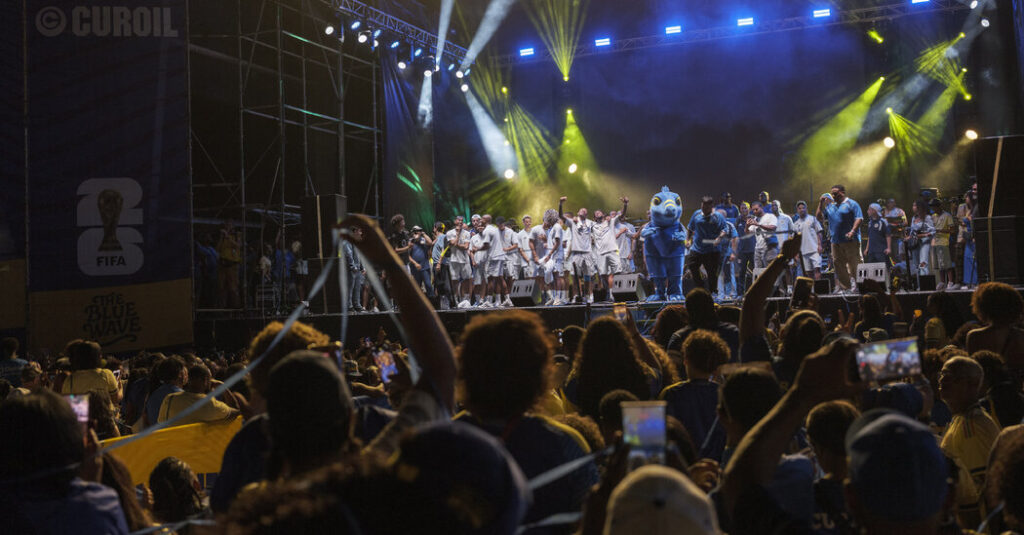
After it was over, thousands of Curaçaoans filled a nearby festival center for a government-organized party with speeches, music and fireworks. The players appeared onstage like rock stars.
It did not matter to Marian Nahr, 33, who was visiting from The Hague, that most of the players were not born or raised on the island. She was born on Curaçao but moved to the Netherlands at 21 for college and stayed for work, returning to see her mother and the national team.
“Curaçao belongs to everybody,” she said. “It doesn’t make you more or less just because you were not born here. It’s about the culture and the togetherness.”
Jealaine Alexander Wawoe, 58, agreed. The players speak Papiamento, visit the island and have families here. “We’re Dutch anyway — Black Dutch,” she added.
The majority of Curaçao is of African descent because the Dutch used it as a major transit hub during the trans-Atlantic slave trade.
Mr. Balentien, the super fan, noted that other national teams, like France and the Netherlands, benefit from the migration pathways created by colonialism and said Curaçao should be no different.
Although they hoped to make improvements, officials acknowledged that the country lacked the infrastructure to develop more homegrown players anytime soon and that it would continue to rely on its diaspora. That mirrors a broader question about Curaçao’s relationship with the Netherlands: A full separation, Mr. van Heydoorn said, is not yet realistic.
No matter what happens in the World Cup, though, several Curaçaoans said they had already won.
“We’re standing with the best in the world,” Ms. Alexander Wawoe said.
The post Meet the Smallest Country Ever to Reach the World Cup appeared first on New York Times.