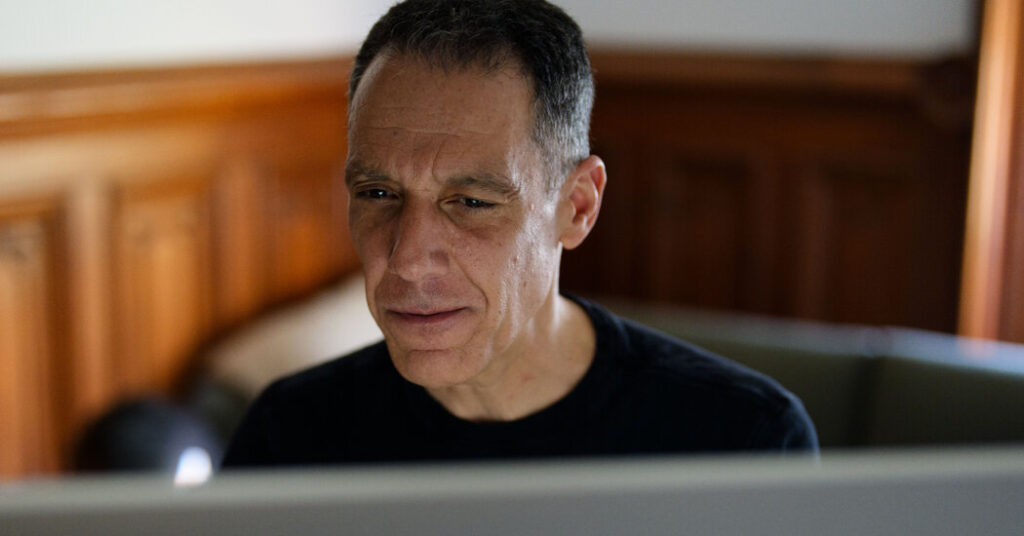
The emails began to arrive on a Sunday morning, as the worst ones often did. Hany Farid opened the first message at his home in the hills above Berkeley and found a link to a viral video purporting to show a U.S.-made missile hitting an elementary school in Iran, where more than 150 people had been killed, most of them children. “Is this an internet hoax or an international war crime?” one note read. “We’re trying to verify what’s real.”
Farid grabbed a pencil and a notepad, leaned into his computer and watched. He saw blue sky, telephone wires and a few palm trees swaying in the wind. Then a missile streaked across the screen, clear and unmistakable even at 500 miles per hour. It looked like a scene from a video game. In the last few days, Farid had reviewed dozens of convincing A.I.-generated videos of fake bombings, fake plane crashes, fake fires and fake executions. His instinct was to be skeptical. He was nearly certain the video was another fake.
He chewed on his pencil and watched it again, slowing down the video, breaking it apart frame by frame. The camera shook in a way that seemed plausible for an amateur filming with a cellphone. The shadows were geometrically accurate. He watched the missile strike a building and noticed a short delay before he heard an explosion and high-pitched screams, which seemed consistent with the speed of sound. Maybe the video was real. It had already been viewed at least 1.1 million times on social media. With each passing second, it was becoming reality, whether it was real or not.
“Anyone can create a video of anything or anybody, doing or saying anything,” Farid wrote back. “This will take a little time.”
For more than two decades, Farid, 60, had been the world’s leading expert in the field of digital forensics, but in the last six months he’d stopped trusting his own eyes. He’d made a career of differentiating visual reality from deepfakes as he fielded requests each day from governments, human rights organizations, journalists, law enforcement and thousands of others who were increasingly confused and deceived by the online world. Farid’s own research had proven that most people could no longer distinguish a real photograph from a digital creation, a real voice from an A.I. clone, a real video clip from a wholesale fabrication. Lately, he was failing his own tests.
“I feel like I’m going blind,” Farid said, and he worried that A.I. was obscuring the truth, distorting reality, fracturing democracies and slowly breaking him, too. He and his wife had begun making plans to leave California and trade the tech culture of Silicon Valley for a farm in rural Vermont.
He restarted the video and played the clip again. Sky. Bomb. Smoke. Screams. In the last hour, at least a dozen media organizations had emailed him to ask about the video. It had been published and shared by an official Iranian news agency, but that didn’t mean much to Farid, because recently he had seen deepfakes created and shared by foreign governments and by staffers at the White House. He geolocated the video using a database of millions of images from around the globe, and it pointed to a street in Minab, Iran, several hundred feet from an elementary school.
Maybe the video itself was real, Farid thought, except that someone had inserted a Tomahawk missile into the frame. He stabilized the video to get rid of the shaking and then charted the missile through a series of still frames, hunting for inconsistencies. The missile’s path was straight, its speed consistent. He zoomed in to measure pixels and calculated that the missile looked to be about 18 feet long, exactly the right size.
Sky, bomb, smoke, screams. He watched at least 100 more times, doubting his instincts and rechecking his math. For most of his career, he had been charged with identifying the rare fake in a world of shared truths. But now fakes were the norm and truth was elusive. Even after a full day of analysis and consultation with other visual experts — all of which confirmed the video’s authenticity — he couldn’t quite bring himself to declare it real.
“Overall, we find no compelling evidence that the video is fake or has been manipulated,” Farid wrote.
He turned off the computer and went outside. He rode his mountain bike through the Berkeley Hills, pushing his speed and leaning into the wind. He smoked a cigar and went to bed, and later that night he returned to the video in his sleep. This time he wasn’t counting pixels or measuring shadows. He was inside the school, sitting down in a classroom of 10-year-olds, watching the warhead detonate, absorbing the concussive blast, coughing up dust and listening to the children’s screams. He woke up and went back to the computer, scanning the internet for news about the bombing.
“You can’t kill 100 schoolgirls and just say ‘whoopsie,’” he wrote to a colleague, as he read through social media posts. Some people were citing Farid’s analysis to confirm the video was real. Others dismissed Farid as somehow biased and said the video looked fake. Several new A.I.-generated videos about the bombing had already begun to appear online, showing fake generals giving orders or fake parents mourning fake schoolgirls. The internet was already moving on from what would turn out to be one of the deadliest bombings of the war, and now Farid saw a new request arrive in his inbox. It was a different video, showing another explosion in a separate part of the world.
“Can you please help us understand what the hell is really going on here?”
It was the question that arrived in his inbox a dozen times each day: What in the world was happening?
Was that really President Joe Biden calling thousands of Democratic voters the day before the New Hampshire primary and telling them not to vote? Was that really President Trump tossing bags of garbage out of a window at the White House? Were those real nude photos of ninth graders circulating around a high school in Pennsylvania, or images that a classmate had generated with a free app? Was that really Tom Hanks advertising an obscure dental plan to his fans? Was that the C.E.O. on the Zoom call asking for a wire transfer of $25 million, or a North Korean impersonator? Was that a real gun in Alex Pretti’s hand, or just a shadow? Was that really a 12-year-old daughter on the phone, screaming for help, saying that she’d been kidnapped?
“I miss the days when it was a grainy video of a shark swimming up the street,” Farid said one night, as he sat on the back deck of his house with his wife, Emily Cooper. He put down his phone and poured a whiskey. “The technology is getting so good. It takes me to a dark place.”
“Because you can’t tell just by looking anymore?” Cooper asked.
“Because nobody can,” Farid said. “I don’t trust anything. Every image I see, I’m drawing lines for shadows and doing geometry in my head, trying to figure out what I’m looking at. It’s over. Within a year or two, our whole visual system will be utterly useless.”
“And then what? You give up? You retire?”
“I don’t know,” he said.
They had met 15 years earlier when Farid came to lecture at the University of California, Berkeley, still confident he had the solutions. His father had worked for 50 years as a chemist at Eastman Kodak, and Farid had grown up visiting the darkroom, watching photographs develop in chemical baths and harden into evidence. He went on to help design a digital fingerprint that found child pornography hiding on the internet — a technology that led to more than 30 million abuse reports each year, hundreds of arrests and several rescues. As deepfakes began spreading online, he built software to catch the moment a speaker’s mouth moved out of sync with the audio. He co-founded a company, GetReal Security, and helped invent tools to measure lighting, shadows and vanishing points, checking online visuals against the physics of the real world.
Cooper was a leading vision scientist at Berkeley. She researched how humans perceive reality, while her husband investigated how that reality could be faked. They’d collaborated on studies about deepfakes, but in the last months that research had begun to follow them home. Instead of dealing with one case every few weeks, Farid was working as an adviser and an expert witness, juggling up to a dozen cases each day. For the first time in his career, he’d become not just an analyst but also a victim, when someone spoofed his cellphone number and used A.I. to clone his voice. The hacker made calls to one of Farid’s colleagues on a sensitive case, impersonating Farid and pressing for confidential information. Now Farid and Cooper had decided never to take their identity for granted. They invented a safe word to confirm they were real at the start of any sensitive phone call.
Farid glanced at his phone and saw a new email: “I’m fact-checking this viral video of a mother and child approaching a flag-draped coffin that we suspect is A.I. generated,” it read. He set the phone back down and looked out from the porch at the Berkeley Hills, the San Francisco Bay, and the sun setting over the Golden Gate Bridge.
“I can’t stand this place anymore,” he said. “These major tech giants will burn everything to the ground as long as they’re making a profit. They’re not interested in anything that’s going to slow them down.”
“It makes me anxious for our students,” Cooper said. “It’s starting to scare me.”
She didn’t believe in hyperbole. Her husband could be brash and combustible — an optimist by nature who had turned increasingly pessimistic by evidence. She stuck to precision and facts, but even those had become undeniable. Her own research focused on 3-D perception and display designs, but the broader crisis unfolding in her field was impossible to ignore. People were spending more time indoors staring at screens and less time looking at the horizon, which sometimes caused the eyeball to permanently elongate. The result was often blurred vision, skyrocketing rates of myopia, an increasing risk of eye disease and an impending epidemic of preventable blindness that many of her colleagues had begun calling a public health crisis.
The potential cure was natural light and distant views, and over the last months they had searched for properties in rural Vermont. They eventually bought a 1920s cabin about a half-hour from Dartmouth College, where they could work as tenured faculty and while Farid continued to analyze images for his company. The property had 100 acres of wooded hiking trails with no other homes within sight.
“I need to reset,” Farid said. “Air, space. I’m so ready to feel far away.”
His phone lit up on the table.
“Do you think it’s even possible to escape?” Cooper asked.
“Probably not,” Farid said. “At least not entirely. But we need to find out.”
He rode down from the hills on his motorcycle to give his last public lecture of the spring semester at Berkeley, passing the A.I. billboards that had become ubiquitous across the Bay Area. They were for start-ups promising to reinvent medicine, disrupt education and transform the future of business. “Stop Hiring Humans,” one billboard read. Farid parked on campus and walked into the lecture hall, where 75 students looked back at him.
He was one of Berkeley’s most popular professors — kinetic, unfiltered and genuinely thrilled by the advancements in A.I. technology at the heart of his courses. He had A.I. agents that wrote code for him. He had a car that could drive itself on the highway. He had apps on his phone that could tighten the phrasing in his emails or turn a photo of his spice drawer into a recipe for weeknight chili. But the computer science majors in his classes were struggling to find jobs as companies waited to see what machines could do first. For the first time in his career, Farid sometimes stood in front of students and found himself at a loss for what to tell them.
He thought about a painting that had haunted him ever since he was a young professor at Dartmouth, where the library featured a mural by the Mexican artist Jose Clemente Orozco. It showed a group of academics rendered as skeletons in their graduation robes, clutching books, their backs turned to a burning world, as one of them delivered a baby skeleton holding a new diploma. “A lot of academia is content just twiddling around on esoteric problems and coddling each other from the truth,” Farid said. He had spent his career trying not to be that skeleton. He believed it was his responsibility to turn and face the fire.
“This technology is being weaponized against us,” he told the students. “The train has left the station. It’s accelerating at a speed that’s unbelievable.”
He paced at the front of the room and started to show slides of A.I. videos from the last several years. A fake image of the Pentagon exploding had briefly rattled the stock market in 2023, erasing more than $500 billion in a few minutes. Deepfakes from the war in Ukraine were still fairly easy to identify, with discolored explosions and misshaped buildings. Gaza fakes were much better. By the start of the Iran war, short A.I. footage was essentially indistinguishable from real video. Now thousands of North Korean government operatives were applying for remote jobs at U.S. companies, using A.I. to impersonate Americans in real time on Zoom calls and then funding a nuclear weapons program with their salaries. A nontechnical criminal, Farid said, could now use a still photograph and a 10-second audio clip to shape shift into anyone online.
“You might think you can look and tell the difference while you’re sitting there doom scrolling,” he said. “Believe me, you can’t. That’s where our methods come in.”
He had helped invent algorithmic tools to verify a person’s mannerisms, vocal inflections and blood flow. When a real person spoke, the eyes dilated and the heart pumped blood in and out of the face. Farid could sometimes measure subtle differences in skin color to see a person’s heart beating in real time, whereas an A.I. avatar was flatlined.
Farid said he was still confident that he could solve almost any A.I. mystery, but the problem was that each investigation took time. The half-life of an average social media post was less than 90 seconds. “Within 20 minutes, the whole ballgame’s basically over,” Farid said. Many times, he finished his analysis, looked up from his computer and realized the damage was already done. A fake had hardened into a fact. A fact had blurred into doubt.
A hand went up in the audience, and Farid pointed to a student in the front row.
“So, the creation of deepfakes is easy, cheap, fast and reliable,” the student said. “Detection is costly and difficult.”
“Yes,” Farid said.
“Is there a solution in the near future, or are we just screwed?”
He paused and took a breath. He thought about the Orozco mural, the school in Iran, the deepfakes piling up in his inbox and the farm waiting in Vermont. He still believed there were solutions. But first, he wanted people to understand what they were up against.
“We’re pretty screwed,” he said.
The chain saw roared to life on a Tuesday morning in late spring, and Farid put on eye protection and felt the vibrations moving from his hands into his chest. He cut open a fallen maple tree and watched the wood splinter into clean logs, which Cooper then fed through the splitter and stacked into a neat pile. Cut, split, stack. They had been in Vermont for less than two weeks, and they’d already lost themselves in the work.
Their cabin sat at the end of a dirt road, on a steep hill with views of river valleys and the Green Mountains. There was no garbage service, no mail delivery, no other houses within view. To get through the winter, they would need to plow their own road and heat the house. Farid estimated they needed about 10 tons of firewood. They worked for an hour and stepped back to look at the pile.
“We’re doing great,” Farid said. “It’s so satisfying to watch it grow.”
“Are you tired?” Cooper said.
“I feel good,” he said. “Let’s keep going. We need more.”
They changed into boots and walked into the forest to search for dry wood. They’d been discovering their property one hike at a time, teaching themselves to slow down again, to look closely: a meadow blooming with trillium and wild violet, a spring creek cascading over mossy granite, a red-winged blackbird diving over a small pond, an abandoned cabin decaying down to its foundation. Now they came into a clearing at the top of the hill, and Cooper stopped to look at the surrounding mountains while Farid walked the perimeter. He found a fallen birch tree, grabbed a branch and called out to Cooper over the wind.
“What do you think?” he asked.
“It’s beautiful,” she said.
She watched him carry the birch back through the meadow, holding it over his head like a trophy. Ever since they’d arrived in Vermont, she could almost see a weight lifting off his shoulders, and she was experiencing it, too. She drank her tea in the morning, savoring the quiet and letting her eyes take in the view. She was experimenting with writing fiction. In the fall, Cooper and Farid would start working and researching again at Dartmouth, but that wasn’t for a few months. The last time they’d lived in Vermont, they’d relied on spotty dial-up internet without the bandwidth for Zoom meetings or streaming videos or bottomless social media feeds. Maybe that level of disconnection was possible again.
They hauled the birch back to the shed, and Farid fired up his chain saw. Cut, split, stack. They worked until the meadow faded into shadow, his shoulders burned and sawdust covered his arms. He stepped back and saw that the woodpile was almost four feet high and nearly covering one wall of the shed.
“Look at what we got done today,” he said. “This is the most concrete progress I’ve made on any work in the last six months.”
“Tired yet?” Cooper said.
“Exhausted,” he said. He’d been going to bed in Vermont with the chain saw still humming in his ears and sleeping until morning.
The first email came before dawn.
The internet had been flooded overnight with another wave of fake images, including hundreds of Cole Tomas Allen, who had broken into the White House correspondents’ dinner with a shotgun in an attempt to assassinate President Trump. Now there was an A.I.-enhanced security video on Facebook that showed Allen walking by guards who didn’t in fact exist. There were doctored photographs on X of Allen posing alongside Tom Hanks and Barack Obama. He had been a running back for the Dallas Cowboys. He had been an astronaut on Artemis II. He had been the private driver for Taylor Swift and Pope Leo XIV.
“Every time there’s a big news event, we are just drowning in this slop,” Farid said.
He pocketed his phone and went outside. He chopped wood and walked around the trails with Cooper, but the emails kept coming as they always did.
“We are looking at this new video of the incident involving United Flight 179,” one read.
“I’m verifying a video claiming to show a mosque being struck in southern Lebanon.”
“I’ve been incarcerated since 2019 on false video evidence.”
He wandered off the trail and deeper into the woods, searching for the edge of the property. He walked up a hill and found an old stone wall, chest high and at least 100 feet long, running through the middle of the forest. Farid stood there for a while, tracing his hand over the moss and the faded gray stones before he turned back toward the trail and checked his phone.
“I’d like to ask for your help investigating live-streamed sexual abuse material.”
“Is this a real explosion at the Dubai Airport? Could you offer your expertise?”
He circled back toward the front of their property. He walked past the woodpile and into the house.
“I’m going to catch up on a little work,” he told Cooper.
“OK,” she said. “Good. Me, too.”
He settled into his office and turned on his computer. Outside the window, birch trees swayed in the wind and the sun dipped toward the Green Mountains. He turned up the volume, opened a video and heard a series of explosions. He leaned into the blue glow of the monitor and watched the fire burn.
The post The World’s Leading Deepfake Expert No Longer Trusts His Own Eyes appeared first on New York Times.