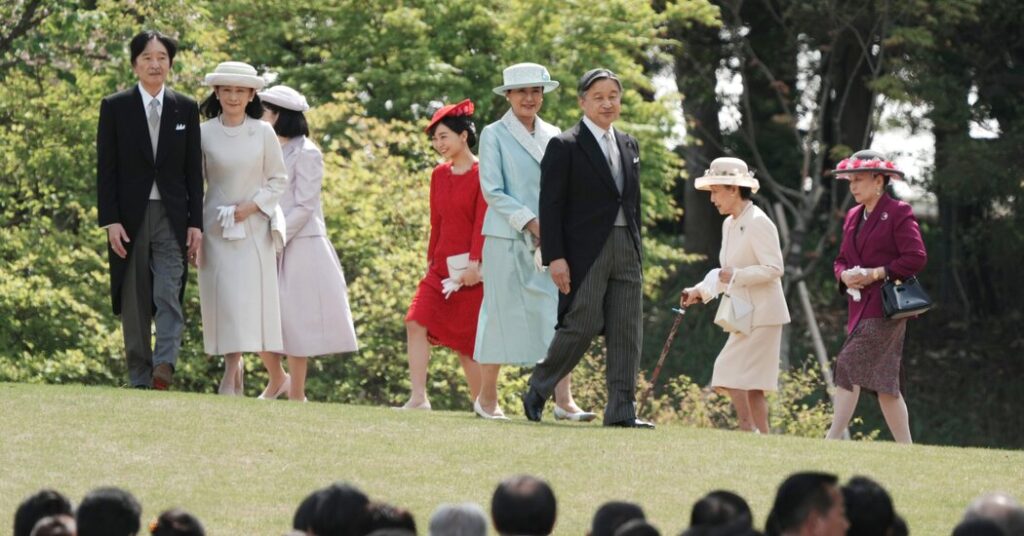
Japan’s imperial family, which has long maintained a male-only lineage for emperors, is running out of royals. Now the country has a plan to help revitalize its dwindling ranks: Recruit more men.
Japan’s legislature, hoping to avoid a succession crisis, moved forward with a proposal this past week to allow the imperial family to adopt scores of distant male relatives. That could give Japan more choices for future emperors — only men are allowed to ascend the Chrysanthemum Throne — and help ensure the survival of the world’s oldest monarchy.
The plan has angered some Japanese officials, commentators and activists, who say there is an easier solution: allowing women to reign as emperor, an idea embraced by a broad swath of the public, according to polls.
“Many citizens want a female emperor now,” said Kiyomi Tsujimoto, a female lawmaker with the Constitutional Democratic Party who opposes the plan. “I have people running up to me every day.”
But in Japan’s patriarchal system, that idea is considered a nonstarter.
Prime Minister Sanae Takaichi, a conservative lawmaker, shattered the political glass ceiling last year when she became the first woman to lead Japan’s government. But she and her allies have been among the most vocal proponents of preserving the male-only lineage.
She has said that “it is considered appropriate to limit eligibility to male descendants of the imperial lineage.”
An Imperial Crisis
Japan’s demographic decline has touched nearly every aspect of its society, including the monarchy. The royal family is now made up of only 16 people — five men and 11 women — down about a quarter since 1990. This makes it difficult for the family to carry out its public duties, like overseas visits and court ceremonies. There are simply not enough royals to take part. Today, there are only three heirs to the throne, compared with six a generation ago.
The reigning emperor, Naruhito, 66, is the 126th in a line that extends back to the country’s founding in 660 B.C. by the Emperor Jimmu, who, according to legend, descended from a sun goddess.
In the early 2000s, the pressure to bear a son drove Naruhito’s wife, Empress Masako, a Harvard-educated former diplomat, into a deep depression. The couple has a daughter, Princess Aiko, 24, who has taken on a more visible role recently, like leading a visit to Laos, and has been championed by some as a future emperor.
But under the current rules, only Prince Hitachi, Naruhito’s 90-year-old uncle; Crown Prince Akishino, the emperor’s 60-year-old brother; and Prince Hisahito, the monarch’s 19-year-old nephew, are recognized as heirs to the throne.
The Adoption Plan
In the aftermath of World War II, the United States sought to weaken the power of the Japanese imperial family members, who were regarded by the public as demigods. (The monarchy historically maintained a divine right to rule.)
Under Japan’s 1947 Constitution, imposed under Gen. Douglas MacArthur, the emperor became “the symbol of the state and of the unity of the people,” a figurehead with no political authority. Eleven imperial families were forced to give up their royal status, shrinking the family to 16, down from 67 in 1946.
Under the plan to be advanced in Parliament, men from these former royal branches would be brought back into the monarchy. While it is unclear how the men would be selected or how many would be eligible, they would most likely come from the Kuni, Higashikuni, Kaya and Takeda families. Experts said their offspring might one day be eligible to inherit the throne.
The men from these families have been living as commoners, working in media, life insurance, advertising and other fields, according to Japanese news reports. Some question whether the public would accept them or their offspring as royals.
Emperor Naruhito said this past week that he hoped the plan would be “understood by the people.”
A Nod to Women
Japan has had female emperors with varying degrees of power, including Go-Sakuramachi, who reigned in the late 1700s. But men have dominated the ranks since then, and Ms. Takaichi’s Liberal Democratic Party, which has led Japan for much of the past seven decades, has long held that the male line of succession is sacrosanct.
The plan now in Parliament would give women in the imperial family some new rights. They would be allowed to stay in the family and retain their royal status if they marry a commoner.
But others argue that equality will not be achieved until women are allowed to reign, an idea that has been discussed on and off over the years. The popularity of Princess Aiko has added to a sense that women could be well suited for the role.
Hideya Kawanishi, an expert on the imperial family at Nagoya University, said the plan would not address the longer-term succession crisis. He said the problem could be solved by elevating women, and the reluctance to do so reflected prejudice in Japan.
“Even though society has changed, there are still old men who lament when a girl is born,” he said. “Over time, the imperial system will become unsustainable.”
Kiuko Notoya contributed reporting.
The post Japan Is Running Out of Royals. Are More Men the Answer? appeared first on New York Times.