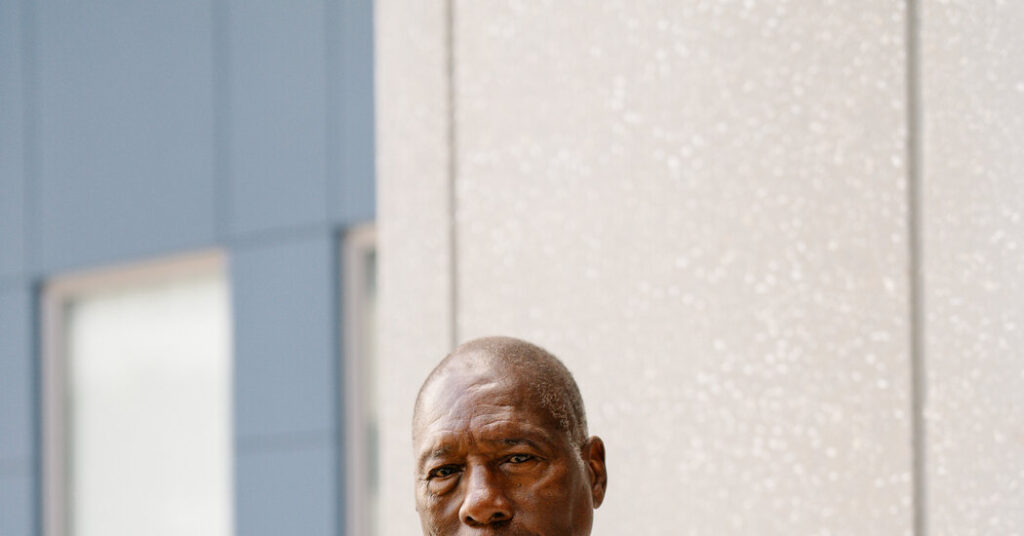
Marvin Dunn, a Florida historian and activist, became so angry this fall after a public college quietly handed over a prime downtown property for President Trump’s future library that he sued. A judge sided with him, ruling in October that the trustees of Miami Dade College had failed to provide reasonable public notice before their vote.
The college appealed, saying it had done nothing wrong. But faced with the prospect of a protracted and expensive trial, the trustees reconsidered. They met again on Tuesday and redid their vote, this time after hearing for more than three hours from over 70 people, most of them in opposition.
The outcome was the same: The seven trustees voted unanimously to convey the 2.63-acre property to the state, which then gave it to the nonprofit foundation raising money for Mr. Trump’s presidential library. The foundation is controlled by the Trump family that has indicated that it expects to raise $50 million this year.
But Dr. Dunn, a former professor who looks younger than his 85 years and who has long sought to preserve Florida history, vowed to keep fighting the library in court.
“We’re just getting started,” he told the trustees at the meeting, which was held at Miami Dade College’s campus in Hialeah, outside Miami. “We don’t want this land given away.”
The trustees defended their initial vote, saying that Tuesday’s hearing was unnecessary but that they were happy to hear from the public. One trustee, Jose Felix Diaz, noted that the board was voting on the land transfer to the state and not directly negotiating anything with the Trump foundation.
The college, he and other trustees said, was not in a position to say no to the state’s request.
“We are a creature of the state,” he said. “We need them, and they need us.”
The transfer of the downtown property to the Trump library foundation began in September, when the college’s trustees voted to give the land to the administration of Gov. Ron DeSantis, a Republican, at the administration’s request. Mr. DeSantis and other top elected state officials who make up the Florida Cabinet then unanimously approved giving the property to the foundation.
Under the terms of the transaction, only certain “components” of the property, a parking lot across the street from Biscayne Bay, would be required to house a presidential library, museum or center. This would leave room for a hotel, condominium or other for-profit development. Construction would have to begin within five years.
After Mr. DeSantis and the Cabinet voted on Sept. 30 to deed the property to the Trump foundation, the foundation said publicly for the first time that it had explored several options before selecting the downtown site.
Dr. Dunn argued in his lawsuit that the trustees’ initial vote violated the state’s Sunshine Law, which requires a certain degree of transparency in government. The only public notice issued ahead of the meeting said the board would “discuss potential real estate transactions,” without any details. The meeting lasted less than five minutes.
After the judge, Mavel Ruiz of Florida’s 11th Judicial Circuit, temporarily ruled in Dr. Dunn’s favor in October, the trustees asked for an expedited appeal. But the appeals court rejected that request. Last week, Judge Ruiz set a trial date for August. The next day, trustees scheduled a new vote, in an apparent attempt to render the lawsuit moot.
Dr. Dunn’s lawyers said during Tuesday’s hearing that they would continue to pursue the case — on Dr. Dunn’s dime. The court required him to post a $150,000 bond for the case to move forward; Dr. Dunn said on a GoFundMe page that he had raised $26,000 toward the effort but had borrowed the rest of the money.
Dr. Dunn, an emeritus psychology professor at Florida International University, has a particular interest in preserving Black history in the state. After Mr. DeSantis signed a law in 2022 restricting teaching on race, Dr. Dunn organized Black history tours. In Newberry, Fla., near Gainesville, he reminded attendees how six Black people were lynched by a white mob in 1916. He then led them to Rosewood, a predominantly Black town that was burned to the ground by a white mob in 1923.
Last month, on the same day that Mr. Trump spoke at a forum in downtown Miami, Dr. Dunn held a demonstration in nearby Overtown, a historically Black neighborhood, where he spoke of the valuable real estate that the college was losing to the Trump library.
The public comment section of the hearing on Tuesday exposed deep political divisions in Miami-Dade County, which Mr. Trump won in 2024 — the first Republican presidential candidate to do so since 1988 — but where his rhetoric and policies, especially related to immigration, have led to raw anger. At times, the proceedings turned raucous, and the board chairman asked for a couple of speakers to be removed.
Some opponents of the land transfer criticized Mr. Trump. Others questioned why the trustees of a taxpayer-supported college would donate land appraised at more than $67 million but believed to have a much higher market value, without any compensation, profit-sharing or other guarantees.
“The college is not a wealthy institution,” said Brenda Mosier, a Miami Dade College alumna. “Why should the trustees — which, by the way, have ‘trust’ in its name — make such a poor financial decision?”
But some supporters of the move noted Mr. Trump’s local popularity, including among Hispanics, who make up a majority of Miami’s population. They said a presidential library would bring more tourism, prestige and research opportunities to Miami, a place that often feels as if it is still trying to prove itself as a big city.
“Today’s discussion is not about partisanship,” said Anthony Cabrera, a first-year Miami Dade College student who supports giving the land to the Trump foundation. “It’s about history, legacy and the continued elevation of Miami-Dade County at a local and global stage.”
Patricia Mazzei is the lead reporter for The Times in Miami, covering Florida and Puerto Rico.
The post Miami Activist Vows to Keep Fighting After New Vote on Trump Library appeared first on New York Times.