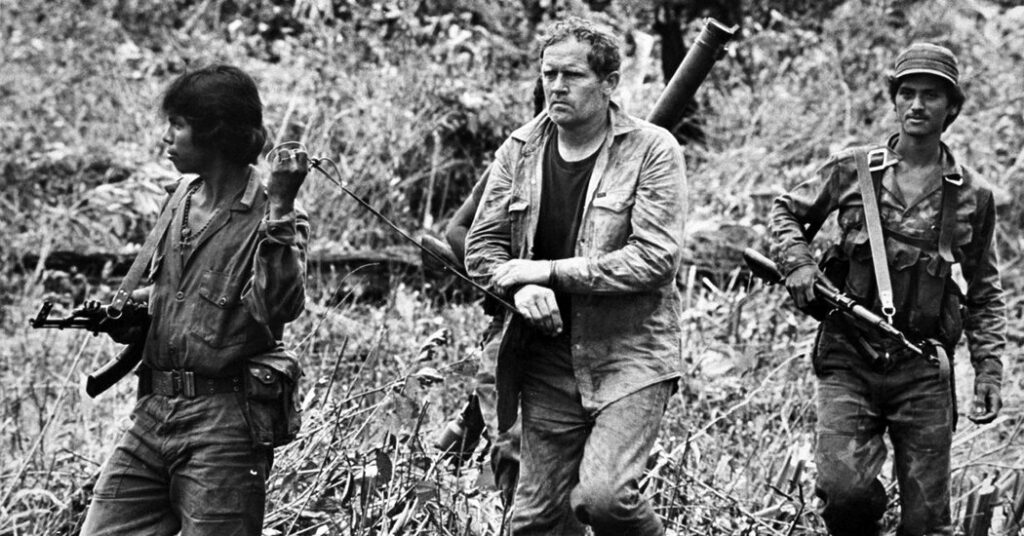
Eugene Hasenfus, who as a 45-year-old former Marine and laid-off construction worker was thrust into the national spotlight in 1986 when, on a covert mission sponsored by the C.I.A., his gunrunning cargo plane was shot down over Nicaragua, setting off what would become known as the Iran-contra affair, died on Wednesday at his home in Menominee, Mich. He was 84.
His death was confirmed in an obituary provided by his family to the Hansen-Onion-Martell Funeral Home in nearby Marinette, Wis., where Mr. Hasenfus was born. He had been treated for cancer for nine years, his family said.
Mr. Hasenfus emerged out of obscurity on Oct. 5, 1986, when a missile fired by troops fighting for Nicaragua’s leftist government downed his plane while it was on a run to drop arms to right-wing rebel forces, known as contras, who were seeking to overthrow the country’s leaders.
The pilot, co-pilot and radio operator of the plane — a twin-engine turboprop of 1950s vintage — died in its fiery crash in a patch of jungle in southern Nicaragua. Mr. Hasenfus, who had been responsible for packing and dropping the arms, was the lone survivor.
An experienced skydiver and the only crewman with a parachute, he had leaped from the cargo compartment, which had been blasted open by the missile, as the aircraft began plummeting to earth.
Government troops captured him a day later, finding him unhurt and protected from an overnight rain under a makeshift tent that he had fashioned out of his parachute.
The Nicaraguan government, controlled by the Sandinistas, charged Mr. Hasenfus with violating its public security laws and accused him and the other crewmen of being C.I.A. agents.
While awaiting his trial, Mr. Hasenfus told the CBS News correspondent Mike Wallace for a segment of “60 Minutes” that when he joined the mission, he believed that he was working for the C.I.A. Asked what an average American would think about the shoot-down, he replied, “He’s going to make that the government is backing this 100 percent, and that’s what I believe, too.”
President Ronald Reagan’s administration initially denied any American involvement in the flight. Those denials began unraveling when it was reported that the cargo plane belonged to Southern Air Transport, a charter carrier based in Miami that was formerly owned by the C.I.A.
Mr. Hasenfus’s capture led to investigations by Congress and by an independent counsel, Lawrence E. Walsh, and ultimately to revelations that the administration, defying Congress, had illegally sold arms to Iran and used some of the proceeds to secretly support the contras. The scandal shadowed the Reagan administration and later the presidency of George H.W. Bush, who was Mr. Reagan’s vice president before succeeding him in 1989.
Before his trial, in a news conference in Managua, Nicaragua’s capital, with Sandinista officials sitting beside him, Mr. Hasenfus said his supply flight had been directly supervised by members of the C.I.A. in El Salvador.
He was convicted and sentenced to 30 years in prison but was freed in December 1986 in what Daniel Ortega, the Sandinista leader who is now the country’s autocratic president, called an act of good will toward the United States.
Iran-contra’s roots dated back to the early 1980s, when the Reagan administration secretly sold arms to the Iranian government despite a congressional embargo on such sales; the White House had hoped that the Iranians would use their influence to secure the release of American hostages held in Lebanon by the Tehran-backed militant group Hezbollah.
Some of the proceeds from those sales were used to fund secret airdrops to the contras through a private network with ties to the Reagan administration. The network, which received logistical and tactical support from the C.I.A., was created as a means of circumventing a 1984 congressional ban on using government funds to aid the contras.
Fourteen figures from the Reagan administration, the C.I.A. and the private network funding the contras faced criminal charges arising from the scandal. Among them were two Reagan national security advisers, Robert C. McFarlane and his successor, John M. Poindexter; and Lieut. Col. Oliver North, a National Security Council official assigned to Latin American affairs. The only one who went to prison, for 16 months on tax-evasion charges, was Thomas G. Clines, a retired C.I.A. officer who, as an international arms dealer, had become enmeshed in the operation.
President Bush issued six pardons to Iran-contra defendants in December 1992 after losing to Bill Clinton in his bid for re-election.
Eugene Haines Hasenfus was born on Jan. 22, 1941, to William and Beverly (Haines) Hasenfus in Marinette, a town of about 12,000 in northeastern Wisconsin. His father was a construction worker.
Soon after Mr. Hasenfus was captured, I.W. Stephenson, a longtime family friend, described him to The New York Times as “a good, plain boy, all-American, in the sense of being a rugged outdoorsy type.” Mr. Hasenfus had played high school football and enjoyed hunting.
Joining the Marine Corps after graduating from high school in 1960, he was trained to handle cargo on military flights and completed airborne school.
He was discharged in 1965 and then flew during the Vietnam War for Air America, a C.I.A.-owned company, dropping arms and food to Laotian forces fighting North Vietnamese troops.
After the war, Mr. Hasenfus operated a parachuting school in Wisconsin with his brother Bill and worked for a construction company until he was laid off in January 1986. That May, he was recruited to fly on the secret missions over Nicaragua by William J. Cooper, a former pilot for Air America. Mr. Cooper flew the cargo plane downed by the Sandinistas.
In 1987, Mr. Hasenfus joined with his wife, Sally (Weber) Hasenfus, and the family of Wallace B. Sawyer Jr., the plane’s co-pilot, in a lawsuit seeking back pay from Southern Air Transport and other damages on grounds that the company had not properly maintained the plane. A jury in federal court found that the crewmen had been paid all that they were due and awarded no damages.
A 1994 report by Mr. Walsh, the independent counsel, found no evidence that President Reagan or President Bush had violated any criminal laws. But Mr. Walsh asserted that Mr. Bush, contrary to his statements, had been “fully aware of the Iran arms sales.” Responding to the report’s findings, Mr. Reagan and Mr. Bush repeated their assertions that they had done nothing wrong.
Life did not go well for Eugene and Sally Hasenfus in Iran-contra’s aftermath. A fire damaged their home, Mr. Hasenfus found only occasional work in construction, and the family faced large legal bills stemming from its lawsuit. The marriage ended in divorce.
According to the Marinette funeral home, Mr. Hasenfus is survived by his children, Sarah Herman and Adam, Taylor and Eugene Hasenfus Jr.; his brothers Bill and Dennis; and eight grandchildren.
In a 1991 documentary, “The Eugene Hasenfus Story,” produced by Wisconsin public television, Mr. Hasenfus spoke of his pride in his military service and of his role in funneling aid to the contras. At one point in the film, the camera followed him into his garage, where he retained artifacts from his flying career. He held up the shirt he was wearing when he was shot down.
He said he had felt betrayed by the U.S. government for not revealing the truth behind the contra supply flights when he went on trial.
“We were a forgotten group as of October 5,” he said, reflecting on the day his cargo plane was shot down. “It’s like I wasn’t there. They didn’t want to know me. They wished I was dead.”
Ash Wu contributed reporting.
The post Eugene Hasenfus, Gunrunner Who Exposed Iran-Contra Plot, Dies at 84 appeared first on New York Times.