As you settle in to watch the world’s biggest sporting event — 39 days, 48 teams, 104 matches and more than 1,200 pairs of pounding, cleated feet — spare a blessing for the grass.
FIFA, the international ruling body of soccer, mandates that every World Cup match be played on natural, living turf. Moreover, the playing experience, including the bounce and movement of the ball and the player “feel,” must be consistent from venue to venue. (Also, the field must be green.)
Achieving this is no small task. The 2026 World Cup involves 16 stadiums — five of them domed, eight with permanent artificial turf that must be overlaid — across three countries and widely varying climates.
“We have this massive, massive tournament footprint,” said Alan Ferguson, FIFA’s senior pitch management manager. “Trying to bring that together in a uniform manner has been our biggest challenge.”
Under Mr. Ferguson’s guidance, FIFA has assembled a crack team of turfologists led by John Sorochan at the University of Tennessee and John Rogers at Michigan State University. They have been working since 2018 to determine how best to achieve the green dream. Here’s where they have landed.
The biological bottom line
There are two dozen species of turf grass; none are created equal. Kentucky bluegrass is a cold-weather species, adapted to lower light levels and shorter growing seasons. Bermuda grass, a warm-climate grass, can’t take the shade. Perennial ryegrass, a cold-weather bunch grass, germinates quickly but is more vulnerable to divots.
Both Bermuda grass and Kentucky bluegrass grow laterally and can be cropped closely — ideal for golf courses and soccer fields. Each of these grasses, and combinations of grasses, has its own growth rate, moisture requirements, ideal mow heights, and presents different physics to the shoe.
To see how various turf combinations responded to players’ movements, Dr. Sorochan’s team invented the Flex, a portable device outfitted with a 3-D-printed foot in a soccer cleat. It strikes the turf with the same impact, acceleration and cutting motion of a 168-pound athlete (the average weight of a men’s World Cup player), and then measures how much energy the turf absorbs and returns to the player.
Other machines are “just a vertical drop, like it’s a missile or something,” Dr. Sorochan said. “This is the first time we’ve actually got something that really mimics a consistent strike of a foot.”
And there’s the ball to consider. According to the FIFA Turf Test Manual, a FIFA Quality Pro ball released onto an elite field from an approved one-meter-tall apparatus — say, the Turf-Tec FIFA Ball Ramp — should roll five to eight meters, with tests conducted at several spots and in several directions. Likewise, a “test specimen” dropped vertically from two meters with the RedDrop Ball Rebound Tester must rebound between 60 centimeters and 100 centimeters.
This holds whether the surface is natural or fake, bluegrass or Kikuyu, at sea level or at an elevation of 7,300 feet in Mexico City. Dr. Sorochan and his colleagues ran these tests and many more.
“We compared Bermuda grass versus bluegrass and rye grass and synthetic turf,” he said. “And we launched a soccer ball in at 55 kilometers an hour at 17 degrees, and used a high-speed camera to measure the coefficient of restitution of the ball coming out, the velocity, everything.”
The verdict? The open-air stadiums in Miami and Monterrey, Mexico, would use Bermuda grass, and the indoor domes and northern stadiums would use a custom mix of 84 percent Kentucky bluegrass and 16 percent ryegrass. The result, Dr. Sorochan hopes, is a playing experience that is “uniform and homogeneous across all 16 stadiums.”
Bring us your sod
The sod for the 16 stadiums was grown at nine sod farms across Canada, Mexico and the United States. For the longest journey, two dozen refrigerator trucks carried rolls of sod 1,400 miles from Colorado to Atlanta — a 30-hour trip, with stops only to switch drivers.
One innovation for 2026 is an agricultural technique known as sod on plastic. Traditionally, when sod is harvested, the roots are cut, which can lead to transplant shock — less resilient turf that takes longer to settle into its new home. For the World Cup, the grass was grown on a thin layer of sand atop a plastic sheet. The roots grow down and then sideways, intertwining into a dense, hardy mat. The sod can then be sliced, rolled up for transportation and installed without trauma.
Once in place, the sod is reinforced with plastic fibers, stitched in with a machine resembling a combination of steamroller and sewing machine. The fibers become anchors for the natural roots and act like rebar to stabilize the field.
The fields are alive
Unlike a basketball court or a hockey rink, a soccer field is a living, breathing entity. Once the turf is installed, it must be kept alive for several weeks, an especially difficult task in domed stadiums.
“The advancement of stadium design kind of overtook the maintenance of the soccer field,” Mr. Ferguson said. “When the stadiums went to the wraparound — the enclosed roof to protect the fans and give them a better experience — they started to shut out things like air and sunlight.”
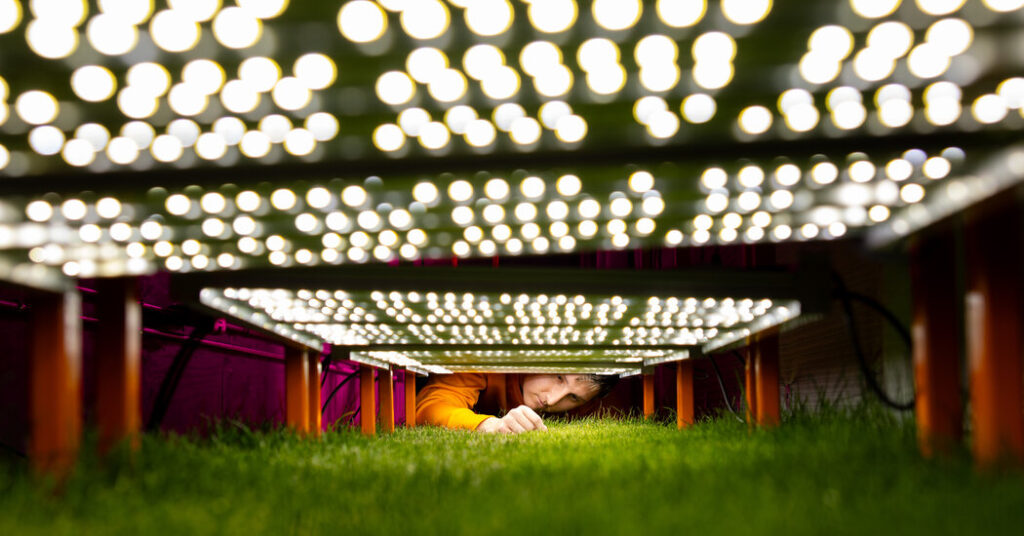
The temporary fields for the 2026 World Cup basically sit atop a life-support system. Below the rolled-out sod are several inches of sand, which provides firm cushioning but also stays more breathable for the roots after weeks of play. Below that is a layer of either gravel or plastic Permavoid, with a drainage system that can pump water in or out. Two-ton LED grow lights are wheeled in for 12 hours a day, while industrial fans blow air across the surface to cool the turf and stave off fungi.
Even after the tournament begins, the testing continues, every day, in every stadium to maintain standards. “We’ll keep an eye on traction, on moisture and on surface hardness,” Mr. Ferguson said, quickly adding that “we don’t want to adversely damage the pitches just by over-testing them.”
Watching the grass (hopefully) grow
Mr. Ferguson will be watching the entire show from the FIFA Tournament Operations Center in Miami, where several dozen staff members work around the clock to monitor weather reports, flight delays and stadium and field updates.
“Every minute and every second of every game, I’ll watch here,” he said. “We’re looking for slips, bad bounces, something that just doesn’t look quite right with the field. Hopefully we don’t get a whole lot of that.”
Only when his native Scotland takes the field will he raise his eyes from the field itself, he said: “Scotland first, pitch second in that 90 minutes.”
The post The Scientific Quest for a Perfect World Cup Field appeared first on New York Times.