Not long ago, a small — or, if you want to get technical about it, large — indicator of American soccer culture’s 21st-century transformation appeared in the night sky above Midtown Manhattan. Just after sundown on May 31, the LED lighting system at the top of the Empire State Building snapped on, striping the tower’s upper facade and spire red and white. It was a tribute to Arsenal, the storied North London soccer club, which had clinched the English Premier League championship a dozen days earlier.
Arsenal’s first league title in 22 years touched off ecstatic celebrations in Britain’s capital and in cities around the world, from Melbourne to Jakarta to Addis Ababa. Similar scenes played out not far from the Empire State Building. When a loss by Manchester City sealed the championship for Arsenal on May 19, joyous die-hards poured out of bars in Lower Manhattan and Brooklyn, many wearing the club’s red and white jerseys.
The following weekend, Mayor Zohran Mamdani, an Arsenal supporter since childhood, was in the crowd at a packed Brooklyn sports bar to watch the team’s last match of the Premier League season and to cheer the ceremonial trophy-lift that followed the final whistle. Again, the party spilled into the streets, where the mayor and another celebrity Arsenal superfan, Spike Lee, joined the throng waving flags and singing terrace chants.
For decades, soccer’s place in American life was marginal and subcultural. At the turn of this century, top European clubs like Manchester United and Real Madrid had become huge global brand names — marquee attractions in what was not just the planet’s most ubiquitous sport, but arguably its dominant form of mass culture, up there with Hollywood movies and pop music.
Yet in the United States, “world football” remained a fringe obsession, shared by a hard core of expats and American fans, who faced steep challenges just to tune in games from Europe’s top leagues. To watch the weekly action in the Premier League, Spain’s La Liga, Italy’s Serie A and the German Bundesliga required subscriptions to specialty cable services or expertise in the internet dark arts. Some of us can recall spending our Saturday mornings hunched over a laptop, gaping helplessly at a buffering feed of a Bayer Leverkusen-Werder Bremen match on an illicit peer-to-peer streaming site. You felt like a ham radio operator trying to contact Mars.
The American press, meanwhile, was indifferent to even the biggest soccer news. The last time Arsenal won the Premier League — in the legendary “Invincibles” campaign of 2003-04, when the club went undefeated — the story barely blipped in U.S. media. In this newspaper, on the day after Arsenal’s final game, the team’s achievement garnered a three-sentence wire service write-up in a “Sports Briefing” column, sandwiched between an item about an N.F.L. running back’s violation of the league’s substance abuse policy and an update on the third-round leaderboard at a golf tournament in Franklin, Tenn.
Things have changed. Today, soccer, like espresso, yoga and other once “exotic” imports, is an ambient everyday presence in American life — on our digital devices, on the street, and, quite literally, in the air, flashing on the skyline of the nation’s biggest city. The day before the Empire State Building lit up, CBS Sports drew record viewership — the largest audience for a club soccer match in U.S. English-language TV history — for its broadcast of another Arsenal match, the UEFA Champions League final. NBC Sports’s broadcasts of the Premier League reach millions of viewers on match weekends, and not just in the coastal metropolises where one might expect to find soccer connoisseurs: Markets with the largest local audience share include New Orleans, Greenville-Spartanburg, S.C., Indianapolis, Cincinnati, Tulsa, Okla., and Buffalo.
A report issued this year by Nielsen, the media analytics company, found that Americans spent nearly 80 billion minutes watching soccer in 2025. In the United States, Nielsen concluded, “soccer has passed from emerging interest to cultural infrastructure, anchored by a fan base over 62 million strong that ranks fifth in the world.” Another survey, conducted by the London-based market-research firm Ampere Analysis in 2024, determined that soccer had overtaken baseball as Americans’ self-declared third favorite sport behind football and basketball.
These trends coincide with the most significant soccer event to take place on these shores in a generation. The 2026 FIFA men’s World Cup, hosted by the United States, Canada and Mexico, kicked off on Thursday in Mexico City. It is the largest-ever edition of the quadrennial tournament, with 48 teams competing in 104 games, 78 of which will take place in this country, in 11 cities.
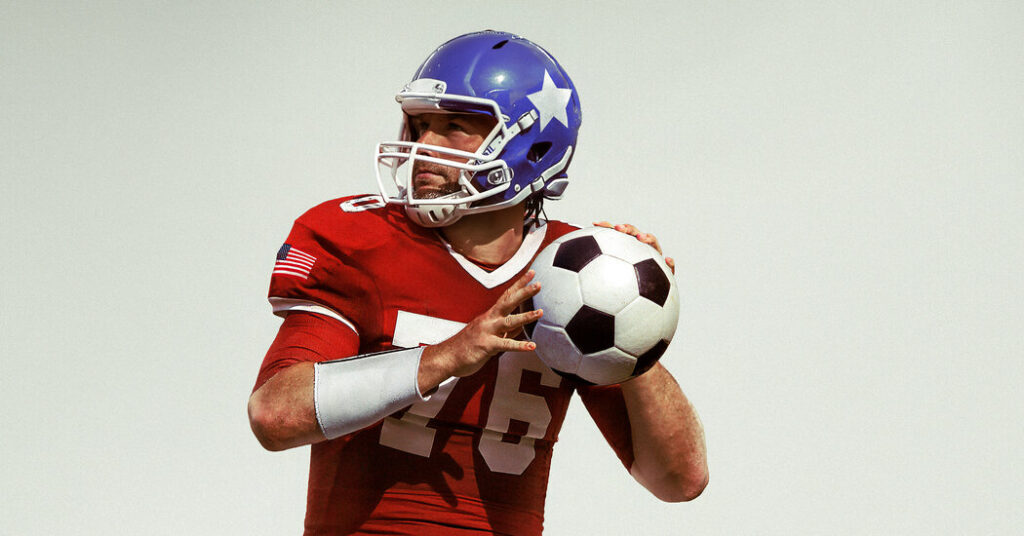
It is a moment to take stock of the altered landscape. For decades, soccer posed a riddle of American exceptionalism. What would it take for the world’s most powerful country to get on board with humanity’s favorite sport? The change, it turns out, came slowly, and then with shocking speed, transforming the United States not just into a bona fide soccer nation, but a novel and unusually influential one. It’s a story that holds a heady plot twist: For better and — more to the point, perhaps — for worse, Americans may not have joined soccer’s universe so much as soccer has embraced America’s.
One thing is certain: We have traveled far from 1994, when the United States first hosted the World Cup, and pundits greeted its arrival with incomprehension and scorn. “World Cup soccer is coming to the United States and I don’t care. Soccer is un-American,” proclaimed the syndicated columnist Charley Reese. In a much-discussed article written in advance of the tournament, USA Today’s Tom Weir compared the case made by soccer’s boosters to “what the Russians told us about Communism.” Weir assured readers they needn’t feel bad about their soccer-phobia: “Hating soccer is more American than Mom’s apple pie.”
Of course, it is literally true that soccer is un-American, and there are interesting things to say about the difference between its rules and rhythms and those of football or basketball. But soccer’s critics preferred crude culture-war framing. Back in 1986, during a House debate on a resolution to support the U.S. bid for the 1994 World Cup, Jack Kemp, a New York Republican and former N.F.L. quarterback, condemned soccer as “European socialist.”
Right-wing commentators took the trope out for a spin roughly every four years, when another World Cup rolled around. During the 2010 tournament, Marc Thiessen, a onetime George W. Bush speechwriter, wrote an essay for the conservative American Enterprise Institute denouncing soccer as “European statist” and “collectivist.” “Capitalist sports are exciting,” Thiessen explained. “People often hit each other, sometimes even score. Soccer fans are excited by an egalitarian 0-0 tie.” The Russian oligarchs and Persian Gulf potentates who owned some of soccer’s most glamorous clubs might have been surprised to learn that they were involved in a leftist mutual aid project.
Soccer’s U.S. partisans had their own set of misguided ideas. For decades, the nation’s soccer leadership — a loose coalition of bureaucrats, benefactors and evangelists affiliated with the U.S. Soccer Federation, the sport’s governing body — imagined that fan culture would flourish when the United States developed talent that could stand with the best from overseas. They placed faith in youth soccer, which by the time of the 1994 World Cup had solidified its place as one of the most popular participation sports for kids in the country. (The trend gave the political world a new term to use and abuse: “soccer mom.”) An earlier attempt to create a top-flight U.S. professional league, the N.A.S.L., had collapsed in the 1980s, but 1996 brought a promising successor, Major League Soccer. Soccer boosters dreamed big, envisioning a time when the nation’s soccer-mad youth would come of age, flooding M.L.S. with homegrown stars and turning the country into a perennial contender in international competitions.
In fact, the United States was already a global power, in women’s soccer. The passage of Title IX in 1972 and the underdevelopment of the women’s game in traditional soccer nations gave the States a leg up. The U.S. Women’s National Team won the inaugural FIFA Women’s World Cup in 1991, and went on to take the competition three more times, including in 1999 — a victory sealed by Brandi Chastain’s instantly mythic shirt-off celebration.
Yet these triumphs did not alter the underlying equation. Millions of kids played soccer in the 1990s without becoming lifelong fans. M.L.S. matured into both a solid professional league and a kind of high-end retirement colony for European superstars. But it has never approached the level of America’s top pro sports leagues, as its backers hoped.
In fact, the U.S. soccer brain trust had a faulty theory of the case. The breakthrough that drew in millions came not with the flowering of the domestic game, but when Americans gained entry to a universe beyond our borders.
Over the past decade and a half, the landscape of American soccer fandom has been transformed — like more or less everything in 21st-century life — by new technology: by streaming services, social media and other digital platforms that offer previously unimaginable access to a wide world of soccer. Live matches, highlights, memes, podcasts, transfer news, tactics breakdowns, rumors, gossip — an unfathomable plenitude of soccer action, analysis and scuttlebutt is now at our fingertips, beamed into the sci-fi walkie-talkies we carry everywhere.
The result, for American devotees, is a surreal reversal of the old conditions. Fans who once inhabited a soccer dead zone may now find themselves in a better position, as viewers of live broadcasts, than Europeans whose homes sit steps from the stadiums where the matches are held. This past season, livestreams of all 380 Premier League games were available to me through two subscriptions — roughly 100 more than fans in England could view, due to British blackout rules.
Sports media in general is increasingly internet-based. But the decentralized nature of soccer — its fragmentation across continents, countries, time zones, languages — makes it an ideal fit for the online era. Soccer’s popularity can be harder to perceive than, for instance, the N.F.L.’s or N.B.A.’s, because it is dispersed among so many leagues and tournaments, not to mention interfaces and apps. The way an American engages with soccer bears less resemblance to traditional sports fandom than to the modern consumption of pop music, another globalized cultural form that has been transfigured by algorithms and streaming media.
Unsurprisingly, the vanguard of America’s soccer fan base are digital natives, members of the millennial and Gen Z generations. But it is hard to generalize about an audience that is so large in number and so varied in its orientations. Some fans primarily follow Mexico’s Liga MX (one of the most watched soccer leagues in the United States). Others concentrate on the UEFA Women’s Champions League or the domestic National Women’s Soccer League.
Soccer is a scrambler of geography. A teenager in Houston might pledge allegiance to Barcelona or Liverpool; his sports idol might be Galatasaray’s striker Victor Osimhen, a Nigerian star of a Turkish team. Many soccer obsessives are only secondarily interested in the (as it were) IRL sport: their focus is EA Sports FC, one of the best-selling video games in the United States and a key soccer entry point that has schooled countless young people in the intricacies of transfer markets, promotion and relegation, and other arcana.
For years, Americans have been regarded as unsophisticated soccer-watchers: enthusiasts, maybe, but not connoisseurs. It’s a stereotype that still holds sway in many corners. A prominent peddler of the narrative is the hit comedy-drama “Ted Lasso,” whose premise — a corn-pone football coach from Kansas who knows nothing about soccer is put in charge of a professional team in London — construes the sport as one of those mystifying European things, like an old master painting or a humane social welfare system, that American rubes are incapable of comprehending. But in 2026, U.S. soccer followers occupy the same internet as fans in England and Brazil, and are as likely to be steeped in the wonkery of 3-box-3 possession structures, expected goals (xG) and other fine points of tactics and analytics discourse.
The most striking aspect of America’s soccer fan culture is its diversity. It is multicultural and multilingual. Many fans have global connections and transnational ties. There is a notable gender mix: A recent YouGov survey found that nearly one-third of serious soccer “followers” in the U.S. are female. Immigrants have long formed the bedrock of America’s soccer audience, and this remains the case. The scale of U.S. soccer fandom is inseparable from the country’s enormous Latin American, African, Arab and Asian diasporic populations, whose roots span nearly every major soccer-playing region of the world.
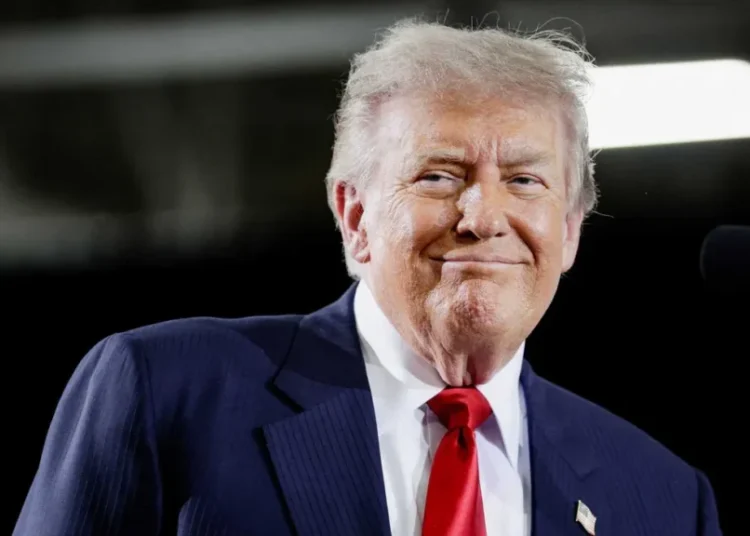
In short, American’s soccer fans may well more accurately reflect the nation’s demographic future than fans of other sports. To put the matter another way: the soccer fan base looks a lot like the future that the sitting U.S. president and his supporters have vowed to eradicate. One surprising development of the run-up to the World Cup was how little anti-soccer hysteria bubbled up from the MAGA bog lands. On the contrary, in December, President Trump went so far as to say that the N.F.L. should rename American football, since the real football, clearly, is the game where you kick the ball around.
The president made those remarks at the World Cup draw in Washington, where he was presented with an award invented just in time for the occasion, the FIFA Peace Prize, by Gianni Infantino, FIFA’s president. Infantino likes to intone high-minded odes to soccer as a force of global unity, but he is a man very comfortable in the company of the world’s warmongers and demagogues. The recent history of soccer’s governing body has been marred by corruption and scandal, and in the current century, the sport has likewise been overrun by morally dubious actors — sovereign wealth funds, petrostate-based owners, and other plutocrats and soft-power operators. It’s a scene where Donald Trump should feel right at home.
Indeed, one of the defining soccer stories of our time is the arrival in Europe of American billionaires and investment firms that have swooped in and scooped up some of the sport’s most glittering prizes, including Manchester United, Arsenal, Chelsea, AS Roma and AC Milan. Historically, clubs in Europe and around the world have been intensely local institutions, often rooted in working-class neighborhoods and strong civic identities. But in recent decades, world football has embraced an American business model, managing teams as global entertainment brands that maximize profits through sponsorships, merchandising and the cultivation of fan bases thousands of miles from their home turf.
An irony lurks here. For many stateside soccer addicts, the sport’s allure lies in part in the folkways of traditional fandom: match day rituals, coordinated chanting, banner waving, scarf wearing, the fervor of derby showdowns, age-old rivalries and unswerving devotion to your club. Yet increasingly, those local practices are imperiled, or at least diluted, by the very forces that allowed Americans to catch on in the first place.
American fans have not simply fallen in love with a “foreign” sport. They’ve fallen in love because that sport has, substantially, been remade in the image of American capitalism and marketed to them, U.S.A.-style. These days, it is loving soccer, surely, that’s as American as apple pie.
Jody Rosen is a contributing writer for The New York Times Magazine and the author of “Two Wheels Good: The History and Mystery of the Bicycle.”
The Times is committed to publishing a diversity of letters to the editor. We’d like to hear what you think about this or any of our articles. Here are some tips. And here’s our email: [email protected].
Follow the New York Times Opinion section on Facebook, Instagram, TikTok, Bluesky, WhatsApp and Threads.
The post How Soccer Changed America and America Changed Soccer appeared first on New York Times.