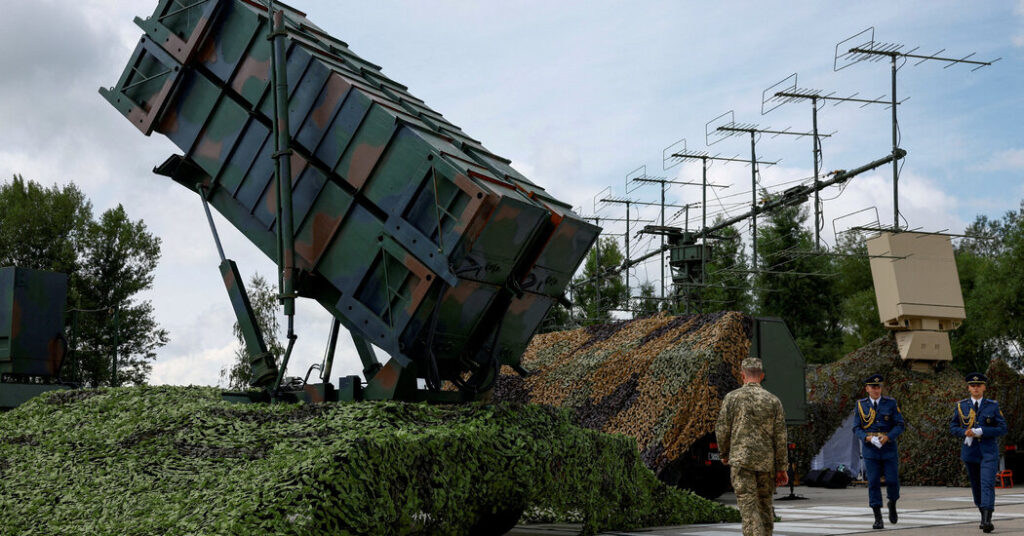
Russia’s ballistic-missile attacks against Ukraine have grown in ferocity and magnitude in recent weeks because Russian military planners are exploiting one of Ukraine’s greatest weaknesses: The Ukrainian military does not have enough Patriot missile interceptors to keep up with the barrages.
Air-defense units around the country are stuck making impossible calculations. Salvos can now include more than 1,000 drones and dozens of missiles. Exhausted crew members who have at times spent 24 hours glued to their radars with little food or sleep are overwhelmed by the much faster ballistic missiles they must try to knock down with their remaining interceptors.
That is, if they have any left in their launchers at all. In interviews with Ukrainian military officials, Western diplomats, security experts and frontline air-defense officers, the message was the same. The deliveries of Patriot interceptors have not kept pace with the drastically rising number of Russian ballistic missiles.
The technologically advanced interceptors are time-consuming to manufacture, and in a world at war, the global supply of them is overextended as never before. The conflict with Iran has unleashed an urgent demand in a host of countries along the Persian Gulf.
In addition, in Ukraine’s huge land mass, a dwindling stockpile is stretched even thinner as air-defense units try to cover the vast terrain the Russians might attack with their escalating salvos.
“A goalkeeper is standing in the goal, and suddenly 10 balls are flying at him at once. He cannot catch all of them,” said Col. Yurii Ihnat, a Ukrainian Air Force spokesman. “He can catch as many as he has hands and feet, right?”
Every miscalculation carries with it the burden of civilian lives in danger. Last month, 24 people died when a ballistic missile struck an apartment building in Kyiv, the capital. That attack, subsequent waves of intense Russian bombing and Ukraine’s public pleas for more interceptors have shattered any remaining sense of safety in Kyiv, where the presence of Patriot systems used to assuage fears of mass casualties.
Patriot missile interceptors are one part of the American-made Patriot mobile surface-to-air defense system that includes advanced radar, a control van and missile launchers. The launchers fire off the interceptors — like ammunition from a gun — with the goal of stopping the target in the air. PAC-3 interceptors are the most sophisticated weapon of this sort, capable of destroying ballistic missiles, high above the earth.
In addition to the Patriot system, Ukraine’s national air-defense network also includes interceptor drones, antiaircraft guns, helicopters and fighter jets. Ukraine has an array of less-sophisticated missile-defense systems as well, from Norway, France, Italy, Germany and elsewhere.
The Patriot system loaded with PAC-3 interceptors is the most important because, with its advanced technology, it can shoot down ballistic missiles more reliably.
A ballistic missile hurtles from the edge of space like a “meteor falling to earth,” said Gustav Gressel, a senior lecturer and researcher at the National Defense Academy in Vienna of the Austrian Armed Forces. When the Patriot interceptor darts upward to meet its target, the combined speeds of the two projectiles can exceed 6,000 miles an hour.
Although Ukraine is working to develop its own version of the Patriot system, at the moment, it cannot make an air-defense system as effective. The antiballistic technology cannot be stitched together with off-the-shelf components the way Ukraine created its homegrown drone industry after the war began.
Almost since the beginning of the war, Ukraine has had a consistent message for the United States and its European allies — that it needs Patriot missiles, the more the better, and that it does not have enough to protect itself from Russian air raids.
Recently, President Volodymyr Zelensky of Ukraine has raised the alarm with increasing urgency, noting in a letter to President Trump last month that the pace of deliveries “is no longer keeping up with the reality of the threat we face.”
Russia went from launching just 74 ballistic missiles in 2023 to nearly 600 in 2025, according to a data set created by The New York Times from daily numbers released by the Ukrainian Air Force. This year so far, Russia has fired 410 ballistic missiles at Ukraine, a pace of roughly 900 for the year if Moscow can keep it up.
In contrast, Lockheed Martin, which produces the advanced PAC-3 interceptors, said that it delivered 620 total last year worldwide. It has committed to increasing production.
It is hard to say precisely how many Patriot interceptors remain in Ukraine’s stockpile. The number is classified. At the end of June last year, there were as few as 16 in Ukraine’s arsenal, The New York Times has reported.
Over the past three years since it acquired its first Patriot system, Ukraine has received more than 1,600 of the expensive, difficult-to-manufacture interceptors, said Colonel Ihnat, the Ukrainian Air Force spokesman, which includes both the PAC-3 and the previous generation PAC-2 missiles. They are not, however, keeping pace with the increasing attacks.
Experts point out that whatever the exact number of interceptors Ukraine has, the figure does not match the sheer number of ballistic missiles that Russia is launching.
“If you compare the number of ballistic missiles being produced every month with the number of interceptor missiles produced annually, the math simply does not work,” said Oleh Katkov, the editor in chief of Defense Express, a Ukrainian media and consulting group that covers the military.
The interceptors have to be in the right place at the right time. Valerii Romanenko, an aviation expert and former air-defense officer at Ukraine’s National Aviation University, said that “there are often simply not enough interceptors immediately available at a specific unit during repeated large-scale attacks.”
Sometimes the launch units “are simply empty,” he said. “We can see the incoming missiles, but there is nothing left to fire at them with.”
Western allies of Ukraine have dipped into their limited stockpiles for years to donate interceptors to the Ukrainians. They say the flow of deliveries has continued.
The multibillion-dollar program to provide critical military equipment and munitions “continues to deliver much-needed capabilities, including Patriot interceptors, to Ukraine,” said Col. Martin O’Donnell, a NATO spokesman. “That’s why continued investment from allies — all allies — for this initiative is vital.”
The war with Iran has upended all calculations of supply and availability of the precious interceptors. Ukrainians have watched in frustration bordering on horror as footage showed Gulf states in some instances using multiple Patriot missiles to shoot down a single cheap, slow-moving drone. The conflicts in Ukraine and the Middle East have far outstripped the production capacity of the missiles this year.
Because they have a limited range and Ukraine is a large country, a Patriot system in western Ukraine cannot protect the front lines in the east or vice versa. Commanders must worry constantly about counterattacks aimed at taking out the radars, the trained personnel manning them and even the interceptors themselves.
“Ukraine cannot keep all missile stockpiles in one location or near one another because Russia would quickly identify and strike those warehouses,” Mr. Romanenko said.
The worldwide shortage of interceptors has prompted a search for alternative air-defense options. Last month, the U.S. Defense Department put out a call for new ideas for lower-cost interceptors capable of bringing down short-range ballistic missiles. Israel now uses its own Arrow air-defense systems to combat ballistic missile threats.
The Ukrainian defense company Fire Point said it had tested a new missile-defense system, but whether it can perform at the level of the advanced PAC-3 remains to be seen.
“These two objects must physically meet in the air at extraordinary speed and precision,” Mr. Romanenko said. “Developing technology capable of doing that reliably requires years of testing and real-world trials.”
In the meantime, American companies are looking for ways to speed up production of existing Patriots. The defense contractor RTX announced in April that it was adding production at a new facility in Germany. In May, L3Harris Technologies, which provides propulsion systems to Lockheed Martin, the manufacturer of PAC-3s, announced that it had agreed to purchase the attitude control motors used to steer the interceptors at a facility in Poland.
“In practice, the entire civilized world has now run into the production limits of what Lockheed Martin can manufacture,” said Mr. Katkov of the Ukrainian media and consulting group.
Maria Varenikova, Liubov Sholudko and Oleksandra Mykolyshyn contributed reporting.
The post Russia Is Rich in Ballistic Missiles. Ukraine Is Short of Ways to Stop Them. appeared first on New York Times.