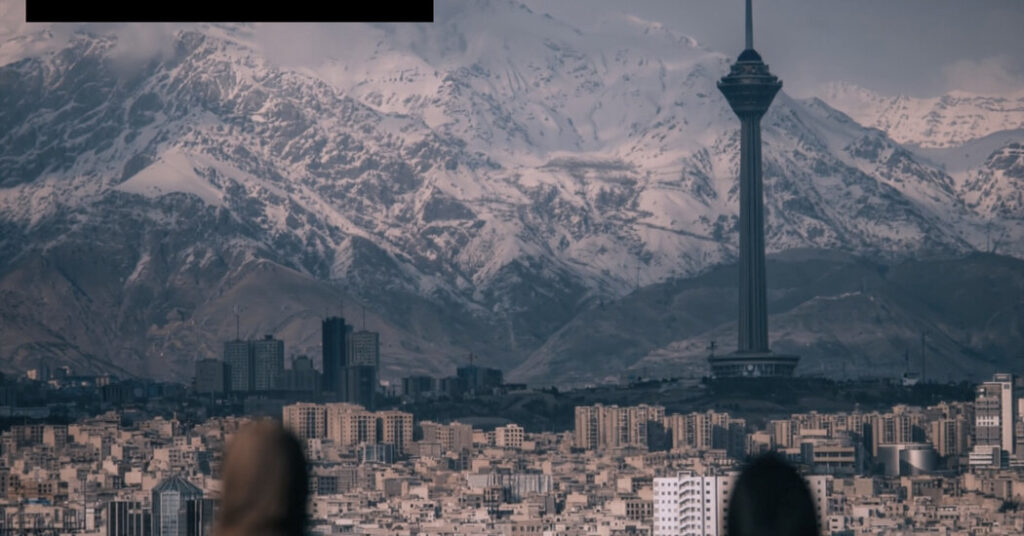
Ash Koosha was in London, not Tehran, when the internet went dark in the Iranian capital during a deadly government crackdown against protesters in January. Some video clips and photographic evidence did eventually trickle out.
But Koosha, who was born in Iran, understood that the true extent of the suffering might never be fully known.
So with his brother, Pooya Koosha, he got to work on “Dreams of Violets,” a 75-minute docudrama in which every image was made by generative artificial intelligence.
On the screen, officers unload their weapons, fires explode on the streets, and a child watches the chaos breathlessly. But the filmmaking was done from inside a London apartment. There were no actors, no sets, no cameras.
“Speed matters here, right?” said Koosha, a first-time filmmaker who left Iran in 2009. “Journalists are scrambling to verify things. Humanitarian organizations are scrambling and artists are scrambling. They’re trying to tell the story.”
Koosha’s movie is a memorial, he says, in a moment when journalism was not possible.
“Dreams of Violets” had its world premiere at the Tribeca Festival in Manhattan this week, making it the first full-length, live-action film completely generated by A.I. to be accepted by a major film festival, according to Fountain 0, the studio behind it. Koosha wrote the script and designed the A.I.-powered production pipeline to bring it alive.
“He’s using what he knows, the technology he has, as his paintbrush, as his keyboard, as his way to express himself,” said Jane Rosenthal, a leading Hollywood producer and Tribeca co-founder who helped bring an A.I.-enhanced version of “The Wizard of Oz” to Sphere in Las Vegas.
“This movie would not exist without this technology,” she added. “You’re not replacing anything or anyone.”
Rosenthal is among the Hollywood power players who are embracing what they see as the inevitable rise of A.I. in film and television.
“Pandora’s out of the box,” she said. “We’ve got to learn it.”
But the topic remains divisive. Some consider A.I. a job killer, a tool to sprint ahead in the unrelenting race to make movies cheaper. Others see it as an existential threat to society.
The premiere of “Dreams of Violets” was well attended, drawing a chatty line outside AMC 19th Street in Flatiron. When the theatergoers later trickled out, they hung around in petite discussion circles, weighing the merits of the film against their qualms.
Some felt it was evident that the footage had been generated by A.I. and not filmed, while others said they were shocked by how real the people looked. But even those who found some of the movie’s A.I.-generated visuals subpar understood the rationale behind the filmmaker’s use of the technology.
Andres Ramirez, a filmmaker, was critical, calling some scenes “cartoonish” and akin to “early PlayStation 2 graphics.” The characters’ emotional reactions, he added, did not always look genuine. Even so, he was sure that “Dreams of Violets” would be the most-talked-about movie of the festival.
Koosha, who has been working with A.I. for years, made the film in the late-night and early-morning hours outside his day job at a tech company. The whole thing cost about $2,000, said Tom Rogers, the executive producer.
As Koosha developed his script, he could look at the footage being generated and match them up. A process of “scripting as you’re generating and then correcting,” he said.
“You’re looking at 30 minutes of color-graded, ready-to-go film,” Koosha said. “And then you’re like, ‘I don’t like it.’ And you go back and do it again.”
At the very end of the process, Koosha said, he adjusted two scenes that had begun to concern him. The changes took him about an hour.
Those kinds of wholesale changes to the filmmaking process have dismayed some in the industry. Protections against generative A.I. were a central demand during the labor strikes in 2023.
In recent months, though, A.I. work has been put on display.
A 95-minute A.I.-generated film called “Hell Grind” premiered at the Marché du Film, the marketplace component of the Cannes Film Festival. At a conference presented by the producers’ guild, a speaker asked audience members whether they had been asked to incorporate A.I. into their work, and three in four hands went up. Later this month, Rosenthal will be a juror at an A.I. film festival planned in New York and Los Angeles.
Renata Plaut, who had come to the “Dreams of Violets” premiere curious about the film’s technical aspects, said it showed that A.I. technology had its place in entertainment. She also appreciated the director’s mission to raise awareness about the plight of Iranians.
Ramirez, the filmmaker, maintained that atrocities depicted by A.I. just do not have the same impact as “the real thing.”
“I think I will always wonder,” he said, “what the documentary of this film would look like.”
The post The Violence in Iran Was Real. The Film Showing It Was A.I. appeared first on New York Times.