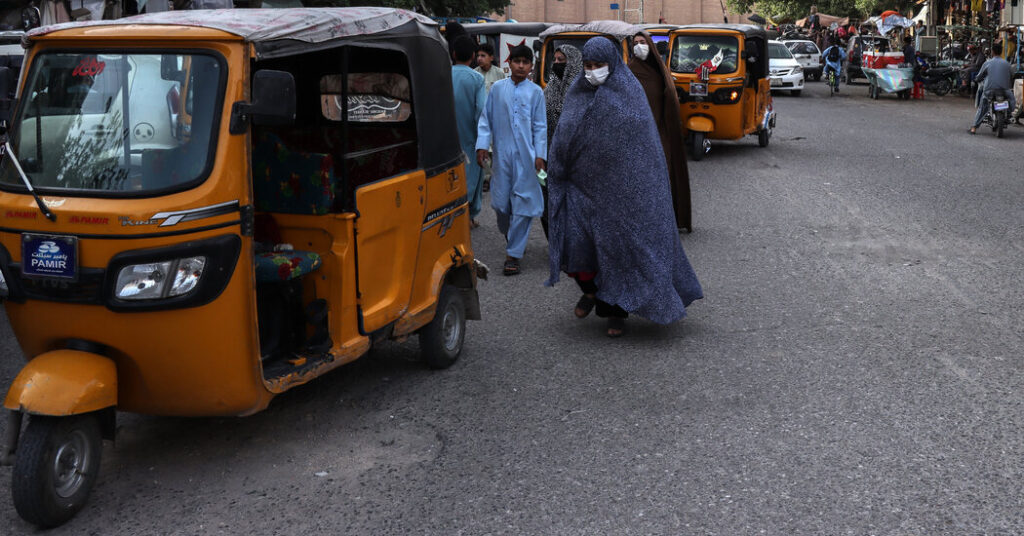
In a rare burst of public opposition to the Taliban’s severe restrictions on women, people organized protests in one of Afghanistan’s biggest cities, which authorities responded to with wide-ranging security measures on Friday.
Reports circulated online and in local media that demonstrators marched toward a government building in the western city of Herat, holding signs and chanting “Women, Work and Freedom!” Videos showing the demonstrations have not been independently verified.
Friday’s planned protests followed demonstrations on Tuesday that resulted in the death of two people, including a boy, and injuries to at least 20 others, according to the United Nations.
Sayed Masoud Hussaini, a police spokesman in Herat, has denied reports of arrests or injuries among what he called “agitators,” contradicting witness accounts and the United Nations.
During Tuesday’s protests, dozens of men and women gathered in a public square in Herat, one of the largest cities in the country, their faces hidden behind scarves and masks, chanting “education, work and freedom!”
The neighborhood in Herat, which has historically been more socially liberal than other parts of the country, is home to many of Afghanistan’s Hazara minority and Afghan refugees who were expelled by Iran last year. The slogans were inspired by Iran’s “Woman, life, freedom” protests of 2022.
The protests followed the arrest of at least 30 women in Herat on June 6 and 7, the United Nations said, by the Taliban’s Ministry for the Propagation of Virtue and the Prevention of Vice for violating laws requiring women to completely cover their bodies and forbidding women from wearing perfume.
A spokesman for the ministry told Taliban-operated outlets that reports of the dress code arrests were “rumors.”
Activists on social media hoped to organize a fresh round of demonstrations, despite the crackdown and warnings against further protests by the Taliban.
The Taliban mobilized law enforcement in Kabul, the capital, and near Herat to discourage people from gathering. Armed government forces set up checkpoints around Herat, local religious leaders were instructed to discourage demonstrations, and clinics were warned against treating injured protesters.
Since taking control of Afghanistan in 2021, the Taliban government has imposed some of the world’s toughest restrictions on women and girls, including education bans, limitations on work and movement, and many other facets of daily life.
Metra Mehran, an advocate with the rights group Amnesty International, said this week’s demonstrations stood out because Afghan men, not just women, had taken to the streets.
“The power comes because we see the people taking huge risks, knowing that it will subject them to persecution and even death by Taliban soldiers,” Ms. Mehran said. “And then, it’s men and women doing it together.”
In a phone interview, a teacher named Razia described a violent scene when she arrived at the protest on Tuesday, which she heard about on WhatsApp.
“I wanted to protest why the Taliban arrested four women from this neighborhood who had a proper hijab; their faces were covered with masks, their hair was covered and they even wore socks,” she said.
The United Nations Assistance Mission in Afghanistan said in a statement that it was “deeply concerned” by the arrests in Herat.
While the women were released on Monday, the impact of such arbitrary arrests and detentions on women and their families is profound, the U.N. Mission said.
“A woman’s detention in Afghanistan carries enormous stigma, which can put women at risk of further violence and isolation in their families and communities even after they are released,” said Georgette Gagnon, the top United Nations official in Afghanistan.
Razia, whose last name is being withheld for fear of reprisal by the Taliban, said she fled the scene of the protest on Tuesday. She said that a friend who was injured was forced to seek treatment at a regional hospital after a local clinic turned her away, afraid of retaliation for treating dissenters.
A pharmacist in Herat said in a phone interview that several people came to him on Tuesday with bullet wounds. A mother brought her son, who had been shot in the knee while riding his bike near the protest, the pharmacist said.
The post Afghans Hold Rare Public Protests Against Taliban Rules appeared first on New York Times.