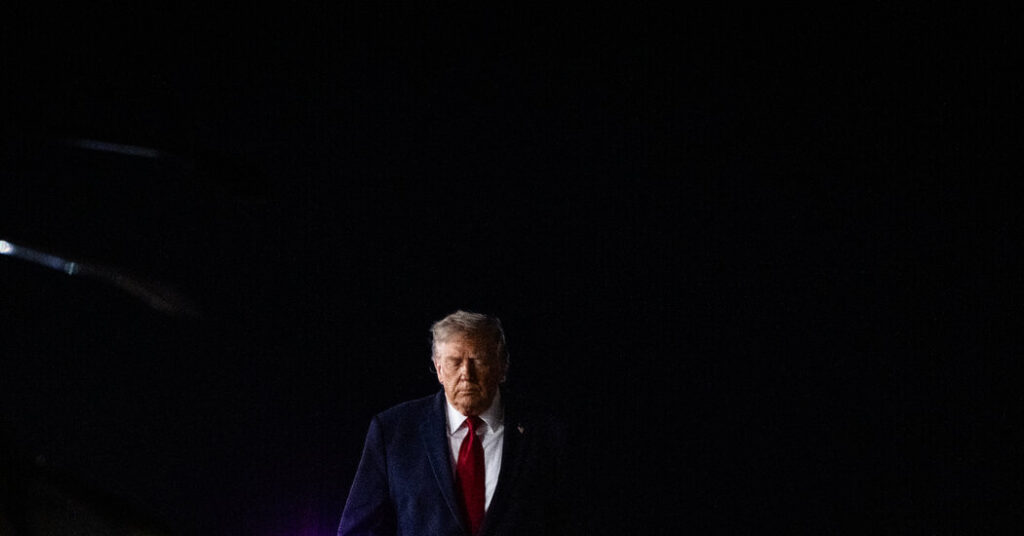
In Iowa, President Trump’s choice for governor was defeated in a Republican primary.
In Washington, Trump faced a revolt over his choice for acting director of national intelligence, while a handful of lawmakers from his party are feeling newly emboldened to buck him.
In the Middle East, the war between the United States and Iran grinded on as confusion persisted about a possible peace deal. Americans, unhappy with high gas prices, remain sour on the conflict — and on Trump.
Trump has had a rough start to the month of June, after a spring in which he won crushing victories over Republicans who have crossed him and watched his party gain an edge in the national redistricting war.
This week, he addressed the latest spike in prices, and gave a remark that doubled as a gift to Democratic ad makers.
“I love it, the numbers were great,” Trump told reporters. “I love the inflation.”
Cue the (private) Republican face-palms.
“I don’t think there’s much optimism,” said Rob Stutzman, a veteran Republican strategist, asked about the mood among his fellow G.O.P. consultants. “Campaigns are going to adapt the best they can, but it’s a party without anyone, without the leader, on message.”
It was only the latest Trump gaffe on affordability and the midterms.
A month ago, he said “I don’t think about Americans’ financial situation” in response to a question about whether Americans’ economic troubles made him want to make a deal to end the war with Iran. Later that month, he said, “I don’t care about the midterms.”
Trump won in significant part because of his promises to lower the cost of living — but prices are still high, and his recent comments aren’t helping Republican candidates who already face a broad array of challenges in navigating the political landscape.
As a result, swing-voting Americans — many of whom are keenly conscious of their painful financial situations — don’t exactly seem to have warm feelings toward Trump or the Republican Party.
Recent polls have repeatedly shown that Americans favor Democratic candidates over Republican ones. Trump’s approval rating is hovering in the 30s, a bad sign for the G.O.P. given how important that number tends to be in determining the fate of a president’s party in midterm elections.
But for many Republican candidates, especially those who have to deal with primaries, it remains politically dangerous to acknowledge any daylight with the president or to be perceived as criticizing him, including over his assessment of the economy.
And as Democrats learned the hard way in 2024, voters don’t care about various positive economic indicators — and certainly don’t want to hear about them — if their own lives still feel too expensive.
“He doesn’t care what families are going through right now, isn’t even aware of it, makes light of it, and families are struggling,” said Representative Suzan DelBene of Washington, the chair of the House Democratic campaign arm. “They promised to lower costs on Day 1. It has been a huge broken promise, and we absolutely are continuing to remind folks of that.”
Of course, the midterm elections are still months away, and the political environment could well change. Trump has hinted that a signing ceremony for a potential deal toward ending the war could happen as soon as this weekend, and has suggested that inflation will drop when the war concludes.
“I don’t think Democrats have cracked the code on becoming a popular party again,” Stutzman told me. “I still think they’re deeply unpopular.”
But right now, he said, “it’s incredibly perilous for Republicans.”
The post Trump’s Haphazard Midterm Leadership Puts Republicans in a Bind appeared first on New York Times.