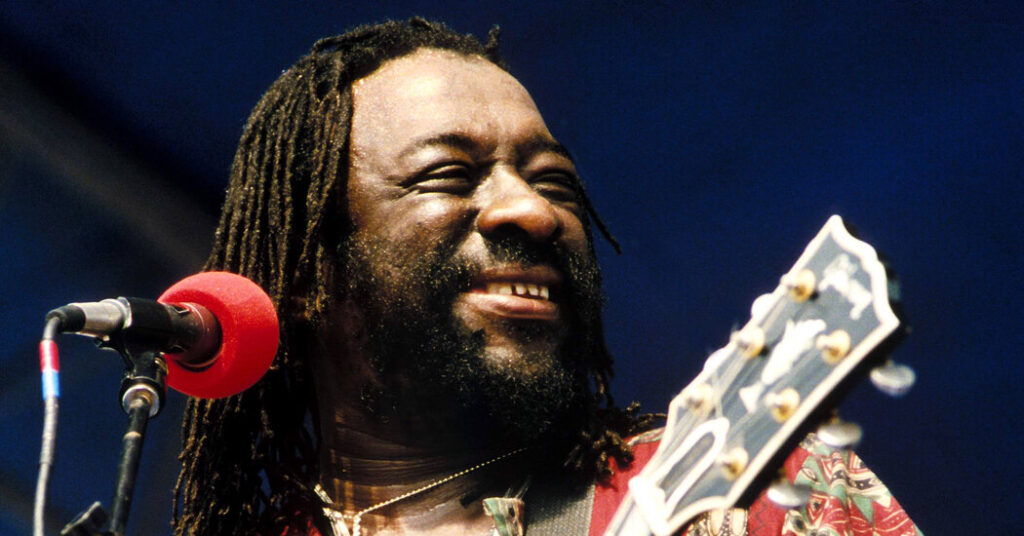
James Blood Ulmer, whose aggressively avant-garde guitar compositions demolished the boundaries separating jazz, funk, punk, blues and even country music, earning him comparisons to Jimi Hendrix, the guitarist Wes Montgomery and his mentor, the saxophonist Ornette Coleman, died on June 3 in Manhattan. He was 86.
In a statement, his family said that the death, at a care facility, was from cardiac arrest.
With roots that ran deep in the gospel sounds of his South Carolina youth and the R&B he mastered early in his career, Mr. Ulmer became a fixture on New York’s downtown music scene in the 1970s, playing not just in jazz clubs but also for rock, punk and no-wave crowds.
His guitar work was explosive, propulsive and exciting. During the seven years he played with Mr. Coleman in the 1970s, he absorbed the saxophonist’s theory of harmolodics: that melody, rather than harmony or predetermined chord changes, should dictate the course of a composition.
Mr. Coleman’s intention was to free musicians from the constraints of Western notation and the hierarchy of instruments in a group.
Mr. Ulmer took those ideas further by tuning all his guitar strings to the same note, a radical move that he said gave him even more freedom.
When he showed Mr. Coleman, his mentor beamed. “He made me feel like I just graduated from his harmolodic school of music,” Mr. Ulmer said in a 2004 interview with the website Wax Poetics.
Mr. Coleman co-produced and played on Mr. Ulmer’s first solo album, “Tales of Captain Black,” recorded in 1978.
By then, Mr. Ulmer was appearing at downtown Manhattan venues like CBGB, where jazz was a rarity. He opened for post-punk bands like Public Image Ltd and for musicians like Captain Beefheart who were just as category-defying as he was.
His second album, “Are You Glad to Be in America?” (1980), was issued by Britain’s Rough Trade label, also unfamiliar territory for jazz musicians. While recording and playing in London, Mr. Ulmer took to wearing a bowler hat around town.
“We hadn’t seen anything like that before,” Geoff Travis, the label’s founder, said in an interview. “Maybe the world hadn’t.”
Mr. Ulmer returned to the United States with a contract from Columbia Records. Three albums followed — “Free Lancing” (1981), “Black Rock” (1982) and “Odyssey” (1983) — are all considered landmarks in the world of cutting-edge jazz guitar.
In a review of “Free Lancing,” the critic Robert Palmer, writing in The New York Times, declared Mr. Ulmer “the most original electric guitarist to emerge since the late Jimi Hendrix.”
Many critics consider “Odyssey” his masterwork, a dexterous culmination of various influences — not just jazz, rock and blues, but also, thanks the violinist Charles Burnham, elements of folk and country.
The critic John Rockwell, writing in The Times, called it “an extremely appealing album, probably the best Mr. Ulmer has made,” adding that “his singing has a charismatic growl that suits his overtly bluesy effusions perfectly.”
Willie James Ulmer was born on Feb. 8, 1940, in St. Matthews, S.C. His mother, Willie Mae (Comings) Ulmer, was a strict Baptist who forbade secular music in the home. His father, James Ulmer, was a Baptist minister who led a gospel group.
When Willie was 4, his father bought him a guitar; when he was 7, his father brought him into the group. He got the nickname Blood when other musicians took to calling him Youngblood, referring to his youthful appearance.
Ten years later, he left home for Pittsburgh, where he had family and could find work with a band. He spent several years there, and later in Columbus, Ohio, and Detroit, playing with doo-wop and jazz bands.
In Detroit, he played in the house jazz band at the storied 20 Grand club. The house R&B group was the Parliaments, led by the future funk impresario George Clinton.
In 1971, Mr. Ulmer moved to New York, ostensibly to meet Miles Davis. Instead, he met Mr. Coleman. After a nightlong jam session, Mr. Ulmer moved into Mr. Coleman’s loft and became the first full-time guitarist in his band, Prime Time.
He also played with the drummer Art Blakey’s Jazz Messengers and on two albums with the saxophonist Arthur Blythe.
In 1980, Mr. Ulmer formed the Music Revelation Ensemble, a loosely united group that at various times included artists like the bassist Amin Ali and the saxophonists Pharoah Sanders and John Zorn. The group recorded seven albums over the next 20 years, three of which were released only in Japan.
Mr. Ulmer’s first marriage, to Sara Penn, ended in divorce in 1984. He married Eva Mikusch in 2017, after a long relationship.
She survives him, along with two daughters, Gia Rae Winsryg-Ulmer and Nisa Brunner; three sons, Gregory Ulmer, Michael Ulmer and Damu Musawwir; a brother, Dennie Leroy Ulmer; two sisters, the Rev. Shirley Ann Abraham and Rosetta Pope; 12 grandchildren; and 13 great-grandchildren. Another daughter, Donna Marie Ulmer, died in 2024.
In the early 2000s, Mr. Ulmer began to explore his Southern roots on albums like “Memphis Blood: The Sun Sessions” (2001), collaborating with the rock guitarist Vernon Reid, the founder of the band Living Colour. Mr. Ulmer received his only Grammy nomination for that album, in the best traditional blues category. He never achieved the fame of his mentor Mr. Coleman, let alone that of Mr. Hendrix. But he said he was fine with that.
“Music is not for judging,” he told Wax Poetics. “You listen to it and take what you can get from it. Put it in your pocket and keep moving.”
The post James Blood Ulmer, Guitarist Who Smashed Through Genres, Dies at 86 appeared first on New York Times.