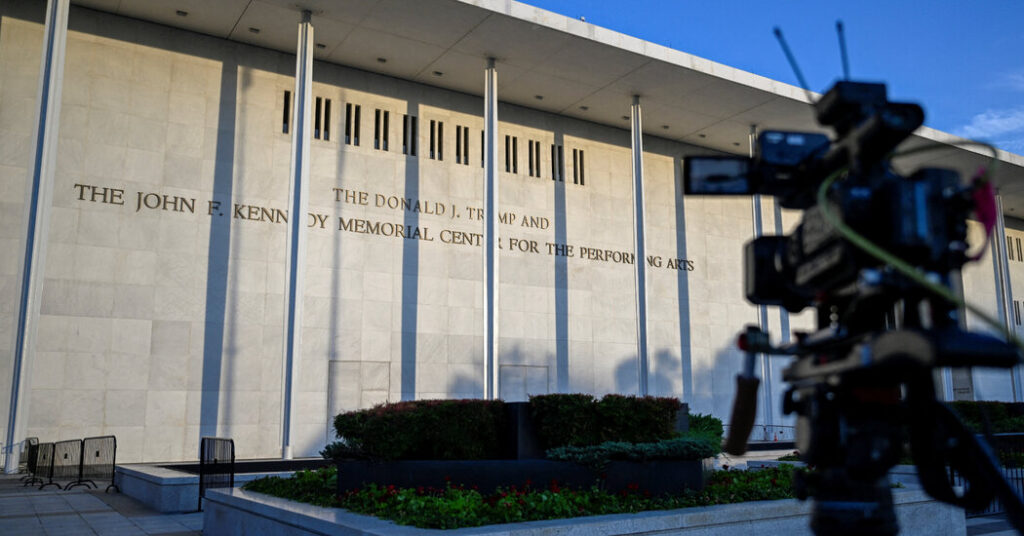
Christine Lienert and Debra Wilfong kept their celebratory champagne on ice until 10:30 on Thursday night. But as news emerged that President Trump’s name would not be coming off the front of the John F. Kennedy Center for the Performing Arts as they had hoped, they slipped the bubbly back into the fridge.
There it sits as some in Washington, and the wider world, await a judge’s review and Mr. Trump’s next move.
The center is currently staring down a legal deadline of Friday to remove the president’s name from the building, based on a federal judge’s order declaring the rebranding unlawful. On Thursday, lawyers for Mr. Trump and the center appealed the decision and sought a stay from the court.
Should Mr. Trump lose his battle to halt the order, “we’re ready to roll,” Ms. Lienert said. “We’ll reload the cooler and come right over,” to toast the removal of the 18 letters that have irked them since they went up nearly six months ago.
The couple live in the Watergate complex next door to the Kennedy Center, where life revolves around its events, restaurant and grounds. Ms. Lienert says that she took a poll at a recent gathering for new residents, and many of them said the Kennedy Center was the reason they moved in. Some are keeping vigil over the signage on the marble, grilling anyone who looks knowledgeable for the latest on its fate.
Lawyers for the center have asked Judge Christopher R. Cooper of Federal District Court in Washington to stay his order pending the appeal. If he denies the request, the center can appeal to the U.S. Court of Appeals for the District of Columbia Circuit. But the timeline of such a process is not clear, and legal observers say the judge’s original order suggests that the center has until midnight to take the name down.
In December, the Kennedy Center board voted to put Mr. Trump’s name on the building in recognition of what officials have described as his dedication to the institution and his effort to secure $257 million to finance what the center’s board said was a much needed renovation.
Early Friday morning a jogger ran up the sun-blasted granite steps leading to the building’s front entrance, craning his neck toward the facade. Seeing the sign still there, he trotted back down, shaking his head as he dug out his phone, ostensibly to share an update.
Bike rack barricades, erected Thursday afternoon, still surround the disputed section of facade, where security guards, photographers and television camera operators mill about. Scaffolding began to be erected on Friday morning.
Residents and tourists walk past or ride up on bicycles and scooters, asking anyone with a camera or a badge what is happening. Some pause for selfies with a sign that most believe will not remain on the building for long.
Two volunteer organizations that were created after the major changes at the Kennedy Center, Hands Off the Arts and Free the Kennedy Center, teamed up to live-stream the signage on the building. One member offered a balcony at the Watergate to host the webcam, which was installed on Monday night.
“It’s our little piece of magic,” said Mallory Miller, who co-founded Hands Off the Arts. Ms. Miller was an assistant manager in the dance programming department when Mr. Trump gutted the center’s board and took over as chair, and she started a union organizing drive with her co-workers. She was fired from the center in August.
Allerton Kilborn, 79, brought a book to occupy him on Friday while he waited for what he hoped would be the removal of the lettering. He had traveled to the center from his home in Chevy Chase, Md.
“For the adventure of it — this is history,” he said.
“I’m so old that I once met John Kennedy and have been an enormous fan of his,” he said. He said he thought the addition of Mr. Trump’s name been a desecration of the memorial to Kennedy.
“I’m not religious,” he said, “but I see it in religious terms.”
The post A Kennedy Center Drama: Whether Trump’s Name Stays appeared first on New York Times.