Maybe it was just an unfortunate coincidence.
How else could the New York Philharmonic and the Metropolitan Opera, next-door neighbors at Lincoln Center, program the same symphony within a week of each other?
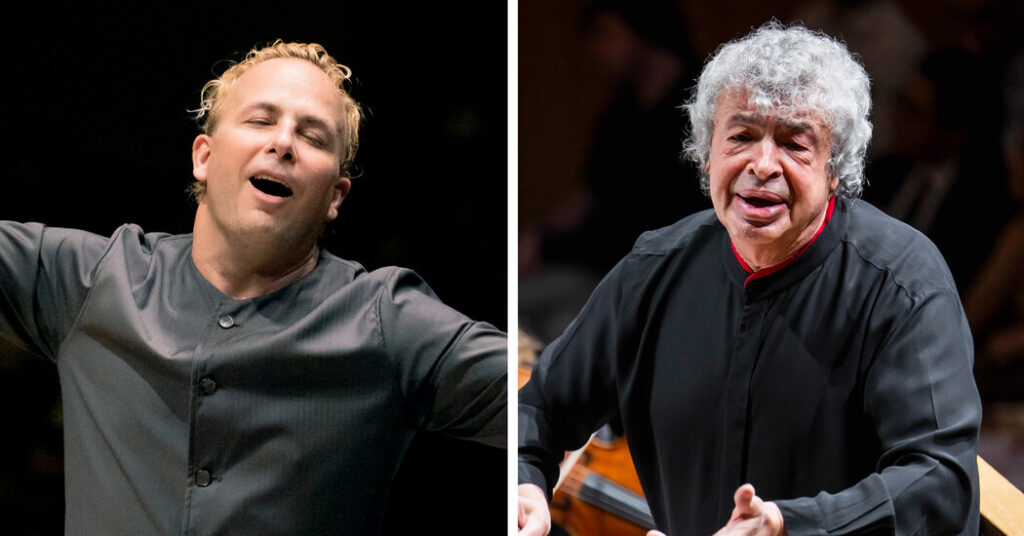
The Philharmonic closed out its David Geffen Hall season on Saturday with a performance of Bruckner’s epically immense Eighth Symphony under Semyon Bychkov. Then, on Thursday, the Met Orchestra was at Carnegie Hall with Yannick Nézet-Séguin leading, yes, Bruckner’s Eighth.
Or maybe this was a case of poor communication, because something similar will happen in the fall. The Philharmonic will bring Puccini’s “Tosca” to Carnegie Hall in concert while the opera is onstage at the Met. There will even be a 24-hour window in which you could hear both.
And yet there’s something irresistible about all this. How often do you get to hear these orchestras engage in a battle of the bands?
Consider it a win, at least, for Bruckner, who once struggled to get his Eighth Symphony performed. His friend Hermann Levi, who had led the premiere of Wagner’s “Parsifal,” found it baffling and unplayable, and declined to conduct it even though the music seems to speak Wagner as a second language. “I have pored over the score for hours, yea days,” Levi wrote to the composer, “but I have not come closer to the work.”
Bruckner overhauled the score, and when it finally reached the stage, the influential critic Eduard Hanslick described it as “interesting in detail but strange as a whole, indeed repellent.” (Then again, he was never a champion of Bruckner.) Now, there are now multiple published versions of the symphony: the initial attempt in 1887 and the revision in 1890, as well as a combination of the two by Robert Haas from 1939. The Philharmonic used the 1890 edition, while the Met adopted the Haas.
Casual listeners probably wouldn’t notice a difference between the two scores, but they probably would notice differences between the performances at Geffen and Carnegie Hall. The Philharmonic held the music’s monumentality in reserve for most of the symphony, while the Met Orchestra’s luxurious tempos and rubato heaped Romanticism onto Romanticism, like adding whipped cream to an ice cream sundae.
Bychkov is an expressive conductor but also a judiciously measured one; he will occasionally contort his face with emotion and whip his arms in a flourish, but at the end of a concert, he just gives the audience a small smile and bow. Nézet-Séguin, the Met’s music director, seems to perform the idea of conducting as much as he does the work of it. If you didn’t know a cymbal crash was coming in the Adagio, you could sense it as he wound up the moment with prolonged choreography. When the Finale was done, he knelt toward the orchestra in a demonstration of humility that, whether intended or not, drew attention to himself.
The two conductors’ visions of the symphony were, of course, filtered by the character of each orchestra. At the Philharmonic, Bychkov was most successful in rendering the symphony’s sudden shifts shocking yet natural, like a tectonic clash giving way to rocky mountains. He adopted a brisk tempo for the first three movements, then slowed down the Finale to heighten its grandeur, ending with the oppressively majestic atmosphere of Wagner’s entrance to Valhalla in “Das Rheingold.”
But the Philharmonic, appearing a little weary and without enough unity in the violins, wasn’t equipped for the task. It was an odd way to end a season that was on the whole good for the orchestra; the house frequently looked full, and there is palpable optimism and energy over the arrival of Gustavo Dudamel as music and artistic director this fall. (He will be conducting that Carnegie Hall “Tosca.”)
The mood is less sunny at the Met, whose season was a roller coaster of financial precarity. Still, the company has maintained a high level of artistic quality that can be easy to take for granted: above all, in the skill of its treasured orchestra.
But even that seems unsure these days. On Thursday, the Met Orchestra was still a fine group but more difficult to grasp as a true ensemble. Nézet-Séguin hasn’t proven to be much of an orchestra builder; he has led the Orchestre Métropolitain in Montreal since 2000, but it remains perplexingly unevolved. Nearly eight years into his tenure in New York, and with the orchestra still rebuilding from pandemic-era vacancies, the Met players have yet to develop any clear identity beyond a belief, borrowed from their leader and often leading to imbalances, that volume can be a substitute for expression.
This past week, neither the Philharmonic’s nor the Met Orchestra’s approach to Bruckner was unequivocally better: the Philharmonic’s interpretively wise but lacking the commitment to carry through, the Met’s fully committed but interpretively thin. As battles go, this one was a draw. See you again for Round 2 this fall.
The post The Philharmonic and the Met Engage in a Battle of the Bands appeared first on New York Times.