Photographs By Max Highstein
We have limited time on this Earth to get a good look at one another’s belongings. We need to move on this—fast—because the years we spend alive could well be our only opportunity for snooping. And it’s so interesting to see what everyone has!
Drink coasters shaped like pieces of well-known fruit, a woven cage for transporting a chicken, a new-in-box gelato maker—these are the stones from which the cathedral of man’s experience is raised.
To be a secondhand shopper is to see the riches of the world and be satisfied that they are enough. Don’t turn any sand into spanking-new champagne coupes on my account. It is also to indulge the wanton impulse of every person to spy on other people. Archaeologists have been cataloging dump sites since at least the early 19th century, when Danish scientists began pawing through heaps of mollusk shells that had been discarded by their Stone Age ancestors. Indeed, studying what people throw away (eventually, people throw away almost everything) is one of the most efficient ways to learn about them.
One needn’t be an archaeologist to snoop through others’ trash. In the United States, the layman can do this any day of the week, especially Saturday, if the weather is nice. This spring, I decided to see what I could learn about my fellow Americans’ lives—and how much I could improve my own life through their discards—for $100.
1. Garage Sales
You never know when God will bring a wonderful new Christmas decoration into your life. My family got our light-up snowman when our neighbor shot himself. I discovered this as a child after he appeared on the landing of our front steps (the snowman!—Christ). My mother, I suspect, had intended to pass him off as a light-up snowman that she had bought brand-new. But my mother never bought anything as big as three feet tall brand-new. Also, his paint was burned off in just the same spots as the snowman that had, for years, served as a jolly sentry outside our neighbor’s front door—a position that was now vacant, while our own home was, in a first, conspicuously and festively guarded. “You stole their snowman?” I asked. “I did no such thing!” my mother yelled. (She was constantly doing no such thing.) “They were throwing it away!”
The point of this story is: You need to be shopping for Christmas decorations year-round. If you’re not buying jingle bells in July—if you’re not steeling your heart against others’ misfortunes in order to scour the residue of their lives for Christmas bibelots that are no longer of any use to them because they have, with all due respect, shot themselves—you are overpaying.
Perhaps you think you don’t need any more Christmas decorations. You do; imagining that you possess a sufficient quantity of Christmas decorations evinces a dullness of spirit that lets me know that any Christmas extravaganza you think you’re pulling off is anemic at best, and not even worthy of the term. Perhaps you will protest that you do not observe Christmas. That’s absolutely no reason not to decorate for it. You should be tossing up ornaments for every holiday you can get your hands on—secular winter decor is fine—simply because they catch the eye, and people who walk by your home will enjoy the pizzazz.
This is why I am so pleased to see, on one block of a community yard sale surrounded by naked scrubland, a white pickup truck’s bed overflowing with boxes of colorful Christmas balls. Hung off its lowered tailgate is a handwritten sign reading FREE. These balls are just the sort I seek: cheap plastic ones covered in glitter, which look as pretty as anything on Earth when hung outdoors, to dazzle in the sun. I need them (I fear the information barreling toward us from the bottom of this paragraph will make my reader question the appropriateness of that verb) to meet a private goal I have set. This past winter, while laboriously freeing the trees and bushes outside my home of the Christmas barnacles I had affixed there months earlier, I decided, for the first time, to count how many ornaments I had hung. I recall, as I load the boxes from the pickup truck into the back seat of my car, that the total was extremely close to a shocking milestone. The number 1,000 is blaring in my head, even though that sounds crazy. Did I really hang approximately but not quite 1,000 small Christmas ornaments outside my house? That would explain why it had looked absolutely sick. And now, thanks to this infusion of free ornaments, I will be able to hang a clean 1,000 next Christmas. Well—
Would you believe that I was wrong? I check the note on my iPhone, where I recorded my tally. It turns out that I already have, stored in my garage, nearly 2,000 ornaments. And now I have more. “Take it all!” urges a cheerful woman, emerging from the home that belongs to the pickup. No problem.
This coincidence—one household possessing such a quantity of superfluous Christmas decorations that its members are moved to put them in their driveway and impel passersby to remove them; my having sufficient space to store 2,000-plus Christmas decorations—is a manifestation of the same conditions responsible for the birth of garage sales in the United States seven decades ago.
In the years following World War II, single-family homes spread across the nation like fireweed. In a distinctively American architectural feature, many of them were joined to a small dungeon dedicated to the tidy storage of automobiles—and other items. Loosed of the wartime imperative to manufacture anti-aircraft guns and submarine torpedoes, factories were free to make bone-rattling dishwashers and mint-colored refrigerators. In the first five years after the war, Americans’ spending on household furnishings and appliances surged 240 percent.
In From Goodwill to Grunge: A History of Secondhand Styles and Alternative Economies, the historian Jennifer Le Zotte writes that the novel spaciousness of suburban homes (in contrast to cramped city apartments) was, paradoxically, responsible for the birth of private sales intended to help homeowners pare down the contents of their dwellings. Unlike people living in cities, suburbanites had room to hold on to old things indefinitely. Subject to the same storage maxim that explains why a purse of any size is always full—the amount of a person’s belongings will expand to fill the space available—the roominess of the suburban home and garage, Le Zotte writes, “made it possible for a single family to acquire and retain” so many “unwanted items” that, eventually, they had to have a yard sale.
Conveniently, this period coincided with a spike in popularity of a hobby that had been inaugurated during the Gilded Age: collecting old American things. Before the late 19th century, Le Zotte writes, wealthy Americans, if they bought any antiques at all, prioritized the acquisition of “foreign-made items.” The deluge of affordable new goods that flooded the country post-industrialization, she suggests, caused shoppers to perceive a “scarcity” in items that were original or unique; items traceable to the country’s colonial past came into vogue. Postwar prosperity gave more Americans the leisure time, disposable income, and car space to begin antiquing. Le Zotte reports that by the 1970s, more than 10 million garage sales were taking place in the United States every year, and people were paying more than $1 billion (cumulatively) for their neighbors’ discards.
But statistics fail to convey the humanity of yard sales—the caprice, whimsy, and high spirits, as well as the cunning, weirdness, and heartbreak, that charge and thicken the air when two people agree to perform an off-the-books monetary transaction. Years ago, at a different community yard sale (surrounded by different naked scrubland), a woman sold me a canvas-mounted collection of 19th-century barbed-wire samples on the condition that I look her in the eye and promise that I would mount the contents of an additional box of loose 19th-century barbed-wire samples that she was including in the low price. She had made an identical promise to the person from whom she herself had purchased both the mounted and unmounted barbed wire, and felt guilt for decades at having failed to keep it (though not so much guilt that she ever got around to doing so). I assured her that I would do it—and let me tell you the lesson I began learning the second I got everything home: It is real, real easy to not ever get around to meticulously mounting dozens of stray pieces of rusty barbed wire when you already have a dynamite display of diverse varieties—“10 Point Spur” (1887), “Crandal’s Champion” (1879), “Sawtooth Ribbon Wire” (1881)—hanging fetchingly above the television in your living room. Eventually, I solved this promise by fobbing the loosies off on my friend Renee, who, having no such dynamite display, was compelled to mount them (she claims, and I choose to believe her).
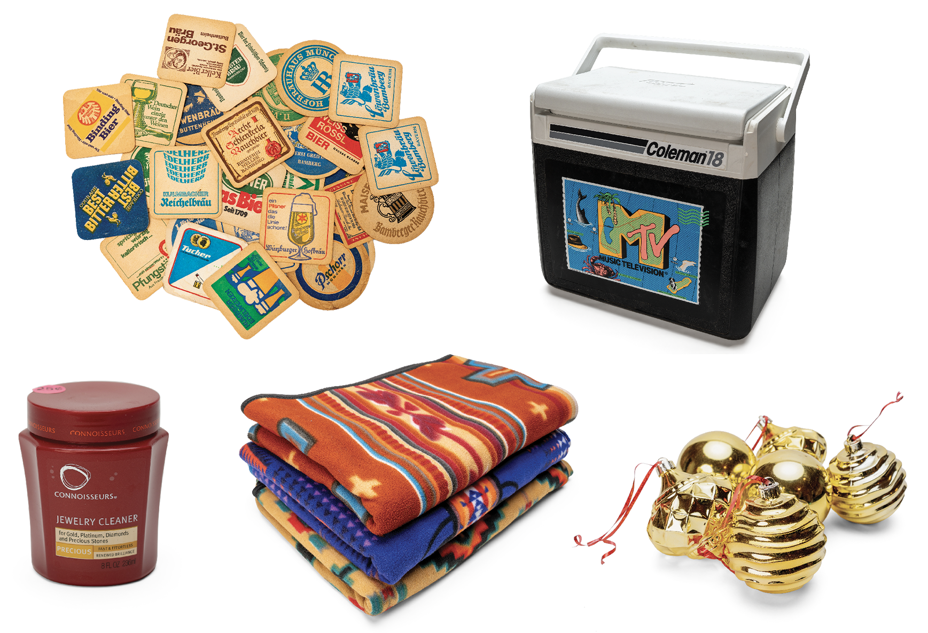
The efficient yard-sale shopper is not an empath. For every bubbly homeowner encouraging you to take this vintage Coleman cooler—featuring the 1980s MTV logo floating in the ocean—off her hands for free, there is a downcast seller attempting to unload dozens of Precious Moments figurines at $10 to $20 a pop because, she says, she doesn’t want to bring them all to Texas, where she is moving to help take care of her mother, who has dementia. (Or maybe she privately does want to take them? Not going to get many bites at those prices.) For every delightful discovery of a charmingly wacky neighborhood where one resident’s garage-door mural features an alien camouflaged among the paddles of a prickly pear cactus, and another homeowner has installed a rooftop statue of an orange pig with blue angel wings, there will be a haunting encounter with a nearly silent man hoping to sell a single button-down shirt for 50 cents. If you don’t have the stomach to witness people’s lives up close, do not ever stop at a yard sale.
PURCHASES:
- Christmas balls for outdoor display: $0
- Skull carved from stone (for Halloween) and mercury-glass Christmas ornaments: $5
- Open jewelry cleaner: $0
- Fleece blankets in sunset colors featuring vaguely southwestern motifs (stepped diamonds, serrated zigzags, geometric crosses, etc.): $0
- Coleman cooler with MTV logo: $0
- Another Christmas ornament (vintage): 50 cents
- Saddle blanket: $4
- Gallon ziplock bag of vintage European-beer coasters: $0
TOTAL: $9.50
2. Thrift Stores
The early crocuses of thrift stores began popping up in this country in the late 1800s, just as officials in her cities were making an honest push to persuade Americans to please stop dumping their trash in the street. The first shops owed much of their success to two forces: the bountiful waste coincident with mass industrialization, and anti-Semitism. “Junk shops, pushcarts, and pawnshops,” Le Zotte writes, had largely been “the province of Jewish immigrants,” who were “relegated to marginal economies.” An 1890 survey revealed “peddling” (often of scraps and secondhand items) as the second-most-common profession among Manhattan Jews. In the turn-of-the-century zeal for orderly streets, Le Zotte writes, Jewish junk dealers were “viewed as a public sanitation hazard, and even a moral menace.” Cities all over the nation attempted to shut them down.
But could there be a nice, Christian way to deal junk? This question was answered in the thundering affirmative by two groups of late-19th-century Protestant social activists whose retail legacies continue, even now, to thrive across all 50 states.
In the late 1890s, Reverend Edgar J. Helms, the young pastor of Morgan Chapel, in Boston’s South End, came up with another one of his schemes to aid—and, more specifically, to Americanize—the immigrant communities (Italian, Greek, Syrian, Polish, Irish) flourishing around his church. Helms instructed church members to collect unwanted clothing to donate to women and children, spread the gathered garments across the pews, and invited those in need to help themselves to it. There resulted such a frenzy of grabbing—“pandemonium,” according to an institutional history self-published in 1924—that the church, on subsequent occasions, charged the poor a few pennies. This money was used to hire unemployed women to repair any garments that arrived damaged. (In time, the operation would expand to encompass many other types of repairs, including the Frankensteining of new poppets from heaps of severed limbs and loose heads in what the self-published history called “an amazing doll shop.”) The pastor’s initiative proved so popular that the church began distributing feed sacks to well-off homes, so Boston housewives could continually set aside castoffs for donation. These sacks eventually came stamped with a label: THE GOODWILL BAG.
But it was the Salvation Army that truly pioneered what Le Zotte calls “the large-scale philanthropic salvage goods system.” This organization’s roots stretch back to 1860s England. Early adherents practiced a public evangelism that The New York Times characterized as “propagating Christianity by rowdy prayers and tambourines.” Members might dress in random articles (coats, helmets) of discarded military gear—or else in torn, dirty rags as a manifestation of their empathy with the abject poor. New, fashionable clothing, it was implied, was materialistic and ungodly.
In New York, restrictions on itinerant peddlers benefited the Salvation Army’s retail operation, which sold the same sort of pre-owned wares from storefronts, rather than from rickety pushcarts. Pamphlets detailing how goods were disinfected prior to sale shellacked an additional veneer of respectability onto the enterprise.
The Salvation Army Thrift Store closest to my home in Santa Fe seems to have relaxed last century’s strict emphasis on cleanliness. Skylights the color of sticky fly tape give the interior a distinct yellow cast, like an image from an old newspaper. Next to a limp rack of sleeveless tops stands a postapocalyptic forager-warrior mannequin in jeans, a faded plaid shirt, and a black baseball cap from the plus-size-women’s brand Torrid. Slung around his torso: an olive-green bag designed to carry a gas mask. Each time I see this figure out of the corner of my eye—as in, every single time I visit this store—I mistake it for a large living person and leap in fright. As I shop around him, the mannequin’s parted, down-turned lips give him the dazed yet dismayed expression of a chiseled male model watching extraterrestrials eviscerate a cow from a distance of several yards.
A more pleasant, or at least less yellow, shopping experience is to be had at Savers, a for-profit chain that speaks of a murky connection to charity in announcements that blare over the speaker system at regular intervals: “Shopping in our stores doesn’t support any nonprofit,” begins the riddle, “but donating your reusable goods does.” Oh no! Or good? Well, anyway, the thing about Savers is that it is big, huge—picture the inside of Mount Rainier, except all one level and very brightly lit.
And it has everything. All day long, in the parking lot, people are driving up, popping their trunks, and unloading a bag, or two, or sometimes an entire car’s worth, of any objects that they want to be rid of without the implied finality of throwing them in the trash. Most of them will still end up there. Clothes especially. The EPA classifies clothing as a “nondurable good”—meaning that the agency expects people to wear every piece of their clothing for less than three years. This improbable estimate may even be too conservative: The U.S. International Trade Commission reports that consumers jettison about half of all “fast fashion items” (which it defines, rather bitchily, as “inexpensive, low quality clothing that quickly cycles out of style”) within one year.
Of that unwanted apparel—about 13 million tons in 2018—85 percent is annually sent to a landfill or incinerated. Most of the rest is donated to charities or thrift stores; of this, half will be recycled into “lower-value” products such as industrial rags and insulation. (“Bottle-to-fiber” recycling is so popular that a recycled PET bottle is now more likely to become polyester fabric than another bottle. It is far less common to turn plastic clothing into drinking vessels.) Only about 20 percent of the textiles donated to thrift stores is actually sold to shoppers.
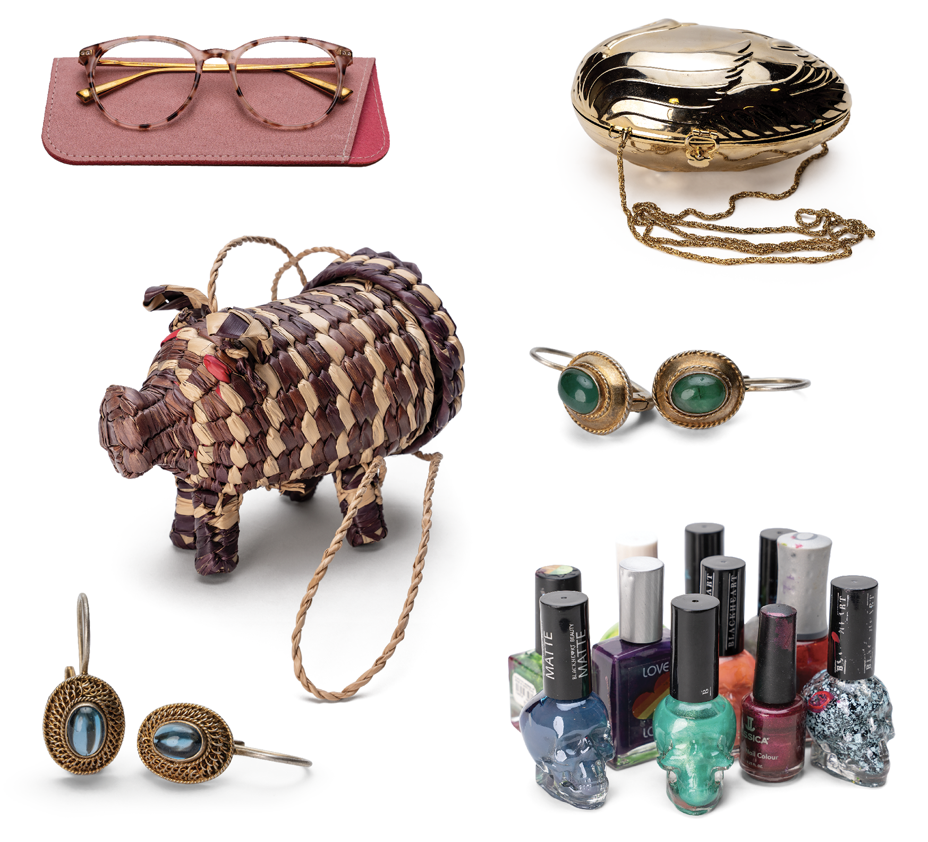
The vast wall of dangling accessories at Savers includes multiple pieces of abalone jewelry—each one of which I must pick up to admire its iridescence, the closest nature has come to reproducing the most flamboyantly beautiful phenomenon on Earth: the gasoline rainbow. I do not purchase any abalone jewelry on my recent visit, because I already own too much, and all of it looks bad on me, and I’ll buy it another time. But I do snap up two pairs of vintage drop earrings with open-backed bezels—a pair with green stones that, in sunlight, have the translucent glow of a watermelon rind made of jelly; and a pair with stones that from certain angles are the black-blue of crow feathers, and from others appear as clear as raindrops—for $2.99 each.
A week later, finding myself in New York City, I approach a few dealers in the Diamond District to ask what they make of the pairs of earrings. I am told, variously, that they are from the Victorian era; that they are from the 1990s; that they are from the 1980s; that one pair is emerald and one is glass; that one is synthetic emerald and one is glass; that both sets of stones are glass; that one is oil-treated emerald and one is synthetic sapphire; that the metal might be copper; that the earrings were probably made in America; and that they are “not very important.”
Back in Santa Fe, I take the earrings to Stephen’s, a consignment shop, where a young man named Nicholas, who professes that jewelry is “not really” his “forte,” immediately guesses that they are gold-plated silver, Etruscan-revival style, probably made in South Asia between the 1970s and 1990s. He offers to quickly test the stones. The green stones he deems most likely chrysoprase—a budget alternative to jade. The blue ones surprise him. His electric probe indicates that they are a stone called spinel, which he hadn’t realized could be blue; he wants to look that up. I ask how he learned all of this.
“I don’t even know where to begin,” Nicholas says. “Probably trying to impress girls”—which makes me laugh.
“Does it work?” I ask.
He looks up from the earrings to make eye contact for the length of a lightning flash. “A little bit,” he says.
Blue spinel, he reads off his phone, is the rarest spinel, primarily found in Asia. But, he warns, this is an AI summary, which tends to exaggerate worth. Specialist reference books, which he doesn’t just walk around with, are more reliable. “People say, ‘Oh, everything’s getting put on the internet now, so there’s no need for books,’ ” Nicholas tells me. But “some of these books are never going to be reprinted or digitized.” Reputable books about Chinese porcelain, he says, “can cost thousands and thousands of dollars.” Despite their hugely discrepant individual assessments, Nicholas and the various Diamond District dealers all provide the same ballpark estimate for the earrings’ worth: somewhere in the vicinity of $100 to $140 for the pairs. But, says Nicholas, the reward of thrifting isn’t found in raw resources; it’s about interpreting the item as a whole. “As far as a made product goes,” he says, “I think you did good.”
What else is there at Savers? A framed photo of a chandelier, and one of a Dairy Queen in Staten Island, its sidewalk overflowing with kids bundled in winter coats (and one reindeer sweater). An ivory-satin beaded clutch with a tag inside reading MADE IN W. GERMANY BY HAND, hanging, like a pork shoulder off a miniature meat hook, next to a wallet designed to look like a Krabby Patty from SpongeBob SquarePants. Shein garments, fine as paper napkins. A demure floor-length dress with a tag that reads MS. CONDUCT CALIFORNIA MATERNITY. A CSI: Crime Scene Investigation DNA laboratory for kids. A big bag of someone’s old nail polish.
I walk around the store for several minutes carrying a straw bucket bag, in an effort to discover if I wish to purchase it. I feel drawn to all woven-straw items because of my surname, which is Weaver. Anytime I see one, I picture myself thousands(?) of years ago (however many would make sense is the amount I picture), on an amber afternoon, sitting placidly while expertly weaving the very object I am looking at in 2026. The other people in my village/town/field—coming and going from their own peaceful tasks that are also their last names (baking, milling, cart … ing? Carting around this and that, I suppose, and God loved them for doing it)—pause for a moment and admire the intrinsic utility and inspiring artistry of my emerging creation, which to me is nothing, because I am a weaver; this is simply what I do. In real life, of course, I would not have the faintest notion of how to begin to create a functioning shoulder bag out of straw, could not do it if you gave me 500 hours, would not even know where to procure the different colors of straw (is it straw?). How much does Savers want for this bag? $7.99. They are dreaming.
In any event, the best thrift stores in town are two shops a five-minute drive apart, both called the Cat. They are the best because their proceeds are donated to the local humane society, and, in every American city, people reserve their very best castoffs for charities that benefit animals. (Or else animal lovers part with their best things more quickly, in order to benefit animals.) After scrounging around in a jumble of bifocals at one of these locations, I come up with a pair of Gucci eyeglasses, which I buy for $1.
PURCHASES:
- Big bag of someone’s old nail polish: $1.99
- Woven-straw purse shaped like a pig: $5.99
- Golden egg-shaped purse embossed with stylized bird with graceful swooping neck: $14.99
- Earrings with chrysoprase stones: $2.99
- Earrings with possibly rare blue-spinel stones: $2.99
- Gucci glasses: $1
- Ted Baker glasses: $1
- Pink carrying case for glasses: $1
TOTAL: $26.16* *Reflects discounts from a coupon a stranger placed in my hand
3. Estate Sales
For the true secondhand connoisseur, nothing surpasses an estate sale. These affairs offer up, for fondling, the entirety of a home’s viscera upon the death of its caretaker. Members of the public are invited in as dermestid beetles are invited into the carcass of an American woodcock, to leave only the perfect, picked-clean bones behind. Art, furniture, personal papers, open cleaning supplies, expired spices, the paraphernalia of half-started hobbies, washcloths, underwear, used lipsticks—these and much, much, much more are available for buying.
The modern American estate sale is a hybrid of a garage sale and a thrift store, with items priced individually, and shoppers left free to browse without close supervision. Although estate sales are occasionally overseen by a decedent’s friends or family, the task of administration is most often left to a professional company, whose employees can traffic huge quantities of loved ones’ belongings unsentimentally.
The arrangements of personal effects at estate sales are memento mori more sobering than any skeleton ever carved into marble. A ziplock baggie of sunblock, bought with the expectation of future hours outdoors; a partially eviscerated Lamb Chop (America’s most popular plush dog toy), priced—ambitiously, considering the extruding fluffy white brain matter—at $2 (and what will happen to the dog?); plastic bins of manila folders with tidy cursive labels like DIRECT TV 10-22 2019; 2025 FORD ESCAPE; NUTRUITION [sic]; and, I realize only when I look, later, at a photo I snapped on my phone, POLICE REPORT.
I love to meander through a stranger’s home and discover who had a secret indoor swimming pool (more common than you’d think), what sorts of tchotchkes they kept around (a crocheted tissue box designed to look like a red-and-white teapot; you pull the tissues out through the spout, like steam), and whether they used nicer conditioner than I do (a dead woman’s nearly full bottle of Kérastase is currently perched on the edge of my bathtub).
Nearly always, a home will have, laid out in the kitchen, a (give or take) 39-piece set of Lenox dishware in the (give or take) “Maywood” pattern, priced at (get a load of this) $245. This is almost certainly one of the few times this millennium that the light of day has bathed these pieces. Formal dining rooms began disappearing from American homes in the last century, replaced by open kitchens, through which all members of the family can cavort freely, like a splash pad; contemporary Americans apparently have little use for the plate. What we want now are “pasta bowls”: wide, shallow craters we can fill with food in any state of wetness, a single mass or particulate items, perhaps requiring mild agitation before consumption (tossed salad; ★★★★★ weeknight sheet-pan bibimbap). The bowls are great because we can hold them in one hand or cradle them on our laps while eating, thus minimizing the mess incurred upon the dining table’s elimination. In 2016, an executive from the company that manufactures Fiesta tableware told The Wall Street Journal that bowls accounted for roughly one-third of the brand’s sales and showed the largest sales growth of any dish type; there is, a marketing director for Waterford, the crystal company, confirmed, “far more demand now for bowls.”
I tend to start in the master-bedroom closet—virtually every piece of clothing I own is something another woman no longer wanted, or perhaps did still want but then she died—and afterward skulk to the garage, to peruse holiday decor. Inevitably, as I nose my way through dead strangers’ belongings, my mind slips to my own estate sale, the one that will spring from my death. These thoughts follow a pattern: First, I am exhilarated by the thought of what a fantastic sale that will be, and long to attend it myself. Next, I resent the scavengers who will descend on my home, attempting to wheedle their way to even better deals on my already reasonably priced possessions. I want my widowed husband to be there, to make sure that all sticker prices are honored. But I also want everyone to leave my grieving husband alone. And, now that I think about it, my husband definitely wouldn’t care about enforcing my pricing system. He yearns for the break-resistant, low-stimulation furnishings of a private suite in a psych ward; the minimalist modernism of an uninhabited cave by the Black Sea; a many-drawered palace in hell where items are “put away” when not in use. He would just want the chore of ridding himself of my 10 trillion fabulous possessions to be finished as quickly as possible. Also: When I was married to him, this man didn’t know the value of a dollar. To him, a dollar was worth a penny; to me, every dollar was worth $9.80. I grow irritated at my husband for letting things go too cheaply (though I do want them to be priced cheaply!). I wonder if I can convince my favorite cousin to take charge of this.
Inside a house in Bernalillo, I find just the kinds of things that make me preemptively sad for my sale: a lanyard from a Carnival cruise; a VHS tape labeled X’MAS IN N.C.; an inexpertly (not that I could do better) hand-painted commemorative plate, depicting a blue-eyed couple above the words GRACE AND VERNON | MARRIED DECEMBER 14, 1928. I wish I knew these people enough to want to purchase their memories. I think of the framed invitation to my beloved grandparents’ wedding, hanging on my living-room wall. To me, a priceless item. To the shoppers at my estate sale, a random piece of strangers’ ephemera not worth a dollar. In a bedroom closet in Bernalillo, on a shelf bearing a gray-haired wig and wig shampoo, I find a government card dated five months before the attack on Pearl Harbor, stating that the cardholder, a resident of Kansas, is eligible to defer his draft by reason of hardship to his dependents. The woman ringing up my Christmas decorations lets me have it for free.
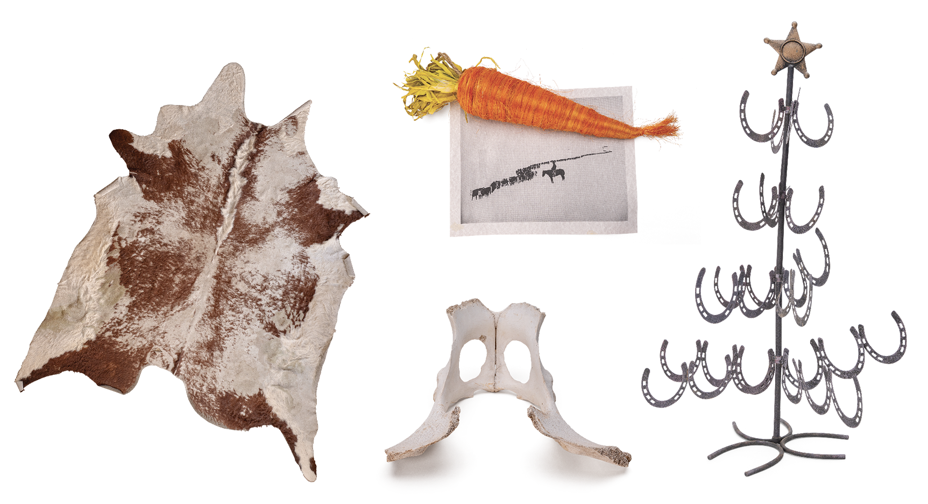
Weeks later, I go to the kind of estate sale you dream about: a wealthy woman’s ranch with a county-road address. Old wagon wheels, almost as tall as I am, are strewn throughout the grounds. Her closet contains a lace wedding dress from the 1920s. A skylight makes her toilet glow. In one(!) of her barns sits an equipal, a leather seat descended from Aztec thrones, the color of burnt sugar; also a great big straw carrot that I swiftly place on the “hold” table. (My editor has asked me to explain “why” I go on to purchase this carrot for $2. To never stare down another sunrise without being the legal owner of a great big straw carrot—is this not obvious?)
Since moving to New Mexico, I have learned to cock my ears for the whistling-firework-tail call of the lesser goldfinch. Inside the ranch house, my ears prick up at an even more striking sound: An elderly shopper is murmuring a joke to his friend in New Mexican Spanish, a vanishing dialect dwindling even in the few towns in which it is spoken. In an interview with The New York Times in 2023, one linguist compared the isolated conditions in which it evolved to a colony of astronauts who landed on Mars and then lost contact with Earth for a dozen or so generations. To overhear it is a rare treat.
This is a radiant Saturday morning—the perfect conditions for yard and estate sales, which usually give the proceedings a frantic air. But in the jewel-colored rooms of this home in the wilderness, people are idling: delighting in the little white Christmas lights strung across the exposed wooden vigas in the kitchen; reading the tiles in the woman’s colorful shower that spell out the names of her favorite horses; lingering in the art studio and on the sweeping back balcony to listen to wind hiss through the trees. I have never been in a home where it was more obvious that the owner lived there exactly as she wanted to. Then, singly and in pairs, we gather up our chosen fragments of this stranger’s life (marked down to half price), and load them into our cars.
PURCHASES:
- Large animal hip bone: $10
- Cowskin rug: $30
- Photo print of cattle in snow: $5
- Huge carrot made of straw: $2
- Beaded Easter eggs and more Christmas ornaments: $7
- Horseshoe jewelry rack: $10
- Pre–Pearl Harbor draft card: $0
TOTAL: $64
GRAND TOTAL: $99.66 LEFT OVER: $0.34
This article appears in the July 2026 print edition with the headline “Cheap Thrills.” When you buy a book using a link on this page, we receive a commission. Thank you for supporting The Atlantic.
The post Cheap Thrills appeared first on The Atlantic.