SAN CRISTÓBAL DE LA LAGUNA, Spain — Pope Leo XIV closed his seven-day trip to Spain with appeals for nations to uphold the dignity of migrants — but also for migrants to integrate and reconsider the “siren songs” of traffickers promising “easy paradises” in the West.
By coming to Spain’s Canary Islands off the coast of Africa, surrounded by waters where thousands of migrants have died in route to Europe, Leo plunged himself into the thick of an explosive debate that has roiled many countries and, at times, set off violence.
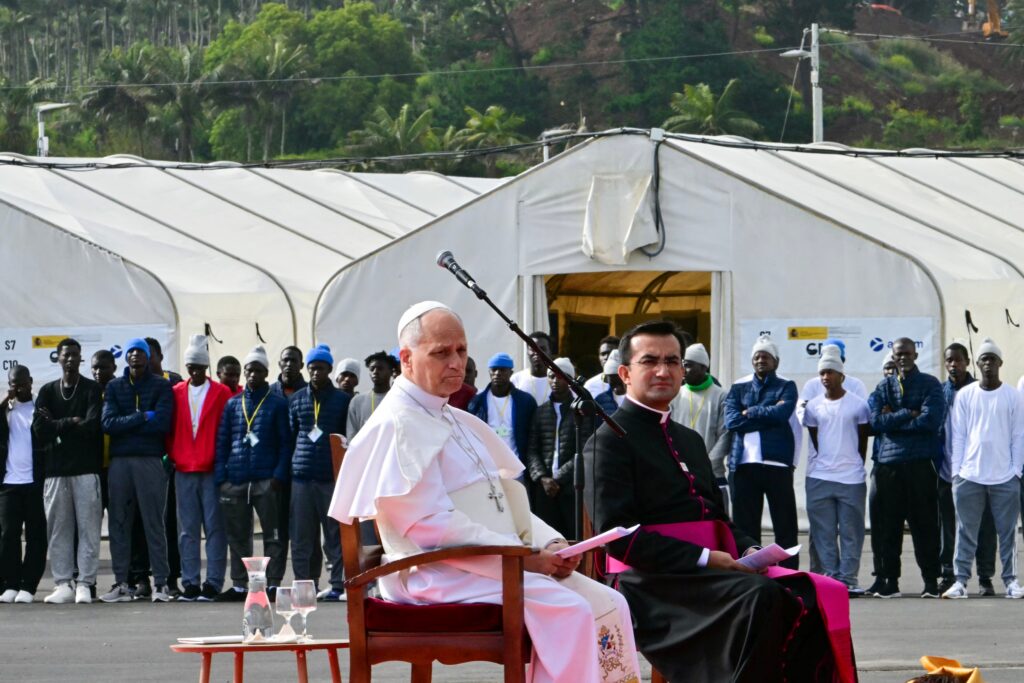
Speaking Thursday at the port of Arguineguín — the so-called “dock of shame” where migrants were crammed by the hundreds into fetid shelters in 2020 — Leo warned Europe, which is in the midst of a new migration crackdown,that it “cannot claim to uphold human dignity while growing accustomed to the Mediterranean and the Atlantic becoming unmarked graves.”
“Human dignity has no passport and does not lose its value when crossing a border,” Leo said before broadening his message to all Christians and casting a bouquet of flowers into the sea to honor the dead.
Leo became the first pontiff in history to visit these islands that have become a symbol of the risk and promise for asylum seekers and economic migrants pursuing the European dream. In doing so, he honored an unrealized wish by Pope Francis, the first Latin American pope, who emerged as something of a patron of migrants.
Some critics, particularly in the United States, have accused the 70-year-old Chicago-born Leo as “woke” on migration, and the political right on both sides of the Atlantic has taken aim at the Catholic Church he leads for its support of undocumented migrants.
But in Spain, Leo balanced calls for dignity and aid with a fuller position that his critics often ignore, and that won some praise from anti-migrant nationalists: He echoed his earlier statements that countries have a “right” to protect their borders.
Leo repeatedly called for migration through “legal” pathways, backed the fight against human traffickers, encouraged would-be migrants to reconsider leaving home and urged them to integrate in their adopted nations should they decide to leave.
On Friday, Leo punctuated that point by meeting with organizations working to integrate migrants in Tenerife. While he said integration “does not mean erasing the history” of migrants, it also does not “mean creating parallel worlds, closed off from one another, where people live side by side without truly encountering one another.”
A day earlier, he called on origin countries to offer justice and economic opportunity to keep would-be migrants home, and for Western nations to help them do that.
“While there is a right to seek refuge when life is threatened, there is also the right not to have to migrate,” Leo said, “the right to remain in one’s own home without hunger, war, persecution, violence, the land becoming uninhabitable, corruption stealing the bread from the poor or weapons destroying the future of children.”
Leo’s first official trip outside Italy to a major Catholic country in the West drew massive crowds, putting on display a pope growing more comfortable and confident in his role.
He interacted physically — holding babies, embracing the disabled, rousing the faithful at packed events. He also seemed more candid and less guarded. At times, he even looked like he was having fun.
In the cockpit on a flight to Barcelona from Madrid, he took almost childish delight, delivering a greeting and blessing to pilots of the Spanish air force fighter jets escorting his plane.
From the popemobile, he garnered giggles by balancing his hands to mimic the “6-7″ internet meme that’s gone viral with TikTok kids. He brushed elbows with Antonio Banderas and held a private audience with Bad Bunny. (In a fateful twist on Bad Bunny’s hit album, “Debí Tirar Más Fotos” or “I should’ve taken more photos,” no images of the encounter were released.)
Leo also took some heat. He met privately with a group of victims of clerical abuse, and denounced abuse as a “scourge.” But in a country where it remains a festering wound, and where the church is seen as coming late to its reckoning, Leo failed to mention the issue during a visit to a Catalonia abbey that became a symbol of the scandals. Spain’s El País newspaper also reported that a former prior accused of covering up cases was permitted to attend a papal event.
The pope’s trip unfolded amid a drumbeat from the right in Spain this week alleging that migrants were behind a series of recent high-profile crimes. The allegations were used to condemn a historic amnesty by the left-wing government of Prime Minister Pedro Sánchez, which is set to legalize hundreds of thousands of undocumented migrants mostly from Latin America.
The Catholic Church in Spain was one of the most powerful backers of the amnesty, appealing directly to Sánchez to embrace it, and enlisting volunteers and local parishes to gather petitions in support.
“There will be no turning back if we do not protect our borders, toughen the laws, and restore safety to our neighborhoods,” Ignacio Garriga, secretary general of the nationalist Vox party, declared on social media, noting a Barcelona killing on the same day Leo arrived in Spain’s second largest city. (No suspect has been arrested in the case.)
Nationalist politicians in Spain have taken on Catholic bishops who have accused them of “weaponizing” the migration issue to score political points.
By contrast, some Spanish conservatives hailed Leo’s support for legal migration and integration, and applauded him for seeming to take aim at a bid by Sánchez’s government to enshrine the right to abortion in the constitution.
Leo, on the floor of the Spanish parliament on Monday, also backed parents’ right to choose children’s education on religious grounds,
“On several points, [Leo’s] words were almost verbatim from Vox’s platform,” said Alberto Rodríguez Almeida, a Vox lawmaker from the Canary Islands. “The right to parents to choose their child’s education, the defense of human life from the point of conception.”
Rodríguez complimented the pope for his call for legal migration. “I believe there is no difference with Vox’s platform,” he said.
As in the United States, liberals and conservatives in Spain each claim Leo is with them. Sánchez, a professed atheist, shadowed Leo both before his trip (by traveling to Vatican City) and during his visit, following Leo to Barcelona and the Canary Islands, while celebrating the two men’s similarities.
“We share the commitment to defend the value of migrants and the rights of all people,” Sánchez posted on X.
Further to the left, some Spanish politicians were openly critical of the pope.
Gerardo Pisarello, a national lawmaker from a left-wing regional party, saw two popes during Leo’s trip. One is a liberal humanist who speaks against war, defends human dignity and is unafraid to take on what Pisarello described as President Donald Trump’s “cruelty.”
But Pisarello said he also saw in Leo an “exclusionary conservative” who seems less embracing of “nonconventional families” and, like all modern popes, opposes an array of liberal causes, including the rights to abortion and euthanasia.
“The Vox deputies who applauded Pope Leo are the same people who boo or vote against everything this pope says every other day of the week,” Pisarello said. “These are the same people who kneel before God and then, on the other hand, are cruel to their weaker brothers.”
But he said Leo had disappointed him and others on the left by focusing on abortion in his keynote speech to parliament on Monday.
“It was, let’s say, very disappointing that the pope decided to vindicate positions in matters of morality that not even a lot of Christians, or even Catholics, support, today,” he said.
But no issue is defining the church’s role in political debates in the West more than its stance on migration.
Leo arrived in the Canary Islands as treacherous seas and countless shipwrecks have transformed the vacation paradise into a graveyard for migrants desperate to reach Europe. The islands have also become a hub for Latin American migrants looking to take advantage of Spain’s relatively welcoming reception policies.
Those who reach these volcanic shores have found an outstretched arm in the Catholic church, which helps cloth them, feed them, shelter them and even offers legal assistance in finding jobs.
Claudia Correa, 45, arrived in the Canary Islands from a town near Cali, Colombia, just after the pandemic, cleaning houses to make ends meet and to send for her children and other family members.
When she arrived, she said church volunteers and aid workers helped feed her, gave her psychological counseling and legal advice. Now, in part because of the church’s support of the amnesty law, she said, she and nine other family members are on the cusp of legalization.
Correa turned out on Thursday to hear Leo partly in gratitude.
“I like him; he is with us — the migrants — just like Sánchez,” she said. “Because of them, we are going to be regularized, we are going to get papers. Because of them we will no longer be exploited.”
Dalila Olmo López in Madrid contributed to this report.
The post Defending migrants, Pope Leo calls for ‘legal’ paths, a nod to fraught politics appeared first on Washington Post.