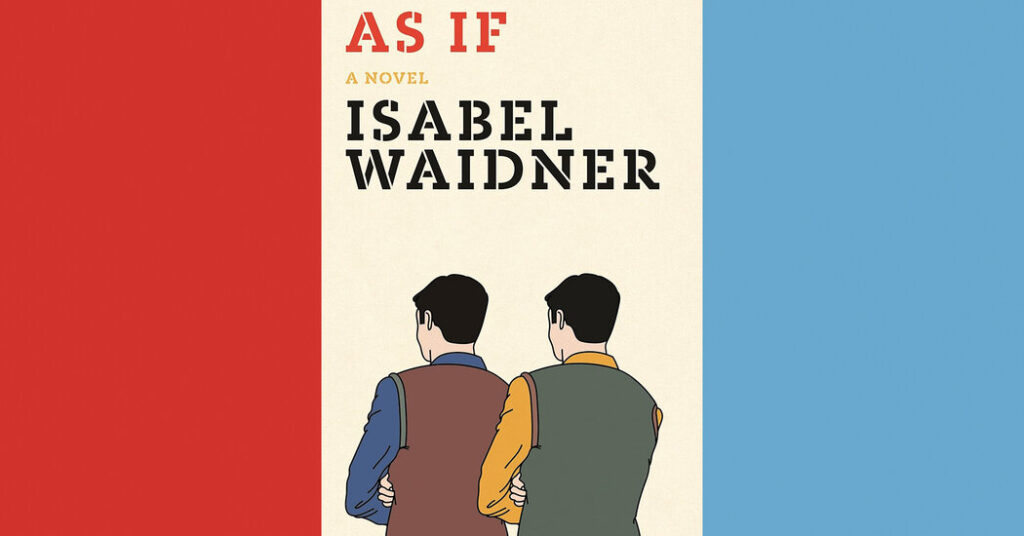
AS IF, by Isabel Waidner
Isabel Waidner’s “As If” follows a pair of Central London doppelgängers who swap lives amid precarious personal and professional circumstances. Lindsey Korine, a man on the lam from his family, follows Aubrey Lewis, a failed actor, back to his flat. The two share uncanny similarities: age, physical appearance, personal histories, spousal tragedies, even the cadence of their names (“Two syllables twice,” as Korine realizes). Eschewing introductions, they launch immediately into distressed conversation, a Vladimir and Estragon-esque exchange in which their multiple crises are palpable. (Fittingly, we learn that Lewis had previously starred in a production of “Waiting for Godot.”) So far, so Beckett-adjacent.
The arrival of a doppelgänger often signals bad luck for the protagonist, though in this case the damage has already been done. The novel’s plot hinges on each man’s failures and how his double shores them up — at least for a time. Korine attends an audition for a project Lewis had once been attached to but then planned to skip over. He does well enough to land the part, even as confusions mount over conflicting personal details and (for his fellow cast members) inexplicable lapses in dramatic ability. Lewis meanwhile takes on the role of husband and father, insinuating himself into the life of Korine’s recently abandoned family.
In both cases, the freedom of portraying the other is preferable to the impasse of their own lives. It can’t be said that the men are happier, per se, though there is a sense of novelty and renewed vigor that may be akin to growth: “I felt my internal spring tightening and, while it scared me, I also liked it,” Lewis says.
Their physical resemblance allows for many of the pleasures we expect from such fictions: role-playing, the blurring of boundaries, existential confusion and a certain cat-and-mouse provocation. As the doubling begins to proliferate alarmingly — Korine’s child is first given the name of a character in Lewis’s former television series, for instance, before a corrective (and a new name) is issued — a general sense of instability reigns.
Born in Germany and currently residing in London, Waidner has published four previous novels, an output suffused with cosmic bafflement and dark humor. “As If” plays to these strengths, suggesting how a profusion of selves and their attendant possibilities lie hidden beneath the crust of a chosen identity.
Grief is the engine of this surreal caper. We learn that Lewis’s wife, Laurie, has recently died of cancer. (Korine’s wife, also named Laurie, is currently in remission from the same disease.) The ambient dread and reality-bending power of loss ripple below the novel’s surface, inducing moments of heightened paranoia: “What if, over the last several years, I had lived with the possibility of my wife’s death so intently that I had invented a version of myself who was actually bereaved,” Korine ruminates. Changing roles is not merely a fleeing from dead ends. It is also a means of repression, a way to cover over the permanence of painful absence.
The novel’s alternating narrators keep things moving briskly, the limited perspective of one chapter delivering the comic payoff of the next. As in most doppelgänger stories, the suspicion remains that both protagonists might merely be two versions of a single individual. (A third man, the sinister Lucien Jelley, an understudy who greatly resembles the protagonists, also lurks at the periphery.)
Amid the dizzying back-and-forth, Waidner conceals a subtle exploration of midlife crisis. The foreclosed potential of one life clarifies the possibility of another: “Who could he be at 46,” Lewis wonders about himself at novel’s end. “The point was, I didn’t know. I’d never dared to find out.”
AS IF | By Isabel Waidner | FSG Originals | 177 pp. | Paperback, $18
The post This Novel Feels Like a Hallucination. That’s the Point. appeared first on New York Times.