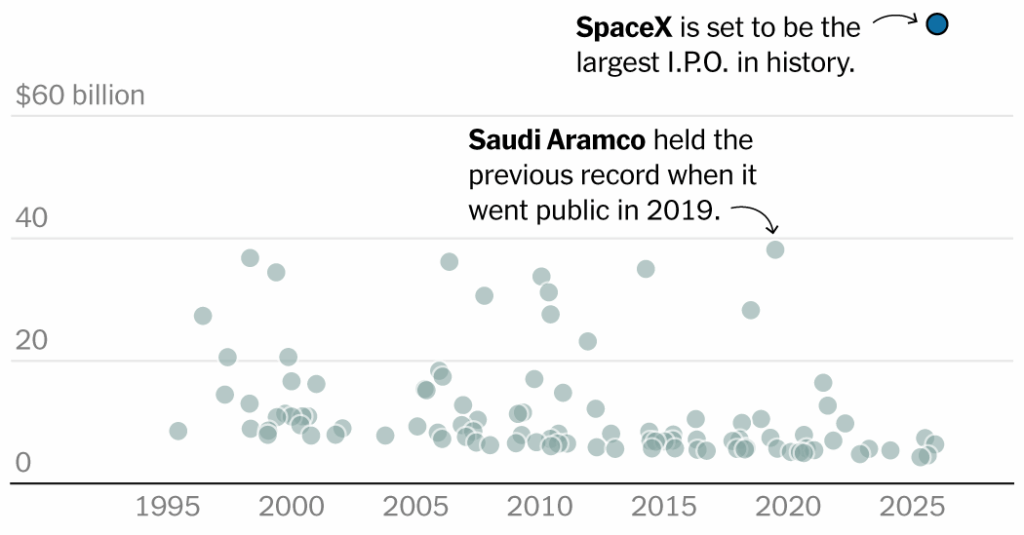
SpaceX is poised to become the largest initial public offering in history, eclipsing the previous record by an extraordinary margin. Its shares begin trading on Friday.
The peak was last set by Saudi Aramco, Saudi Arabia’s state-owned energy company, which raised $29 billion in 2019 (roughly $38 billion today when adjusted for inflation).
SpaceX is set to raise roughly twice that amount, valuing the company — which includes rockets, satellites, artificial intelligence and social media — at $1.77 trillion, according to the I.P.O. price set on Thursday. The offering could make Elon Musk, the company’s chief executive and already the richest person in the world, the first trillionaire, depending on how the shares trade after the market debut.
The I.P.O. comes at a critical moment. It will be a testament to investors’ faith in Mr. Musk, who has, among other things, promised to use the company to put people on Mars. It will also be a test of the stock market’s excitement about artificial intelligence.
SpaceX has increasingly focused its energies on A.I. development, acquiring xAI, another company controlled by Mr. Musk, in February. It also has a deal to acquire Cursor, an A.I.-assisted coding start-up, this year.
With the A.I. companies OpenAI and Anthropic preparing for their own I.P.O.s, SpaceX’s debut will be something of a barometer for whether the A.I. boom can live up to the lofty expectations of investors.
Jay Ritter, an I.P.O. expert at the University of Florida, said the current valuations of SpaceX, Anthropic and OpenAI were “not based upon how profitable they currently are or even how much revenue they have, but rather the very optimistic and not totally implausible scenarios for how they might become enormously profitable.”
SpaceX’s I.P.O. price is $135 a share. At that level, the company’s offering will be billions of dollars larger than all the I.P.O.s in 2023 and 2024 combined, and nearly the same amount as all offerings last year. Banks managing the offering also have an option to sell an extra 83 million shares over the coming month, which could raise even more money for SpaceX.
Recent large I.P.O.s have had mixed results. Uber and Lyft went public in the spring of 2019 in two hotly anticipated offerings. But their stocks struggled after listing, raising questions about whether public markets shared the enthusiasm that had fueled their rapid rises as start-ups. Saudi Aramco’s record-breaking listing later that year showcased the enormous wealth of the oil industry at its peak.
Once trading of SpaceX shares on the public market starts on Friday, it will provide an early verdict on whether its enormous I.P.O. valuation is justified.
“When you’re currently valued at $1.8 trillion, dropping to $500 billion would be a big disappointment,” Mr. Ritter said. “There’s an old saying: A great company isn’t necessarily a great investment. And I think that applies to SpaceX.”
The post How SpaceX Stacks Up to the World’s Largest I.P.O.s appeared first on New York Times.