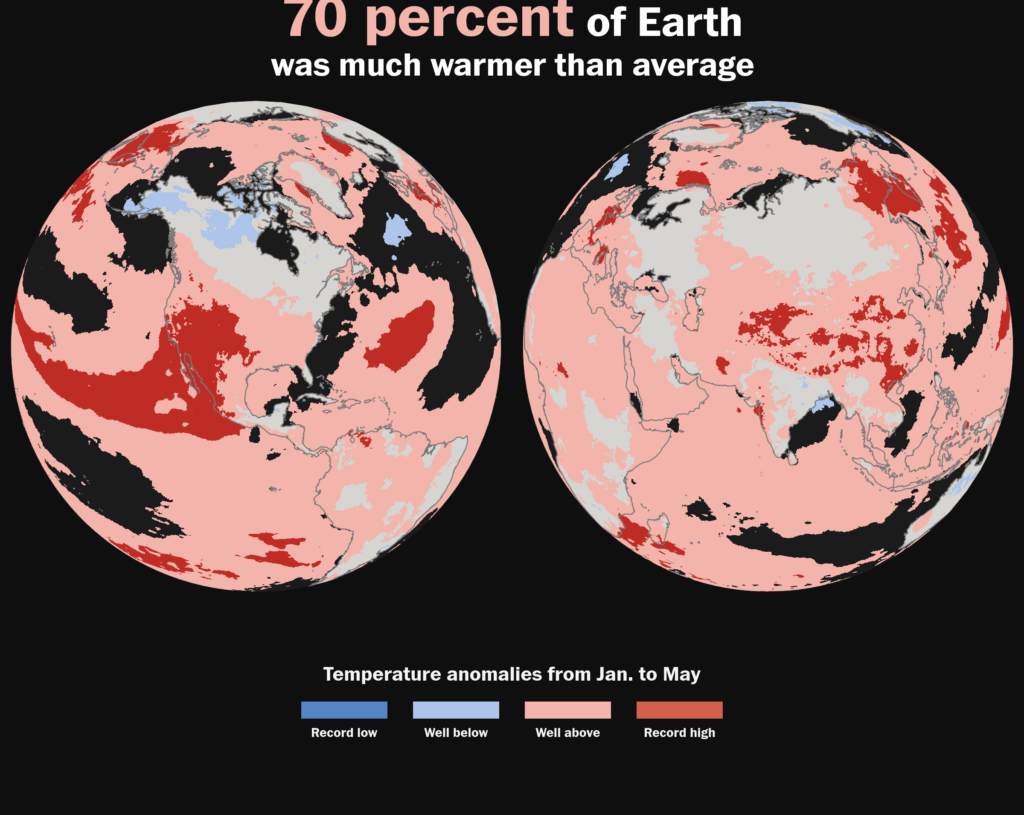
It’s been a particularly toasty start to the year on planet Earth — and it may be a sign of the kind of temperature extremes coming in the year ahead.
So far this year, over 70 percent of the globe has experienced well above average temperatures. Of that area, 8 percent has seen record-breaking warmth, including parts of the western United States, Asia and the Arctic. Meanwhile, just about 1 percent of the planet has experienced well below average temperatures.
This significant imbalance has occurred despite one of the coldest winters in decades along the East Coast, where temperatures so far this year have balanced out closer to average from Boston to Miami. It has been particularly chilly in Alaska and northern Canada.
But that has been the exception, not the rule.
And that imbalance may grow more extreme in the next year, with growing potential for a now-official El Niño to become the strongest such event on record later this year. Not only would that etch a new page in the weather history books for record-breaking Pacific Ocean temperatures, but it could drive high temperature extremes that millions or even billions of people feel into 2027.
Strong El Niño periods often appear as an upward stairstep in long-term plots of global temperatures — but this El Niño could be worth two stairsteps instead of one.
And that has forecasters concerned about the weather extremes that the next year will probably bring.
However, shifts between La Niña and El Niño, as well as other natural climate variations, don’t tell the whole story.
Record or near-record high levels of ocean heat in the West Pacific — which are fueling the developing El Niño — are linked to the long-term tailwind of rising global temperatures.
And that shows how climate change is amplifying the developing El Niño, with the combined influence of both natural and human-driven factors producing more warming than either would alone.
How hot could the next year get?
Climate scientist Zeke Hausfather created a dashboard that tracks global climate anomalies and projected global temperature rankings, which consider the planet’s long-term warming trend and an increasingly likely super El Niño this year into next.
According to his data, which extends back to 1850, this year has about a 54 percent chance of becoming the second-warmest year on record and a 31 percent chance of becoming the warmest year and surpassing 2024. That year had a global temperature anomaly of 1.6 degrees Celsius above average (2.9 degrees Fahrenheit).
However, 2027 has even higher odds of becoming the warmest year on record: The latest projections show nearly an 83 percent chance.
That’s partly because increasing air temperatures from El Niño lag slightly behind increasing ocean temperatures. Although peak ocean temperatures from El Niño will probably occur around December of this year, air temperatures will continue to rise after that.
Annual to decadal projections recently released by the World Meteorological Organization (WMO) echo Hausfather’s projection, predicting an 80 percent chance that at least one year from 2025 to 2029 will be warmer than the warmest year in 2024.
While described as “exceptionally unlikely” by the WMO, there is also now a 1 percent chance that global temperatures reach more than 2 degrees Celsius (3.6 degrees Fahrenheit) above average during at least one year in the next five.
The report also highlighted that the Arctic is likely to continue to warm, with temperature anomalies there predicted to be three and a half times the average across the whole planet — contributing to further reductions in sea ice concentrations.
Because of this, there will be “increasing climate risks and impacts on societies, economies and sustainable development,” the organization said.
The post Why a notably warm start to the year foreshadows what’s ahead appeared first on Washington Post.