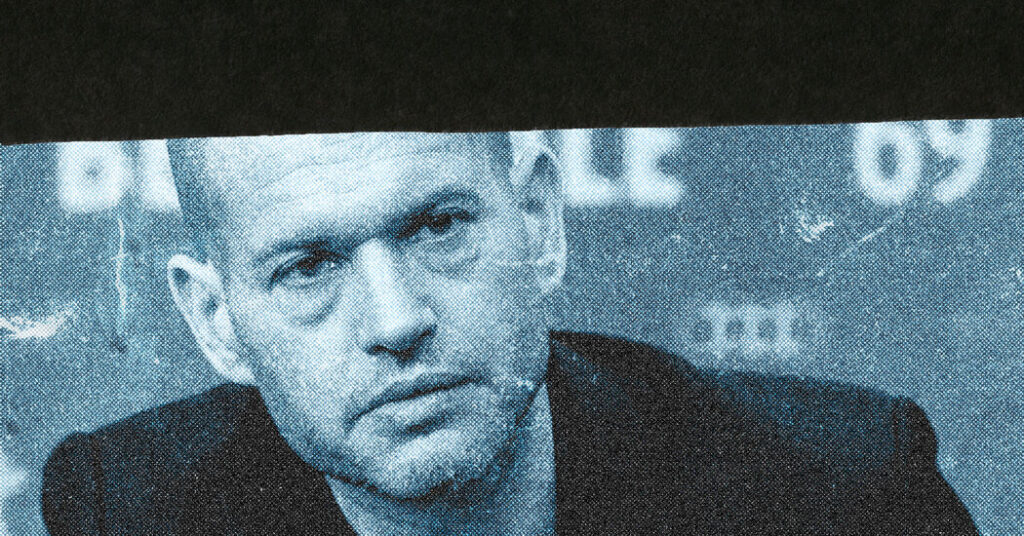
In 2021, the Israeli film director Nadav Lapid moved to France because, he told me, he felt his country was in a state of “total moral collapse.” After Oct. 7, as Israel ground much of Gaza into dust, Lapid returned to Israel to make “Yes,” an impossibly scathing, bitterly surreal attempt to capture that collapse on film.
“Yes” tells the story of a struggling pianist and party entertainer known only as Y who is commissioned to write a new national anthem celebrating genocide in Gaza. (The song borrows from a real one in a video by an Israeli nationalist group.) Lapid’s film is a vision of a traumatized country where life has become a frenzy of orgiastic partying and histrionic self-righteousness. It’s like “The Zone of Interest,” the 2023 film about the banal life of a Nazi family living next to Auschwitz, with Eurovision aesthetics. Though of course, as Lapid has pointed out, “The Zone of Interest” wasn’t made while the Holocaust was happening. In “Yes,” you can sometimes see and hear the real-world annihilation of Gaza in the distance.
Making “Yes” in a country at war and bursting with national fervor wasn’t easy. Many in the Israeli film industry refused to have anything to do with it; Lapid had to bring a makeup artist in from Serbia. He’d received money from the Israel Film Fund, which gets Israeli taxpayer funding but works independently of the government, and he feared that if the Ministry of Culture found out what he was up to it would find a way to shut the production down. So he forbade his actors from posting anything about the project online. He dodged the military to film guerrilla-style along the Gaza border.
“Yes” has been furiously denounced by leaders in Israel. The night of the Ophir awards — Israel’s version of the Oscars — police officers detained its star, the left-wing performance artist Ariel Bronz, on dubious grounds. (They said they were investigating whether a poem he’d posted on Facebook months earlier incited terrorism.)
Israeli outrage about the film was predictable. More surprising is that some leftists in Europe are boycotting Lapid and his work in the name of Palestinian solidarity. Last month, about a dozen pro-Palestinian filmmakers threatened to pull out of the Marseille International Film Festival because Lapid, an Israeli who’d taken public money, was going to be on the jury. Not wanting to cause trouble for the organizers, Lapid agreed to step down and instead hold a public master class on his films, but that too was canceled under pressure. “For them, even if I would have been selling hot dogs in the festival, it wouldn’t be legitimate,” he told me.
This wasn’t the first time that Lapid has felt stung by the European left. In Spain, he said, the movie screened under police protection because of bomb threats. An Italian distributor turned it down, he said, because she didn’t want to be accused of releasing movies from a genocidal state. And though “Yes” premiered at Cannes, the most prestigious film festival in the world, he thinks others have shied away from him and his work because they feared precisely the sort of dispute that broke out in Marseille.
Given that Lapid believes in boycotting Israel, the boycott of him has elicited a smug satisfaction in some quarters. After all, Israel’s partisans often claim that the country is hated not for what it does, but for its essential identity. Israel’s culture minister gloated that no matter how much Lapid tries to curry favor with the country’s enemies, they will always see him as nothing but “a Jew from Israel.”
“Yes” mocks Israelis who view themselves as eternal victims and insist that all their critics are antisemites. After being driven from the film festival in Marseille, Lapid felt like the butt of his own film’s joke. For about 10 minutes, he said, he thought that “maybe those people in Israel were right.”
But since then, he said, the film industry has rallied around him. Open letters supporting Lapid have been signed by leading figures in French cinema, as well as by the Palestinian intellectual Elias Sanbar and the actress Natalie Portman. The letter signed by Portman calls Israel a criminal state but argues — I think irrefutably — that its dissident artists should be treated like those from any other rogue regime. “Russian, Israeli and Iranian filmmakers should not be threatened with erasure to atone for crimes committed by governments they often fiercely oppose,” it says.
All this support, said Lapid, has exposed where cultural power really lies. The overwhelming consensus in his favor even makes him a little uncomfortable. “I don’t enjoy this feeling,” he said. “I don’t like to be a part of the majority.”
Surveying the whole debacle, Lapid puts much of the blame on cultural institutions that let themselves be cowed by a noisy purist minority. Most festival programmers and film distributors, he believes, don’t care all that much about Israel or Palestine. They just don’t want trouble. Decades ago, he said, conflict and controversy “made cinema relevant and important and sexy.” Now a sort of prudence reigns.
The result is that relatively few films reflect the discombobulating, absurd and often apocalyptic texture of modern life. Sometimes Lapid feels that the most truthful moment in a cinema is when patrons read news updates on their phones before the feature starts. “Then they see the true face of the world,” he said. “Then they see the chaos, then they see the madness.” When the film starts, they’re lulled into distraction. “While the present is playing crazy punk death metal,” he said, movies are playing “a nice intermezzo by Chopin.”
“Yes” is in part a disgusted condemnation of such escapism. Almost two hours into it, a voice-over says, “The Israelis, who grew up with the question, ‘How could people live normally while perpetrating horror?’ have themselves become the answer.” The inanity of the leftists who’d censor such a film shouldn’t distract us from the right-wing nightmare it reveals.
Source photo by Asatur Yesayants/Shutterstock.
The Times is committed to publishing a diversity of letters to the editor. We’d like to hear what you think about this or any of our articles. Here are some tips. And here’s our email: [email protected].
Follow the New York Times Opinion section on Facebook, Instagram, TikTok, Bluesky, WhatsApp and Threads.
The post ‘Yes’ Is a Scathing Portrait of Israeli Depravity. Why Are European Leftists Boycotting It? appeared first on New York Times.