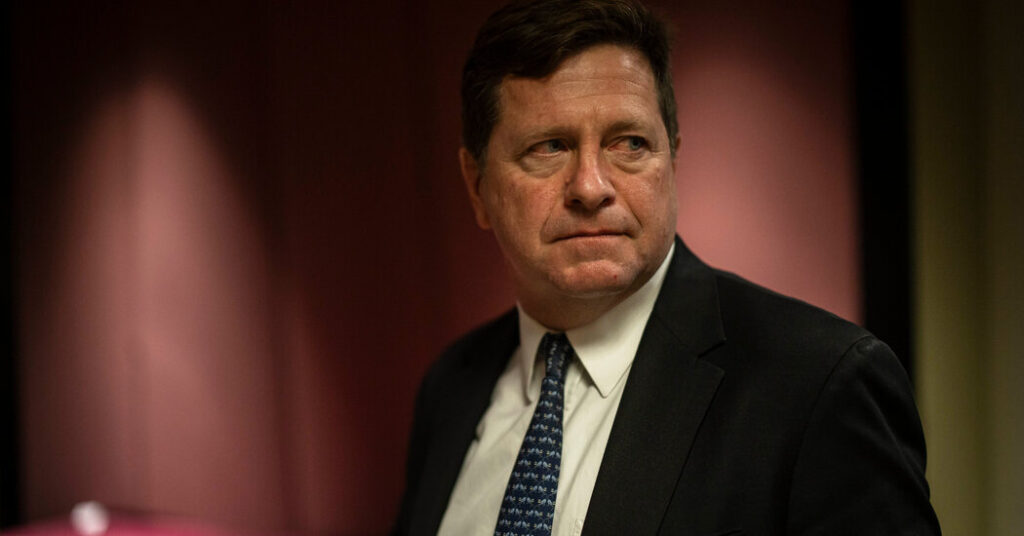
President Trump said on Thursday that he would nominate Jay Clayton, the U.S. attorney in Manhattan, to be the next director of national intelligence, after the president faced a revolt from lawmakers over his choice for an interim director without any relevant experience.
Mr. Trump had been under pressure to move on from his decision to appoint Bill Pulte, a top housing official, as the acting director, replacing Tulsi Gabbard, who announced last month that she would step down from the post.
Mr. Pulte, who has used his current job to attack Mr. Trump’s enemies, had come under withering criticism from Capitol Hill. Both Republicans and Democrats have argued he was unqualified to lead the nation’s intelligence agencies.
Mr. Trump, in a social media post, encouraged the Senate to confirm Mr. Clayton “as soon as possible.”
“Few people anywhere in the Legal Community are respected at the level of Jay,” Mr. Trump wrote.
Mr. Clayton was recommended for the post by John Ratcliffe, the C.I.A. director, according to a person familiar with the conversation. The current plan is for Mr. Pulte to take over from Ms. Gabbard on June 19 and serve as the acting director until Mr. Clayton’s nomination is reviewed by the Senate.
Mr. Pulte, the person said, will seek to shrink the office beyond the cuts Ms. Gabbard had made. Mr. Trump wants Mr. Clayton to lead a smaller office, more narrowly focused on coordination among the 18 intelligence agencies.
Senator John Thune, the Senate majority leader, got no warning about the announcement but spoke positively about Mr. Clayton’s nomination.
“I think he’s considered to be a very qualified professional with a great skill set for managing a complex problem set,” Mr. Thune said. “We will try to get him up and considered as soon as possible.”
Representative Jim Himes of Connecticut, the top Democrat on the House Intelligence Committee, praised Mr. Clayton and said he would make a “terrific” director of national intelligence.
Senate Democrats may also support a speedy confirmation of Mr. Clayton, if only to push Mr. Pulte out of the acting role. Senator Mark Warner of Virginia, the top Democrat on the Senate Intelligence Committee, said he needed a guarantee that Mr. Pulte would not serve as the acting director, a sentiment echoed by Senator Chuck Schumer, the minority leader.
“Pulte has to go,” Mr. Schumer said. “He cannot be in the D.N.I. role. Our national security is too important.”
The appointment of Mr. Pulte derailed the congressional reauthorization of one of the government’s most powerful surveillance authorities.
But the announcement of Mr. Clayton, who is also a former chairman of the Securities and Exchange Commission, to be nominated for Senate confirmation seemed unlikely to immediately solve Mr. Trump’s problems with reauthorizing the law.
The House on Thursday rejected a three-week extension of the law, Section 702 of the Foreign Intelligence Surveillance Act, which will expire at midnight on Friday. With Congress now out of town, and some lawmakers headed overseas, it would be difficult to schedule another vote before the deadline.
In an administration stocked with officials seeking to win the president’s favor, Mr. Clayton has kept a relatively low profile. But since taking over the most prominent federal prosecutor’s office in the country in April 2025, he has frequently golfed and socialized with the president, including at Mar-a-Lago, Mr. Trump’s estate and club in Florida.
Mr. Clayton arrived at the Manhattan U.S. attorney’s office at an unusual time for the proud institution, once nicknamed the sovereign district in a nod to its independence from Justice Department headquarters in Washington.
That independence was compromised almost immediately after Mr. Trump returned to the White House. He put Mr. Clayton in charge of the office months after his top Justice Department officials instructed its prosecutors to abandon a corruption case against the mayor of New York City, Eric Adams.
That directive led to the resignations of a number of leading prosecutors, including the office’s interim U.S. attorney, Danielle R. Sassoon.
Mr. Clayton had long expressed an ambition to lead the office, and some veteran prosecutors had hoped he would stabilize it. But instead, he has often been absent, and office alumni have been struck by his willingness to speak out publicly in support of the president.
As U.S. attorney, Mr. Clayton oversaw much of the document review related to convicted sex offender Jeffrey Epstein. His prosecutors also brought a case against Nicolás Maduro, then the president of Venezuela, who was captured by American military forces in January.
The office has brought several other prominent prosecutions. Last month it charged the commander of an Iranian-backed militia with plotting to attack Jewish sites in the United States, including a synagogue in New York City.
But former prosecutors have said that the office is bringing fewer, and smaller, cases than in previous years.
Mr. Clayton came under particular criticism in the legal community, including by Southern District alumni, after he refrained from commenting publicly when the Trump administration fired one of the senior prosecutors in his office, Maurene Comey, the daughter of James B. Comey, the former F.B.I. director.
But more recently, he did speak out, to buttress Mr. Trump’s concerns about voter fraud. This week, he appeared on CNBC’s “Squawk Box” and raised concerns about the recent elections in California, after Mr. Trump suggested there had been fraud in the vote.
Mr. Clayton told CNBC that the country was “doing an absolutely terrible job” on issues of election integrity, “and the American people are right to question it.” He also questioned California voting laws, including the lack of voter identification.
“I’m not saying that there is fraud,” Mr. Clayton said. “I am saying that the opportunity for fraud makes no sense to me when we can make a much better system.”
During her time as director of national intelligence, Ms. Gabbard won praise from Mr. Trump for her work on elections. She joined an F.B.I. raid on voting records in Georgia. Still, Ms. Gabbard did much to dismantle the foreign malign influence center, which had been built up in the Biden administration to warn the public about election threats.
It was not immediately clear on Thursday who would lead the U.S. attorney’s office in the Southern District of New York in Mr. Clayton’s absence. Much of its work was already being overseen by two veteran prosecutors — Amanda Houle, the chief of the office’s criminal division, and Sean Buckley, the deputy U.S. attorney.
Reporting was contributed by Carl Hulse, Maggie Haberman, Jonathan Swan and Dustin Volz.
The post Trump Picks New Intelligence Chief After Revolt Over Pulte appeared first on New York Times.