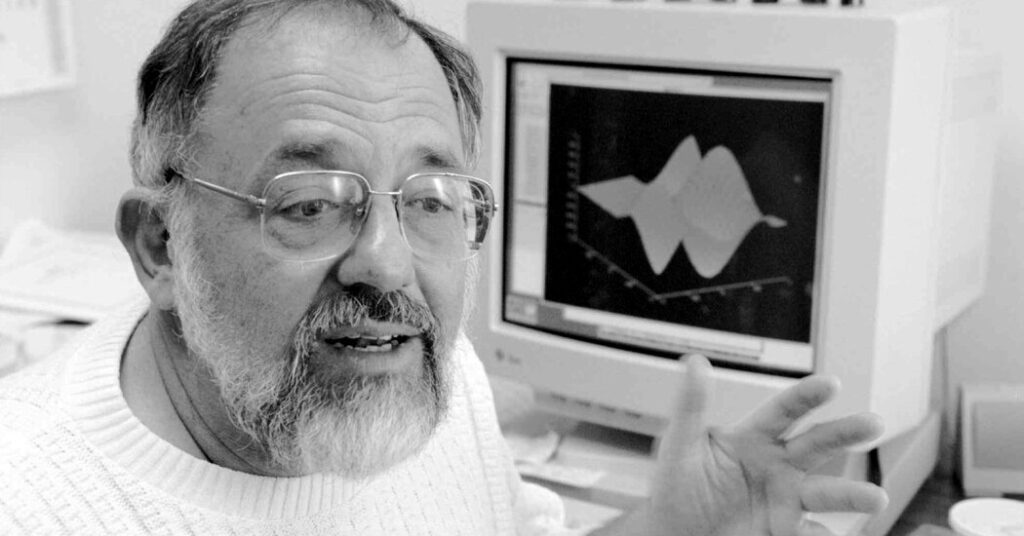
Cleve Moler, a mathematician who, in the 1970s and ’80s, developed tools that made it possible to do complex calculations on computers without having to understand or write the underlying code — an achievement that unlocked the vast power of computing in fields as diverse as finance, automobile design and medical imaging — died on May 20 at his home in Saint Michaels, Md. He was 86.
His daughter Kathryn Moler said the cause was Parkinson’s disease.
In the early 1970s, computing was at an impasse. Scientists knew that computing power and memory had the potential to be nearly limitless. At the same time, fields like engineering and biomedical research were running up against quantitative problems far too complex for humans to solve with pen and paper.
Computers could, in theory, help with those problems. But especially early on, working with them was extremely difficult, requiring a deep understanding of FORTRAN, the first high-level programming language, along with hours spent writing the necessary code.
Dr. Moler arguably did more than anyone else to bridge that gap.
In the 1970s, he played a central role in developing two libraries — essentially collections of prewritten code — within FORTRAN, called EISPACK and LINPACK, which provided a standardized set of shortcuts.
That addressed only the coding part. Researchers had to write their inputs on paper, which was then converted into punch cards that were fed into computers — at the time, still giant hunks of metal and wires. It could take a day or more to get an answer, or to find out if there was a flaw in the code.
Dr. Moler saw this problem firsthand with his students at the University of New Mexico, where he taught in the mathematics and later the computer science departments.
Starting in the late 1970s, he developed MATLAB, an interface that allowed students to engage directly with a computer, at first through a Teletype machine. His invention was akin to a super-calculator that was able to quickly process mountains of data without the need to program each calculation in advance and without going through the process of creating punch cards.
Though Dr. Moler intended his interface to serve as a student aid, word spread and soon thousands of people were using it.
The advent of the personal computer gave every engineer access to a powerful computational device. MATLAB offered a relatively simple way of unlocking those computers’ full potential.
“I was lucky in that the things that I was personally interested in were useful to other people,” he told Scientific Computing World magazine. “I didn’t invent MATLAB to be used by a lot of other people. I put things into MATLAB that I found useful, and other people have also found them useful.”
In 1984, Dr. Moler and Jack Little, an electrical engineer, founded MathWorks, a company that develops and markets scientific computing software; Dr. Moler became the company’s chief mathematician.
Today, MATLAB is used by millions of scientists and engineers worldwide, and MathWorks has 6,500 employees and annual revenue of about $1.5 billion.
“It’s not that he was the leading figure in producing, like, amazing new methods” of numerical analysis, Thomas Haigh, a professor of computing history at the University of Wisconsin-Milwaukee, said in an interview. “But he made probably the biggest contribution in terms of actually getting those methods used.”
Cleve Barry Moler was born on Aug. 19, 1939, in Salt Lake City, where his parents, Murray and Eleanor (Barry) Moler, worked as journalists.
He began studying at Caltech in 1957, two weeks before the Soviet Union launched Sputnik, the first man-made satellite. The achievement shocked the United States, which flooded university campuses with money to fund research on computers and engineering. Dr. Moler rode that wave of largess.
After graduating in 1961 with a degree in mathematics, he received his doctorate in the same subject at Stanford University in 1965. He might have gone into computer science instead, but the department was not created until after he arrived.
In 1967, he teamed with his adviser George Forsythe to write one of the foundational textbooks in computer science, “Computer Solution of Linear Algebraic Systems,” still considered a classic in the field. He went on to teach at the University of Michigan and, beginning in 1972, at the University of New Mexico.
Dr. Moler’s marriages to Nancy Martin and Shaaron Kent ended in divorce. He married Patsy Wiser in 2000. She survives him.
In addition to his daughter Kathryn, from his first marriage, he is survived by two other daughters, Teresa Moler, from his first marriage, and Antonia Moler, from his second; two stepdaughters, Carolyn Lupton Franco and Byerly Cline; two sisters, Martha Moler and Elizabeth Moler; and two grandchildren.
Dr. Moler’s work may have changed the world, although its highly technical nature meant that it, and he, were far from household names. But anyone who has seen the first “Star Trek” film, released in 1979, has gotten a glimpse of it.
During filming, the producers asked the Los Alamos National Laboratory for accurate computer graphics to run on a display at Dr. Spock’s console. The lab gave them film showing the results of a matrix computation, designed by Dr. Moler, appearing as jagged peaks on a square.
It’s visible over Dr. Spock’s shoulder, just as the starship Enterprise enters a nebula in search of an evil superintelligent cloud called V’Ger.
The post Cleve Moler, Who Unlocked the Power of Computing for Millions, Dies at 86 appeared first on New York Times.