Members of Congress departed Washington on Thursday without acting to extend one of the government’s most powerful surveillance authorities for collecting information on foreign threats overseas, all but assuring that the law will expire as scheduled on Saturday.
In a 218-to-198 vote, the House rejected a measure to temporarily renew a statute that underpins the government’s cornerstone electronic spying program, known as Section 702 of the Foreign Intelligence Surveillance Act. Not long afterward, Democrats blocked a similar last-ditch effort in the Senate, underscoring the stalemate ahead of a Friday midnight deadline to extend it.
A clutch of bipartisan lawmakers had until recently been negotiating some marginal changes to the law in a push to earn enough support from privacy advocates to renew the authority for three years. But the group splintered after President Trump said last week that he was installing Bill Pulte, a top housing official and a close ally who has no intelligence background, as acting director of national intelligence.
Democrats, including those who had been pushing for the spy law’s renewal, said they would not pass legislation extending it unless Mr. Trump backed down from his pick of Mr. Pulte or nominated a suitable permanent pick. Up until Thursday afternoon, the president had refused, despite Republican entreaties to do so or risk a lapse of a critical surveillance power.
But hours after the extension bill failed in the House and lawmakers began leaving Washington for a weeklong recess, Mr. Trump said he would nominate Jay Clayton, the U.S. attorney in Manhattan and former chairman of the Securities and Exchange Commission, as his permanent pick for spy chief.
It was not immediately clear whether Democrats would view Mr. Clayton more favorably than Mr. Pulte, and the announcement appeared to be too late to prevent the expiration of Section 702. Mr. Trump also did not withdraw Mr. Pulte as his choice for acting spy chief — a demand made by some top Democrats.
The expiring authority permits the government to collect from U.S. technology companies like Google and AT&T the communications of foreigners located abroad without a warrant when seeking foreign intelligence information. Officials from multiple administrations have credited the program with helping identify terrorist plots, combat cyberattacks and monitor the activities of foreign adversaries.
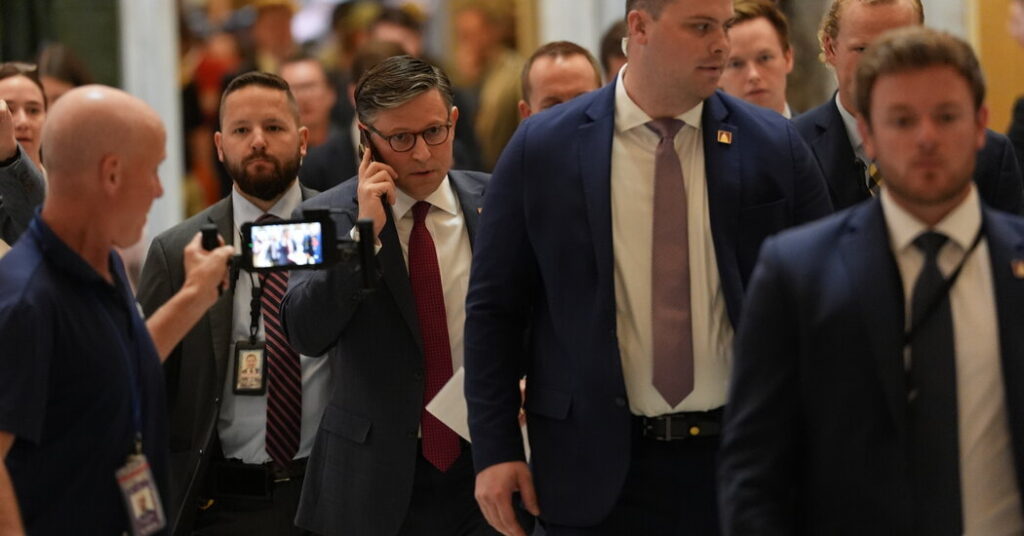
Speaker Mike Johnson laid its imminent expiration at the feet of Democrats, calling their opposition to the temporary extension “dangerous, and very, very shameful,” even though more than a dozen Republicans joined them in defeating the measure.
“They are willing to jeopardize the safety and the security of the American people to make a cheap political point,” Mr. Johnson said of Democrats. “I pray that we do not have a serious calamity on our shores.”
But the law has long faced resistance from civil libertarians on both the left and the right who are concerned that it allows the government too much latitude and tramples on privacy protections. Lawmakers in both parties have pushed for years, mostly without success, for stronger restrictions on how the F.B.I. treats Americans’ communications that are incidentally swept up in foreign intelligence collection.
This year, however, the debate has been further complicated by the selection of Mr. Pulte.
Democrats have argued that Mr. Pulte, who has used his perch as the director of the Federal Housing Finance Agency to carry out a campaign of retribution on behalf of the president, would weaponize the nation’s intelligence apparatus to do Mr. Trump’s bidding. The president, who has long desired a spy chief who would comply with his desire to punish his perceived enemies, has already urged Mr. Pulte to conduct mass firings of employees at the Office of the Director of National Intelligence. The current spy chief, Tulsi Gabbard, has overseen significant downsizing at the agency.
On Thursday, Senator Mark Warner of Virginia, the top Democrat on the Intelligence Committee, said that Mr. Trump’s naming of Mr. Pulte had blown up a potential bipartisan compromise to reauthorize the law that had been on a “glide path.”
“There have been a half a dozen exit ramps for the White House on this problem,” he told reporters. “They have chosen not to take them.”
In the House, Representative Hakeem Jeffries of New York, the minority leader, urged Democrats to oppose the temporary extension, saying it lacked necessary changes to the surveillance programs and expressing frustration over Mr. Pulte’s appointment.
“There is a path to reauthorizing FISA, but it will require enacting meaningful reforms,” Mr. Jeffries said before the vote in a statement issued with other Democratic leaders. “We oppose this bill to kick the can further down the road.”
Nineteen Republicans and all but seven Democrats voted against the stopgap measure. Hours later, Senate Democrats objected to bids by both Senator Tom Cotton, Republican of Arkansas and the chairman of the Intelligence Committee, and Senator John Thune of South Dakota, the majority leader, to win quick approval of temporary extensions.
The Senate is scheduled to return on Monday, while the House is planning to return on June 23.
Should the Section 702 statute sunset, a built-in safety mechanism would most likely enable it to continue operating. The surveillance court that oversees FISA issued new annual certifications for the program in March, meaning the National Security Agency could continue to operate it until next spring — though such a scenario could invite legal challenges from the companies that the law requires to share communications data with the government.
Olivia Diaz contributed reporting.
The post House Rejects Bill to Extend Spy Power, All but Assuring a Lapse appeared first on New York Times.