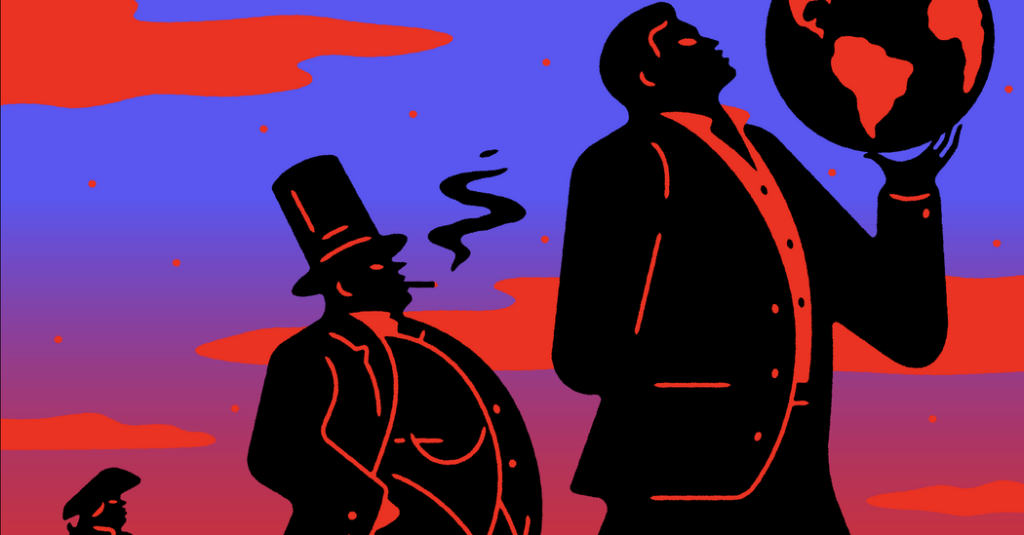
Increasingly, we see some of the leading figures in and around Silicon Valley expressing skepticism of contemporary notions of egalitarianism and even disdain for equality.
In his 2014 book, “Zero to One,” the tech investor Peter Thiel, who has had a hand in the rise of companies from PayPal to Palantir, described an economic world in which “a small few radically outstrip all rivals,” a power dynamic that is “the law of the universe.”
Last year, in a post on X, Elon Musk said “it increasingly appears that humanity is a biological bootloader for digital superintelligence,” a phrase that seems to suggest we’re all just inputs for wealth-generating enterprises.
Carlos Carvalho, the president of the University of Austin, an institution with supporters including Mr. Thiel and other tech moguls, gave a convocation address last year titled “In Defense of Inequality.”
It’s tempting to believe that these paeans to inequality represent a new and heterodox train of thought in our politics. After all, Americans like to think of ourselves as a country that believes deeply and universally in equality for all. We tend to say, yes, the ideal that “all men are created equal” was radical when it was first set out in the Declaration of Independence, but that over time it has steadily become a given.
Not exactly.
Our country has long nurtured a strain of anti-egalitarianism, especially when it comes to the economy. Dr. Carvalho concedes in his speech that we are “created” equal. But throughout our history there have been voices that have contended that despite the abiding tension between political democracy and the forces of capitalism, we should learn to view inequality as something that is natural and even good.
This skepticism of equality can be traced at least to the era of the founders. In 1814, John Adams wrote that “to teach that all men are born with equal powers and faculties, to equal influence in society, to equal property and advantages through life” is a “fraud.”
Opposition to equality has sometimes taken on an explicitly racial character. In 1854, the pro-slavery author George Fitzhugh wrote that the Declaration’s preamble consisted of falsehoods that didn’t present a problem “until abolition arose.” People, he insisted, simply were “not born physically, morally or intellectually equal,” and therefore “their natural inequalities beget inequalities of rights.”
Later in the 19th century, as industrial capitalism led to the emergence of startling new concentrations of wealth, new arguments about the inevitability of inequality began to circulate. The Yale political economist William Graham Sumner, who argued that the concentration of wealth that results from capitalist competition was inescapable, maintained that “the assertion that all men are equal is perhaps the purest falsehood in dogma that was ever put into human language.”
His contemporary Andrew Carnegie was more conflicted about economic stratification. But in “The Gospel of Wealth,” the steel magnate articulated his view that “the concentration of business, industrial and commercial, in the hands of a few” was in everyone’s best interest, for the wealthy would thus be able to act as trustees for the benefit of society, investing in grand cultural institutions such as libraries and concert halls that working-class people would not be able to attain on their own.
In the 1920s, the sensationalist writer Theodore Lothrop Stoddard, a eugenicist, argued that “natural equality is one of the most pernicious delusions that has ever afflicted mankind.” For Stoddard, economic and racial hierarchy were linked: His ideal social order was one in which “Nordic” people were in positions of authority with regard to the “under-man,” and he feared Bolshevism as a threat to the racial order.
In his autobiography, Henry Ford claimed that it would be a “terrifying prospect” for him to work on an assembly line, but suggested that for those more suited to working on assembly lines, creative thought would be similarly terrifying. He wrote, “Most certainly all men are not equal, and any democratic conception which strives to make men equal is only an effort to block progress.”
The gospel being preached by some of today’s tech barons appears to be, at least in part, a kind of justification for the existence of a billionaire class. It meshes with the philosophy outlined by Milton and Rose Friedman in the libertarian treatise “Free to Choose,” which embraces equality of opportunity but takes a dim view of prioritizing equality of outcomes. They argued that material inequality was justified as long as economic competition was open to all.
It also runs alongside challenges to progressive ideas that seek to engender both civic and economic equality. Mr. Musk routinely fulminates against so-called wokeness. Dr. Carvalho praises stratification as a societal building block, saying, “Democracy runs on equality; freedom and excellence run on inequality.”
Today’s debates about wealth inequality and affordability are driven in part by the question of whether equality of opportunity can meaningfully exist in a society in which wealth — and control of powerful technologies like artificial intelligence — is increasingly concentrated in the hands of a few. Those who try to reassure us about the inevitability and benefits of inequality often avoid addressing the problems that the extreme concentration of wealth in our own day creates for democratic life.
The constant revival and rediscovery of the supposed virtues of inequality points to the radical potential that remains in the egalitarian ideal, 250 years after the signing of the Declaration. That so many have sought to counter the central precept of our founding reminds us how potent and challenging the idea of equality remains.
Kim Phillips-Fein is the author of “Country of Lords: Neo-Aristocrats, Social Darwinists, Tech Utopians and the Long Fight Against Equality in America.”
The Times is committed to publishing a diversity of letters to the editor. We’d like to hear what you think about this or any of our articles. Here are some tips. And here’s our email: [email protected].
Follow the New York Times Opinion section on Facebook, Instagram, TikTok, Bluesky, WhatsApp and Threads.
The post ‘All Men Are Created Equal’ Is Still a Radical Idea appeared first on New York Times.