On Friday, when SpaceX shares begin trading in the largest ever public offering on record, a host of Elon Musk’s friends, associates and hangers on are poised to become fabulously rich.
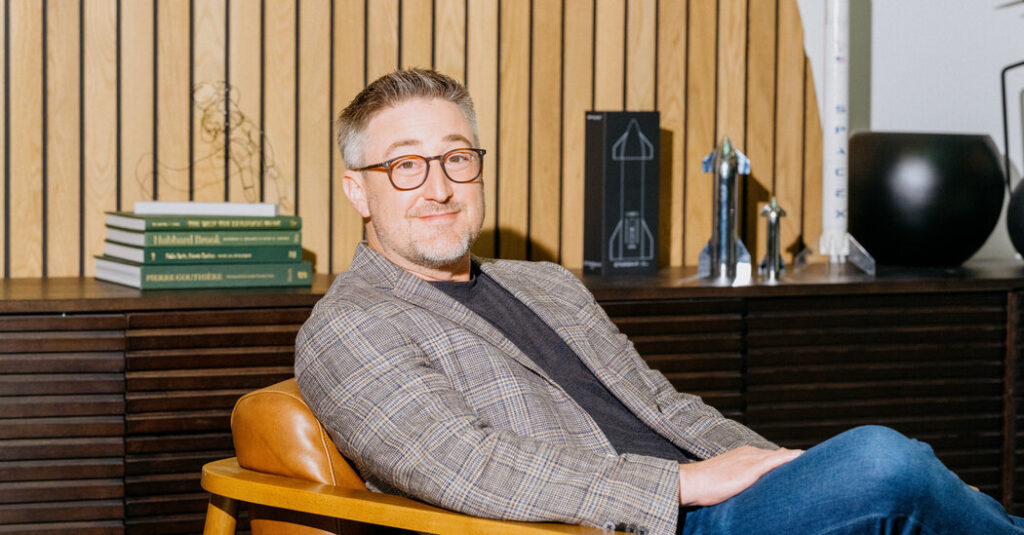
Also on the list for a life-changing financial windfall is Justin Fishner-Wolfson, long a minor figure in Mr. Musk’s orbit, but one whose livelihood hews on being one of the rocket maker’s most steadfast investors.
Working out of unmarked San Francisco offices above a tailor shop, Mr. Fishner-Wolfson has spent the past 15 years amassing as much ownership of SpaceX’s privately held shares as possible.
He has raised money from all corners of the world to buy stakes directly in the company, including by offering to buy shares from SpaceX employees. Since his investment firm, 137 Ventures, made its first investment in 2011, it has not sold any SpaceX shares, no matter the temptation to lock in profits earlier.
Little by little, Mr. Fishner-Wolfson’s firm now owns more than 1 percent of SpaceX, worth roughly $20 billion at the company’s expected $1.77 trillion valuation at its listing price. He has been privately buying SpaceX’s shares since the company was valued at $1 billion.
“This will most likely define my career,” he said in an interview this week.
Some SpaceX investors, who have been financing in the rocket maker for at least as long as Mr. Fishner-Wolfson, have already entered the realm of Silicon Valley legends. They include an early Tesla booster to whom Mr. Musk gifted the company’s second roadster; a space enthusiast who wore pajamas to SpaceX board meetings; and the U.S. ambassador to Denmark, who lent Mr. Musk use of his Texas mansion. (News of Mr. Musk’s extended stay at the mansion came out at a time when he was publicly boasting about his modest lifestyle.)
Mr. Fishner-Wolfson has kept a lower profile. A Texas native, Mr. Fishner-Wolfson skipped the second grade, allowing him to matriculate at Stanford at 16 years old. He is quick to point out he was rejected from Harvard, and to draw a contrast between himself and Silicon Valley stereotypes (“I’ve done basically no drugs,” he volunteered).
His initiation in SpaceX traces back to 2008, when the company seemed somewhere between a dream and a joke. Then 26-years-old and the most junior of five investment employees at Peter Thiel’s venture capital firm, Founders Fund, he was assigned to check in on their new investment into SpaceX.
So unknown was SpaceX at the time that Founders Fund used to keep hand-drawn sketches of future rocket prototypes on the office white boards.
That August, Mr. Fishner-Wolfson flew to Los Angeles and stood in the control room at the company’s headquarters next to Gwynne Shotwell, SpaceX’s president, to watch a live video feed from the Marshall Islands of the company’s third attempt to launch a reusable rocket. The ship made it all of two minutes in flight before crashing in flames.
“What are you going to do?” he recalled asking Ms. Shotwell. His partners had just poured $20 million into SpaceX, or about 10 percent of their most recent fund. He needed an explanation of what went wrong at the launch.
She was nonplused, he recalled. Maybe it was a software timing issue, she suggested. They would have to build another rocket and try again.
“That’s it?” Mr. Fishner-Wolfson responded. He returned to San Francisco knowing not much more than he had when he left. But his bosses at Founders Fund were unfazed and stuck with SpaceX.
The fund’s $20 million investment is now worth billions, according to three investors in the fund.
“Nobody could have expected this 20 years ago,” Mr. Fishner-Wolfson said.
SpaceX did not respond to requests for comment.
Three years after witnessing the doomed rocket launch, Mr. Fishner-Wolfson struck out on his own and started 137 Ventures, named after the seat his grandfather held at the New York Stock Exchange.
He invested in other start-ups, such as Uber, but SpaceX was by far his central interest. The 137 offices contain a shrine of sorts to the company. In the entryway, in lieu of a receptionist, sits an enormous used engine from a SpaceX rocket. A crane was needed to knock out a window to get the rocket into the building.
There have been moments of doubt. About 10 years ago, when SpaceX began raising money for what seemed like an outlandish side project, the satellite internet service Starlink, the venture capital firm, which has 25 employees, debated whether to keep investing. “There was a lot more risk on the table,” said Alex Jacobson, a partner at 137 Ventures.
Mr. Fishner-Wolfson, 44, is eager to talk about the business of SpaceX, but he is shy to discuss Mr. Musk, who even after the public offering will maintain a vast majority of the controlling shares. Asked whether he had ever delivered tough feedback to Mr. Musk, he paused for 19 seconds before answering in the affirmative, without providing details.
“You can say whatever you want to say, and then he’ll either change his mind or he won’t,” he said, adding: “It’s usually a short conversation.”
Mr. Fishner-Wolfson said he had learned to ignore the newsmaking moments about Mr. Musk’s personal and political life. “Whoever Elon happens to be dating at any given moment is not that relevant to the business of SpaceX,” he said.
Mr. Fishner-Wolfson’s next decision — perhaps his biggest yet — is what to do with his SpaceX stake after it goes public.
He has been preparing for that for years, having moved to Las Vegas in 2018 in part to establish residency in a low-tax state, according to a friend who discussed it with him (he says he moved to be closer to his parents, too).
But after spending more time than practically anyone else with SpaceX’s top executives — and even hosting some at his wedding — not even Mr. Fishner-Wolfson can predict whether the company’s lofty valuation will hold once its shares go public. SpaceX has been losing billions of dollars, and some of its core businesses like artificial intelligence lag rivals.
He has settled on a sort of practiced Zen.
“On Friday, it could quadruple or go down 50 percent,” Mr. Fishner-Wolfson said.
The question of whether to sell remains out of his hands for the time being. Like other pre-I.P.O. investors, Mr. Fishner-Wolfson and his firm are barred by SpaceX from even beginning to sell shares until just after the first earnings report, expected in August, and will not be permitted to unload all of the shares until six months from the I.P.O.
He said he would, at the earliest opportunity, distribute to the firm’s investors most of their SpaceX shares, which would allow each to decide whether to sell or hold on longer.
He said he was in no personal hurry to sell — he expected SpaceX could be worth 10 times its offering price before long. “It’s still a company I believe in,” Mr. Fishner-Wolfson said.
The post He Spent 15 Years Amassing SpaceX Shares. Now Comes the Windfall. appeared first on New York Times.