Senator John Cornyn was not consoled when President Trump professed on social media that the senior Republican from Texas would “remain my friend for a long time to come” after the president had enthusiastically endorsed the man who defeated Mr. Cornyn, ending his Senate career.
“If that’s the way friends treat you, you wonder about his enemies,” Mr. Cornyn said this week in his first extensive interview since his loss two weeks ago to Attorney General Ken Paxton of Texas, an opponent Mr. Cornyn labeled corrupt and unfit for the Senate.
Mr. Cornyn said he had come to terms with his defeat, a stinging loss he attributed in part to public disillusionment with extreme partisan politics that led to low voter turnout. Now the Trump administration might find itself having to come to terms with Mr. Cornyn as he flexes new political freedom, joining a handful of other Senate Republicans not seeking re-election or defeated in primaries at Mr. Trump’s behest who now have added room to maneuver.
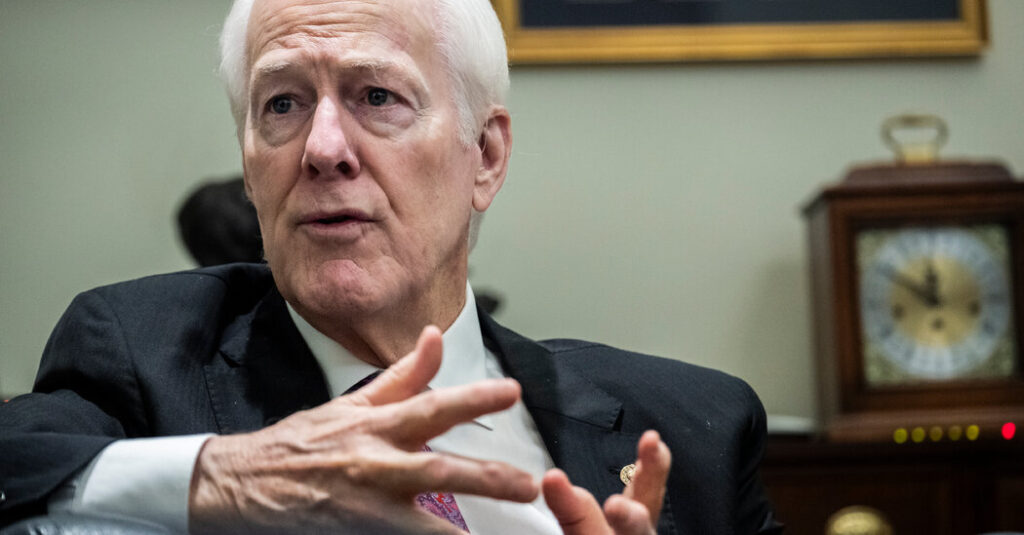
“I think it is going to be a pretty bumpy ride for the next seven months,” Mr. Cornyn said during a wide-ranging conversation in his Capitol office as he reflected on the tumultuous Texas election and his nearly quarter-century in Washington.
“It does give some of us a little more freedom, and certainly leverage,” he said, before invoking Mr. Trump’s notoriously heated Oval Office meeting with President Volodymyr Zelensky of Ukraine last year. “As the president told President Zelensky when he was in his office a year or so ago — he said, ‘You don’t have any cards.’ Well, we’ve got some cards to play.”
Mr. Cornyn said he is not a “wounded bear” seeking retribution or revenge. He is determined that Republicans hold the Senate because he said he feared they would lose the House in November.
But in the interview, he gave voice in starkly candid terms to a growing sentiment among Senate Republicans that Mr. Trump was hurting his own party with self-serving decisions and his insistence on “slavish” loyalty, ultimately setting himself up for a midterm “disaster” that would pave the way for “the most miserable two years of his life.”
And in the interim, Mr. Cornyn said, he reserves the right to choose “where I’m going to — or going to not — defer” to Mr. Trump.
One of those areas appears to be the special protection from I.R.S. scrutiny that the Justice Department granted Mr. Trump and his family and businesses as part of a settlement of a lawsuit over the leak of his tax data, an exemption Mr. Cornyn said needed to be overturned.
“I think that’s a terrible mistake,” Mr. Cornyn said. “The president needs to be treated like everybody else.”
Mr. Cornyn did not elaborate on how he would seek to reverse the deal. And unlike Senator Bill Cassidy of Louisiana, another Republican ousted in a primary by a Trump-backed challenger, he has yet to break with Mr. Trump on a major vote since his defeat. But he made it clear that he found the settlement unacceptable.
He attributed Mr. Trump’s election in part to a backlash against allegations of self-dealing in the prior administration. “To me, the message by the voter was, ‘We don’t like this,’” he said. “We can’t replace one form of self-dealing and corruption with another.”
Mr. Cornyn, who was first elected to the Senate in 2002, knew he was going to face a difficult re-election when Mr. Paxton, a MAGA darling and Trump loyalist with a string of political and personal scandals, entered the race against him. But the more institutionalist incumbent, who came up just short of being elected majority leader after the 2024 elections, was always seen as a safer — and less expensive — general election bet than the tarnished Mr. Paxton.
The prospect of Mr. Trump’s endorsement loomed large in the race, and the Cornyn camp and his allies in the Senate pushed to secure Mr. Trump’s backing — or at minimum prevent the president from endorsing Mr. Paxton. Mr. Cornyn even brought on campaign operatives with strong ties to Mr. Trump.
But the fact that Mr. Cornyn in 2023 had expressed some misgivings about Mr. Trump running for re-election — fairly mild comments compared with some other Republicans — provided a line of attack against him by Mr. Paxton and lingered with the president.
Then, after trailing in public polls, Mr. Cornyn finished a somewhat surprising first in the initial round of voting. For a moment, it seemed that Mr. Trump, in his desire to back winners, might endorse Mr. Cornyn. But he held off.
Mr. Paxton then made what was viewed by all sides as a shrewd move: He said he would consider dropping out of the race if Senate Republicans eliminated the filibuster and passed new voting restrictions that have been a top priority of the president to try to limit midterm losses. Senate Republicans were never going to do so, though Mr. Cornyn did drop his longstanding defense of the filibuster. But the gambit seemed to reinforce Mr. Trump’s frustration with Senate Republicans, and he stayed on the sidelines as the brutal race played out in Texas.
“I had really thought that we’d gone on so long with no endorsement that he was just going to stay out of it,” Mr. Cornyn said. “But he couldn’t resist.”
On May 19, as early voting in the runoff was underway, Mr. Trump gave his public blessing to Mr. Paxton, calling him a “true MAGA warrior.” In the Senate, where Republicans had balked at gutting the filibuster and were raising objections to funding the president’s White House ballroom project, the endorsement was seen as much as a slap at them as at Mr. Cornyn. It provided a late surge for the challenger, particularly when such a small segment of voters was going to turn out in a primary runoff the day after Memorial Day.
“These are the devoted MAGA supporters, and when they saw what President Trump said when he said it, I think it no doubt had an influence,” Mr. Cornyn said. “I do think the most important factor was just the small turnout, but certainly the president’s endorsement had an impact.”
Mr. Cornyn believes that impact will reach far beyond his race. He is the epitome of a reliable conservative with what he listed as his “99.3 percent” voting record in line with the president. Unlike Mr. Cassidy of Louisiana, he did not vote to remove Mr. Trump from office after the Jan. 6, 2021, assault on the Capitol by Trump supporters. Still, he said, the president threw him under the bus.
“If he would do that to me, he would do that to anybody,” Mr. Cornyn said. “There’s never going to be good enough for him, other than 100 percent, you know, slavish adherence to whatever he wants. But obviously that’s not what the senator’s role is supposed to be, especially in terms of checks and balances.”
Mr. Cornyn stood by his attacks on Mr. Paxton and said that while he supported the party ticket, he would not campaign or raise money for his primary opponent — a loss for Mr. Paxton since Mr. Cornyn was a prolific fund-raiser. But he fears Republicans are in for a rough midterm and Mr. Trump for a difficult final two years, in part because of self-inflicted wounds such the president’s endorsement of Mr. Paxton putting the Texas seat at risk.
“It’s going to make things harder, certainly more expensive in Texas, and make it harder around the country,” Mr. Cornyn said, predicting that Mr. Trump would come to regret his actions. “I don’t say that with any sort of desire for vengeance; I just think that’s the way it’s going to be. He’s going to have the most miserable two years of his life in the last two years of his term, I think, because I think November is going to be a disaster.”
As for himself, Mr. Cornyn is looking ahead to his remaining months in his office and life outside the Senate.
“I am going to continue to look for opportunities to make this next seven months as productive as possible,” he said, suggesting there could be positive aspects to his loss. “I’ve always said that former senators look happier, healthier, and they’re certainly more prosperous. So, I’m kind of, like, looking forward to what comes next.”
The post After Senate Loss, Cornyn Predicts ‘Miserable’ Final Two Years for Trump appeared first on New York Times.