Speaking to a conservative radio host on Monday, the top federal prosecutor in Los Angeles made an unusually pointed prediction that cast doubt on the results of California’s primary races, even as votes were still being counted.
“We will be charging some people,” the prosecutor, Bill Essayli, told the host, Glenn Beck, delivering a promise that would most likely have been considered a violation of Justice Department policy under decades of past practice. “It will be election fraud charges in the next — I hate to put timelines on things — one or two months I believe. We need some of these results to be certified so we can prove some of the allegations.”
The declaration, issued by an outspoken loyalist to President Trump, was a vivid example of the Justice Department’s approach to voting under the Trump administration. The agency is seeking to assert more control over elections and challenge how states conduct them, a shift that could have significant consequences in the midterm elections this year, when control of Congress hangs in the balance.
It is part of a broader effort by Mr. Trump to undermine confidence in the elections by repeatedly making baseless claims of voter fraud. The playbook dates to his first run for office in 2016, when he raised the specter of a rigged vote during his campaign and revisited the unfounded assertion even after he was declared the victor because Hillary Clinton had won the popular vote. In 2020, he revived the strategy, going so far as to try to overturn the results in swing states that had been won by Joseph R. Biden Jr.
In the last year alone, the Justice Department has sought voter roll data from most states; sued those that have declined to comply; opened a criminal investigation into 2020 election results in Fulton County, Ga., a state Mr. Trump narrowly lost that year; and demanded ballots from the 2024 race from Wayne County, Mich.
The administration is “throwing everything against the wall that they can find, and nothing is sticking,” said David Becker, a former voting rights lawyer at the Justice Department who is now the executive director of the Center for Election Innovation and Research.
“Almost all of their work is going back over conspiracy theorists’ allegations that were debunked five years ago,” he added. “They are running out of tools in their toolbox.”
California appears to be an early testing ground, as Mr. Trump and his allies stoke doubt about election outcomes they do not like, despite a lack of evidence of widespread fraud.
According to Justice Department regulations, officials “should not engage in overt criminal investigative measures in matters involving alleged ballot fraud until the election in question has been concluded, its results certified, and all recounts and election contests concluded.”
The same section declares that the Justice Department “should generally avoid interfering or appearing to interfere with election administration, tabulation, validation or certification.”
Asked about Mr. Essayli’s remarks, a department spokeswoman, Natalie Baldassarre, said that election integrity was a top administration priority, and insisted that the department had legal authority to enforce election law, including by requesting state voter rolls.
The investigations in California, she added, were “in line with this authority, and will continue despite the state’s unwillingness to comply and reassure voters that their elections are in fact free, fair and transparent.” A spokesman for Mr. Essayli declined to comment.
The administration has already effectively dismantled its public integrity section in Washington, which had for years included round-the-clock legal advisers in the week leading up to a general election.
Its lawyers consulted with federal prosecutors and agents across the country about instances of possible election-related crimes, like ballot tampering or threats against candidates. Those lawyers tended to act as important checks on overly aggressive investigations that could be seen by the public as trying to affect the outcome of races.
Most often, the public integrity lawyers would advise investigators to proceed cautiously and quietly, rather than give more attention or importance to rumors or false accusations.
But under Mr. Trump, that institutional check has disappeared, with local U.S. attorneys encouraged to more aggressively investigate, prosecute and discuss their work on election fraud.
Mr. Essayli has not only loudly announced his investigations, but he has also dispatched a prosecutor to the offices where ballots were being counted. And he has appealed for anyone with evidence of voter fraud to come forward, saying that “what we need right now are witnesses.”
Since taking over as the top prosecutor in Los Angeles, Mr. Essayli, a former state assemblyman, has proved willing to carry out Mr. Trump’s agenda. He has dropped cases against the president’s allies; aggressively pursued charges against protesters rallying against the administration’s immigration crackdown only to face a string of losses; and investigated California over its policies toward transgender athletes.
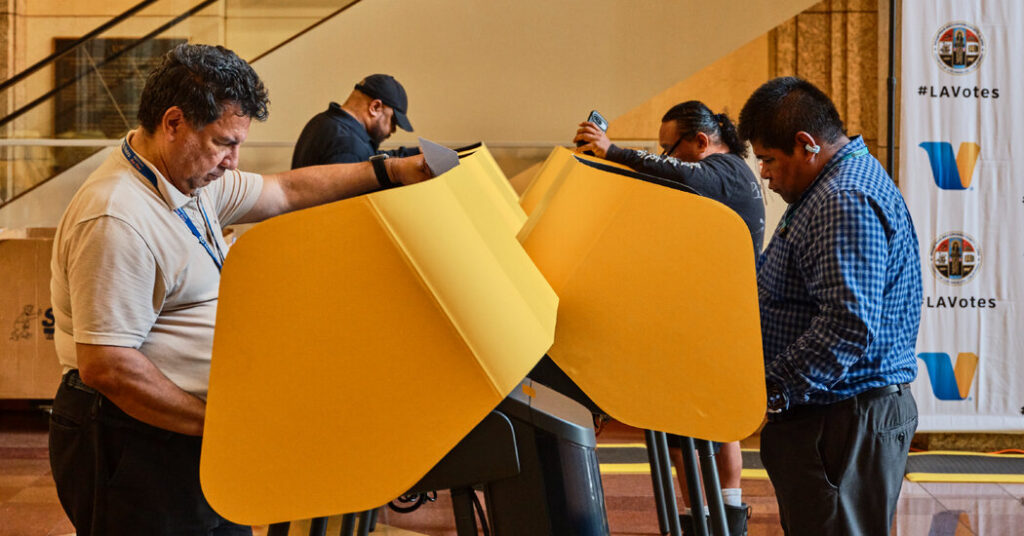
Mr. Essayli has criticized voting laws in the state as particularly vulnerable to fraud and manipulation, joining a chorus of Republicans who have assailed the process. California is particularly slow when counting ballots because of how many residents vote by mail. After holding an election on June 2, officials in the state were still counting votes this week, prompting G.O.P. lawmakers to claim that the delay meant deceit.
“Some of these efforts are so diabolical and so far upstream it is impossible to prove,” Speaker Mike Johnson said. “But I think everybody knows instinctively something is wrong here.”
Shirley Weber, California’s top elections official and its secretary of state, has countered that the priority is accuracy.
“Accuracy comes before speed,” she said in a statement last week. “California is the nation’s largest voting state, with millions of ballots to process and count. Taking the time to do this work correctly protects voters’ rights and ensures the integrity of our elections.”
States, not the federal government, do the bulk of the work involving elections, and election law experts said that the administration’s efforts to portray California’s voting as crooked were wrong and unfair, because the amount of voter fraud discovered by the authorities is exceedingly rare.
On social media, Mr. Essayli has tied his criminal investigations to a wide-ranging effort by the Trump administration to sue more than 25 states over their voter rolls, which includes the personal data of millions of Americans.
California, he said, “has stonewalled every effort to verify that only eligible U.S. citizens are registered to vote.” He warned that his office would “not look the other way.”
“We will investigate and prosecute,” he added. “Every legal vote deserves to be counted. Every illegal vote cancels one out.”
In recent weeks, Justice Department leaders have ramped up their rhetoric about elections, particularly regarding Mr. Trump’s loss in 2020.
The acting attorney general, Todd Blanche, said in an interview last month on Fox News that there was “a ton of evidence that the election was rigged.” Such evidence had existed for many years, he added, but the people responsible were “very good at hiding up misconduct.”
Even though the White House has no formal or legal role in administering elections, Mr. Trump installed Kurt Olsen, who tried to help overturn his election loss in 2020, to oversee election integrity and security. Mr. Olsen has since moved to the Justice Department, working in a U.S. attorney office’s in Florida that is investigating what Trump supporters call a “grand conspiracy” against him.
Despite the Trump administration’s demands for voter roll data, at least eight federal district judges have turned the administration away. Half of those judges were appointed by Mr. Trump. The administration is appealing the decisions.
“I don’t know that the Department of Justice has ever had a zero-for-eight streak,” Mr. Becker said, adding that Mr. Essayli’s comments were likely to make it even harder for a judge to rule in the administration’s favor.
Under Mr. Trump, the Justice Department has struggled to retain personnel, rapidly losing thousands of career lawyers and installing ardent, less experienced loyalists in their place.
While the president’s unfounded claims of fraud were eroding trust in the election system, Mr. Becker added, the Trump administration’s election investigations were having a similarly corrosive effect inside the department.
“They are running out of people,” he said. “When the only people you can hire are bad lawyers, you get bad cases litigated badly.”
The post Trump Administration Pushes Limits of Election Investigations appeared first on New York Times.